Father of the Bride Speech (Kenyan Wedding Edition)
4 complete father of the bride speech templates for Kenyan weddings. Includes traditional, emotional, humorous, and brief options with cultural tips and delivery advice for nervous speakers.
Father of the Bride Speech (Kenyan Wedding Edition)
You walked her to school on her first day. You sat with her during homework you did not understand. You watched her grow from the girl who hid behind your leg to the woman standing beside the man she chose. And now, somehow, you are expected to stand in front of 300 people and say something that captures all of that in five minutes.
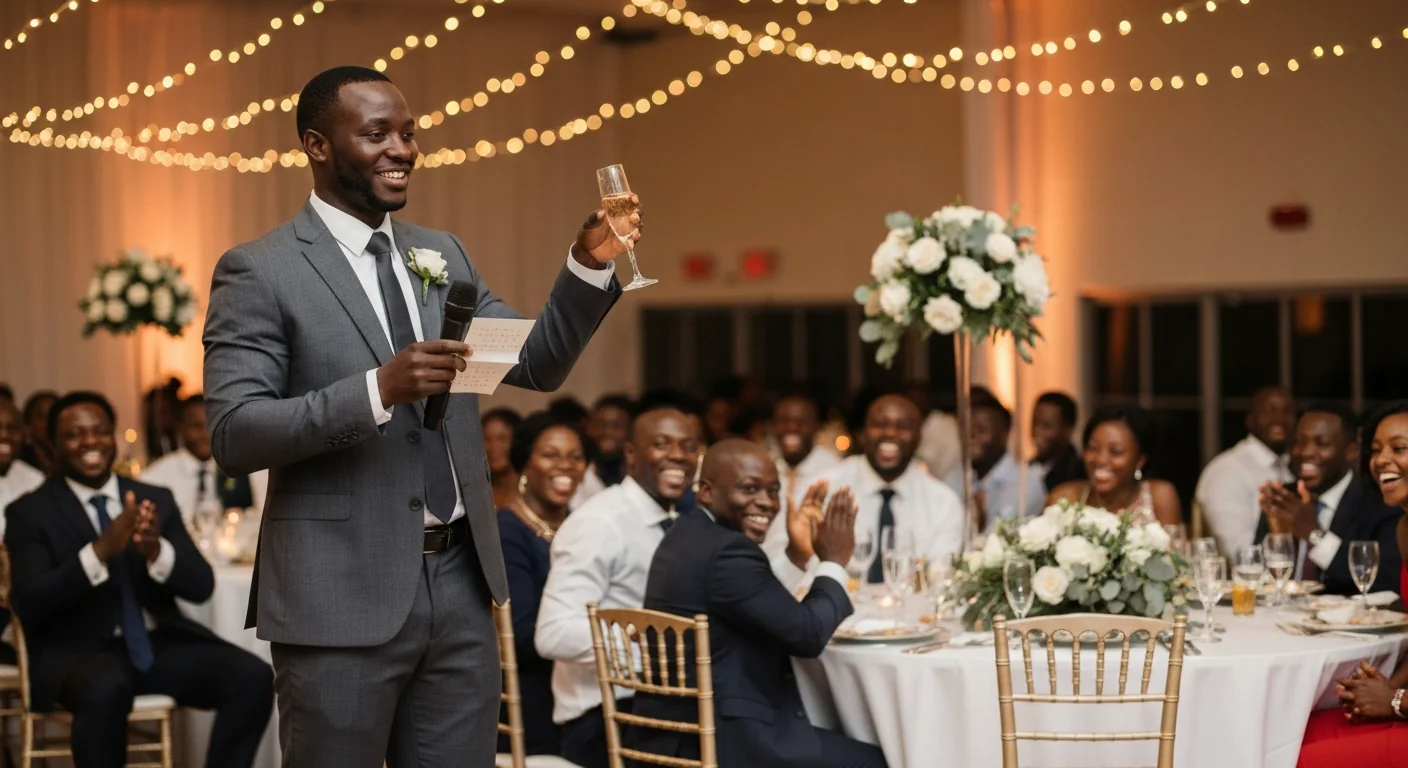
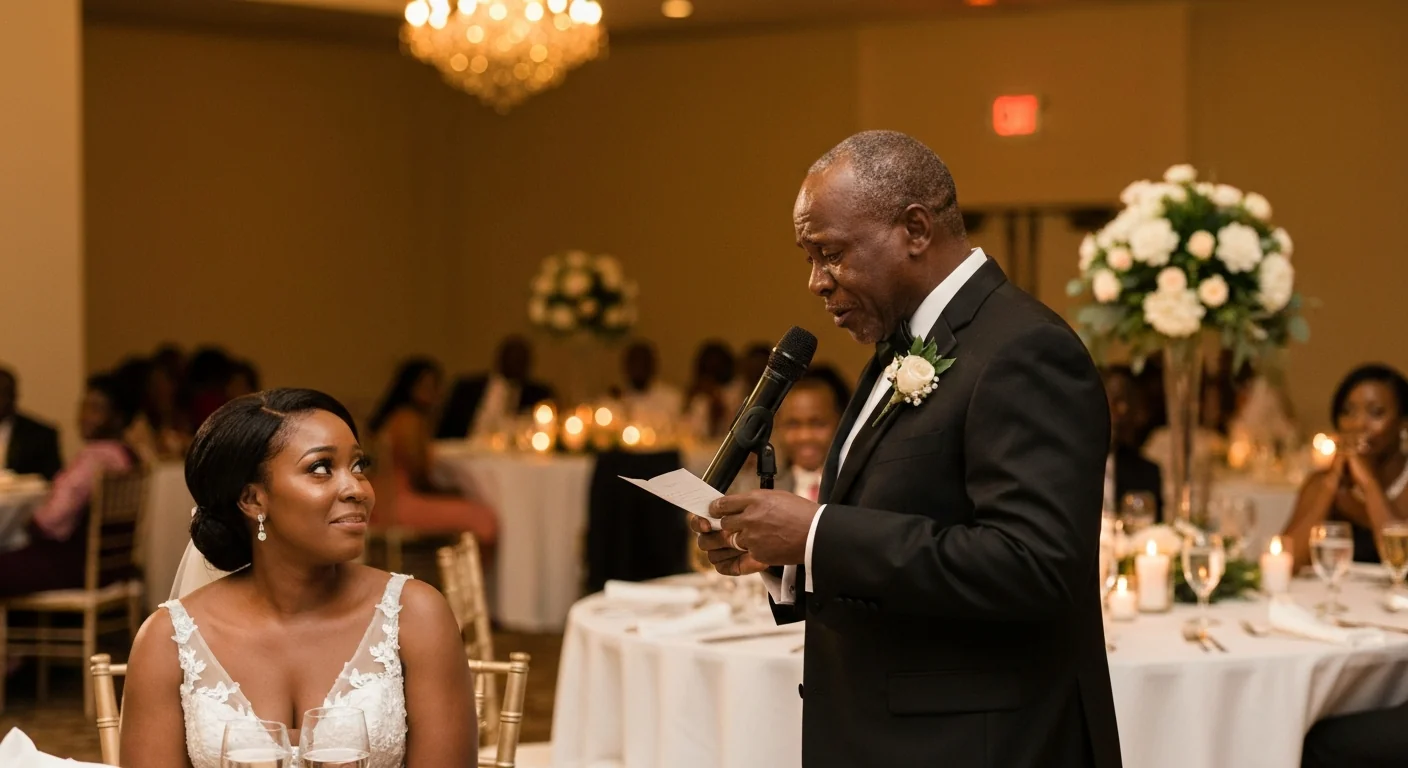
The father of the bride speech is one of the most powerful moments at a Kenyan wedding reception. It is not a performance — it is a father speaking to his daughter, welcoming a son into his family, and telling a room full of people what this moment means to him.
That is a lot. And for many Kenyan fathers — men who were raised in a generation where emotions were kept private and actions spoke louder than words — standing behind a microphone is unfamiliar territory.
This guide is for you. It gives you four complete speech templates you can use as-is or adapt to your own words, a simple structure to follow, practical tips for managing nerves, and guidance on cultural elements that Kenyan audiences appreciate.
The Structure for a Father of the Bride Speech
1. Welcome the Guests (30 seconds)
As the bride’s father, you are one of the hosts. Welcome everyone — especially the groom’s family — and thank them for coming.
2. Speak About Your Daughter (1-2 minutes)
Share a memory or describe who she is. The best material comes from specific moments: a childhood story, a lesson she taught you, a quality she has that makes you proud. Do not list accomplishments — tell a story.
3. Acknowledge the Groom (30-60 seconds)
Welcome him into your family. What have you observed about him? What gives you confidence that your daughter is in good hands? Be genuine — forced praise sounds hollow.
4. Offer Wisdom or a Blessing (30-60 seconds)
Share advice, a prayer, or a blessing over the couple. In Kenyan culture, a father’s blessing carries significant weight. This is the moment where your words have the most impact.
5. The Toast (15-30 seconds)
Close with a clear toast. Raise your glass. Let the applause carry you back to your seat.
Total time: 3-5 minutes. A father’s speech does not need to be long. Some of the most memorable ones are under four minutes.
Speech 1: The Traditional Father
Best for: Fathers who value tradition, family honour, and the cultural significance of the day. Measured, dignified, and warm.
“Good afternoon, ladies and gentlemen. On behalf of my wife [Mother’s Name] and myself, and the entire [Family Name] family, I welcome each of you to this celebration. Some of you have travelled from very far — Kisumu, Mombasa, even abroad — and your presence here honours us deeply. Karibuni sana.
I also want to extend a special welcome to the [Groom’s Family Name] family. Today our two families become one, and that is not something we take lightly. We have watched, we have observed, and we are satisfied. [Groom’s Name], you are welcome in our home. You are welcome in our family. And you are welcome as our son.
[Bride’s Name], from the day you were born, your mother and I prayed for you. We prayed for your health, for your education, for your future. And in those prayers, we always included one line: ‘Lord, when the time comes, bring her someone worthy.’ Looking at [Groom’s Name] today, I believe that prayer has been answered.
You were always a determined girl. When you were about six years old, you decided you were going to learn to ride a bicycle. You fell so many times that your knees were scraped raw. Your mother wanted to stop you. But you got back up every time. And when you finally rode that bicycle down the road without falling, you turned around and shouted, ‘Baba, are you watching?’ I was watching. I am always watching.
Today, I am still watching. And what I see is a woman who has grown into someone far beyond anything I could have imagined. You are kind, you are strong, and you are ready.
[Groom’s Name], I am entrusting you with someone very precious. Take care of her. Respect her. Build a home that your children will be proud to come from. And know that you are not doing this alone — you have two families behind you.
To [Bride’s Name] and [Groom’s Name] — may God bless your marriage, your home, and your future. Mungu awabariki. Please raise your glasses.”
Speech 2: The Emotional Father
Best for: Fathers who are comfortable showing emotion and want to speak from the heart. Moving, personal, and deeply sincere.
“Good afternoon, everyone. Thank you for being here today. I want to be honest with you — I have been dreading this speech. Not because I do not have things to say, but because I was not sure I could say them without falling apart. So bear with me.
[Bride’s Name], I remember the day you were born like it was yesterday. The nurse placed you in my arms, and you were so small, so fragile, and so perfect that I was terrified. I thought, ‘How am I supposed to protect something this precious?’ And for the last [number] years, that question has guided everything I have done.
I have not been a perfect father. I have missed things I should have been there for. I have been too strict when I should have listened. I have given advice when you just needed someone to sit with you quietly. But through it all, I hope you have always known one thing: everything I have ever done has been because I love you more than I know how to say.
You grew up so fast. One day you were sitting on my lap asking me to read you a story, and the next you were telling me about this young man who made you laugh and who, you said, ‘just gets me, Dad.’ I was not ready for that. No father is. But I listened. And over time, I understood.
[Groom’s Name], the first time I met you, I was watching you more carefully than you knew. I was watching how you treated my daughter. I was watching whether you listened to her or just waited for your turn to speak. I was watching whether you were patient, whether you were kind, whether you were real. And I have to say — you passed. Not because you are perfect, but because you are genuine. And that matters more.
I want to say something to both of you. Marriage is not a ceremony — it is a decision you make every single day. Some days it will be easy. Many days it will not. But if you keep choosing each other — especially on the hard days — you will build something beautiful.
[Bride’s Name], you will always be my little girl. That does not change because you are married. It just means I am sharing you with someone I believe is worthy.
Please raise your glasses. To my daughter and her husband — may your love be the kind that endures, the kind that deepens, and the kind that, decades from now, still makes you look at each other and think, ‘I chose well.’ To [Bride’s Name] and [Groom’s Name].”
Speech 3: The Humorous Father
Best for: Fathers with a natural sense of humour who want to keep the mood light while still delivering a meaningful message. Entertaining, self-deprecating, and warm.
“Good afternoon, everyone. For those of you who do not know me, I am [Name], [Bride’s Name]‘s father — also known as the man who has been paying for everything.
I was told to keep this speech short. My wife said, ‘Do not embarrass her.’ My son said, ‘Do not try to be funny.’ [Bride’s Name] said, ‘Dad, just be normal.’ So the expectations are very low, and I intend to meet them.
Let me start by welcoming the [Groom’s Family Name] family. You are gaining a wonderful daughter-in-law. You are also gaining a young woman who will rearrange your living room furniture without asking, tell you exactly what she thinks whether you want to hear it or not, and somehow make you love her more for it. Welcome to our world.
[Groom’s Name], I want to share some advice with you as someone who has been married for [number] years. First: she is always right. I know that sounds like a joke. It is not. Save yourself years of trouble and accept this early. Second: when she says ‘I am fine,’ she is not fine. Investigate immediately. Third: learn to cook at least one meal well. It does not need to be fancy — ugali and sukuma wiki is enough — but the gesture matters.
On a serious note, [Groom’s Name], I want to thank you. Before you came into [Bride’s Name]‘s life, she was happy. She was thriving. She did not need anyone to complete her. But what you have done is add to her happiness in a way that I can see every time she talks about you. She does not just love you — she respects you. And in my experience, respect is the foundation that outlasts everything else.
[Bride’s Name], I have watched you grow from a little girl who used to hide my car keys so I would not leave for work, to a woman who is strong enough to build her own life and wise enough to share it with the right person. I am proud of you. More than you know.
So please, everyone, raise your glasses. To [Bride’s Name] and [Groom’s Name] — may your life together be full of laughter, patience, and the good sense to never argue about directions when you are both lost. To the couple!”
Speech 4: The Brief and Dignified Speech
Best for: Fathers who prefer few words, who are uncomfortable with public speaking, or when the programme is running long. Concise, powerful, and genuine.
“Good afternoon, everyone. I will be brief, because [Bride’s Name] has heard enough of my lectures to last a lifetime.
On behalf of my family, I welcome you all. Thank you for being here to celebrate with us. And to the [Groom’s Family Name] family — karibu sana. We are honoured to join our families today.
[Bride’s Name], you have always made me proud. Today is no different. I look at the woman you have become, and I see the best of your mother and, I hope, a little of me.
[Groom’s Name], I trust my daughter’s judgment. She chose you. That is enough for me. Take care of each other.
To the couple — may God bless your marriage, your home, and every year ahead. Raise your glasses, everyone. To [Bride’s Name] and [Groom’s Name].”
Tips for Fathers Who Are Nervous About Speaking
Public speaking anxiety is extremely common, and it is especially acute for Kenyan fathers of a generation that was not raised to speak publicly about emotions. Here is how to manage it.
Write It Down
Do not rely on memory. Write your speech in full, even if you plan to speak more freely on the day. Having the words on paper gives you a safety net. Print it in a large font on a single sheet that you can hold comfortably.
Practice Three Times — Minimum
Rehearse your speech out loud at least three times. Not in your head — out loud. The first time will feel awkward. By the third time, you will know which lines feel natural and which need adjusting.
It Is Okay to Read
If speaking freely from notes feels too difficult, it is perfectly fine to read your speech. Nobody will judge you for having a written speech at your daughter’s wedding. What matters is sincerity, not style.
Pause When You Feel Emotional
If your voice starts to break, stop. Take a breath. Take a sip of water. Look at your daughter and take a moment. The audience will wait. They understand. A father pausing because he is moved is one of the most powerful things anyone can witness at a wedding.
Stand With Your Wife If It Helps
Some fathers feel more comfortable standing with their spouse beside them. If having your wife next to you makes you feel steadier, do it. There is no rule that says you must stand alone.
Keep Your Hands Occupied
Hold your speech in one hand and your glass in the other. This prevents fidgeting and gives you something to do with your hands.
Accept That It Will Not Be Perfect
You are not a professional speaker. Nobody expects you to be. Your daughter chose you as her father, not as her MC. She wants to hear your voice, your words, your blessing. That is enough.
Cultural Considerations for Kenyan Father of the Bride Speeches
The Father’s Blessing
In many Kenyan communities, a father’s words over his daughter carry the weight of a blessing. This is not merely a speech — it is a spiritual and cultural act. If your family tradition includes a specific form of blessing, include it in your speech or deliver it as a separate moment after the speech.
Acknowledging Both Families
Kenyan weddings are family events, not just couple events. Acknowledge the groom’s parents by name. If elders from both families are present, a general acknowledgment — “I greet and respect the elders gathered here today” — shows cultural awareness.
Community Language
If a significant portion of the audience speaks a community language, consider including a few lines in that language. A Kikuyu father might say, “Ngai amurathime” (God bless you). A Luo father might add, “Nyasaye ogwedhi” (God bless you). A Kamba father might say, “Ngai akuathime.” Even one or two lines in your mother tongue adds authenticity and moves the elders in the room.
The Dowry Reference
If a traditional ceremony (ruracio, ayie, koito) preceded the wedding, it is appropriate to acknowledge it briefly: “We are grateful that the proper customs were observed before we arrived at this day.” This shows respect for the process and reassures the community that cultural protocols were followed.
Thanking the Committee
In Kenyan wedding culture, the committee (kamati) plays a major role in fundraising and planning. A brief acknowledgment — “I want to thank the wedding committee for their tireless work in making today possible” — is appreciated and expected.
What to Avoid
Do Not Make It About Yourself
This is not the time for a detailed autobiography. Brief references to your role as a father are appropriate, but the focus should be on your daughter, the couple, and the families.
Do Not Criticize or Lecture the Groom
Light humour is fine. A genuine warning — “If you hurt her, you will answer to me” — can work if delivered warmly. But do not use the speech to issue serious warnings or express reservations. If you have concerns, address them privately, not at the microphone.
Do Not Mention Money
Do not reference how much the wedding cost, how much the dowry was, or how much you contributed. Financial details are private. Comments about money — even joking ones — can make guests uncomfortable and diminish the dignity of the moment.
Do Not Drink Too Much Before Speaking
Liquid courage has a tipping point. One drink to settle nerves is reasonable. More than that risks slurred speech, lost composure, and a performance your daughter will not want to remember.
Do Not Go Over Five Minutes
A father’s speech should be 3-5 minutes. If you are approaching the five-minute mark, wrap it up. The most powerful speeches are often the shortest.
When the Father Is Not Present
If the bride’s father has passed away, is absent, or if another family member is filling the role, the speech structure remains the same. A stepfather, uncle, grandfather, or older brother can deliver the speech with the same warmth and authority. Acknowledge the relationship honestly: “I am [Name], [Bride’s Name]‘s uncle, and I have had the privilege of being part of her life since she was born.”
If the bride wants to honour an absent father, a moment of silence or a brief tribute can be included in the programme — but this is the couple’s decision, not the speaker’s.
Your Wedding, Beautifully Organized
Plan your speeches, timeline, guest list, and every detail of your Kenyan wedding — all in one place, completely free.
Start Planning on Harusi Hub