Wedding Program Template for Kenya (Order of Events)
A complete wedding program template with order of events for Kenyan weddings. Includes church ceremony, garden wedding, and reception timelines with practical timing guides.
Wedding Program Template for Kenya (Order of Events)
Your guests arrive at the reception and the first thing they ask is: “What is happening next?” Your bridal party is wondering when to line up. The caterer wants to know when to plate the food. The DJ needs the programme order. And nobody has a written plan.
A wedding programme is the single most important document on your wedding day. It is not a decoration — it is the operating manual that keeps your MC on track, your vendors in sync, and your guests informed. Without it, your beautiful day becomes a series of improvised decisions made under pressure.
This guide gives you complete, copy-ready wedding programme templates for the most common Kenyan wedding formats: a church ceremony followed by a reception, a garden wedding with an integrated ceremony and reception, and a Muslim Nikah celebration. Each template includes realistic timing, the order of events, and notes on what happens behind the scenes at each stage.
What Goes Into a Kenyan Wedding Programme
Every Kenyan wedding programme, regardless of format, typically includes these core elements:
- Arrival and seating of guests
- Opening prayer or invocation
- The ceremony (church service, garden vows, or Nikah)
- Signing of the register or marriage certificate
- Bridal party entrance or couple’s grand entrance
- Welcome remarks
- Speeches (best man, maid of honor, parents, couple)
- Meal service
- Cake cutting
- First dance
- Entertainment and games
- Vote of thanks
- Closing prayer
- Send-off
The order can shift depending on your preferences, but the flow above represents the standard structure that most Kenyan couples, MCs, and vendors expect.
Template 1: Church Ceremony + Reception Programme
This is the most common format in Kenya — a church wedding service followed by a separate reception at a different venue.
Part A: Church Ceremony (1.5-2 hours)
| Time | Event | Notes |
|---|---|---|
| 10:00 AM | Guest arrival and seating | Ushers guide guests. Groom and groomsmen arrive and take their positions. |
| 10:15 AM | Prelude music | Choir or instrumentalist plays as guests settle in. |
| 10:30 AM | Processional | Bridal party enters: groomsmen, bridesmaids, flower girl, ring bearer. |
| 10:35 AM | Bride’s entrance | Bride enters, escorted by her father or chosen family member. Guests stand. |
| 10:40 AM | Opening prayer and welcome | Officiant welcomes the congregation. |
| 10:50 AM | Hymn or worship song | Congregation sings together. |
| 10:55 AM | Scripture readings | One or two readings, often by family members or close friends. |
| 11:05 AM | Sermon or homily | Officiant delivers a message to the couple and congregation. 15-20 minutes. |
| 11:25 AM | Exchange of vows | The couple recites their vows — either traditional or personal. |
| 11:35 AM | Exchange of rings | Ring bearer presents the rings. |
| 11:40 AM | Declaration of marriage | Officiant declares the couple married. “You may kiss the bride.” |
| 11:45 AM | Signing of the register | Couple and witnesses sign the marriage register. Choir may sing during this. |
| 11:55 AM | Presentation of the couple | Officiant presents Mr. and Mrs. [Surname] to the congregation. |
| 12:00 PM | Recessional | Couple exits the church, followed by the bridal party. |
| 12:05 PM | Congratulations and photos | Guests congratulate the couple outside the church. Photographer captures moments. |
Part B: Reception Programme (3-4 hours)
| Time | Event | Notes |
|---|---|---|
| 2:00 PM | Guest arrival at reception venue | Guests find their tables. Cocktail hour or soft drinks served. |
| 2:30 PM | MC opens the programme | MC welcomes guests, sets the tone, introduces themselves. |
| 2:35 PM | Opening prayer | Pastor, elder, or family member leads prayer. |
| 2:40 PM | Bridal party entrance | MC announces each pair. Music plays. Energy is high. |
| 2:50 PM | Couple’s grand entrance | The highlight. Couple enters to their chosen song. |
| 3:00 PM | Welcome remarks | A brief welcome from a family representative or the couple. |
| 3:10 PM | First course / starters | Served while programme continues. |
| 3:15 PM | Best man’s speech | 5-7 minutes. |
| 3:25 PM | Maid of honor’s speech | 5-7 minutes. |
| 3:35 PM | Father of the bride’s speech | 5-7 minutes. |
| 3:45 PM | Mother of the groom’s speech (optional) | 3-5 minutes. |
| 3:50 PM | Couple’s speech (optional) | 3-5 minutes. The couple thanks guests and families. |
| 4:00 PM | Main course / buffet | Tables called one by one. Allow 20-30 minutes for everyone to serve. |
| 4:30 PM | Cake cutting | Couple cuts the cake. Photos. Cake distributed to tables. |
| 4:40 PM | First dance | Couple dances. Bridal party joins, then all guests. |
| 4:50 PM | Entertainment and games | Shoe game, bouquet toss, performances, dance-off. |
| 5:20 PM | Special tributes (optional) | Video montage, musical performance, surprise element. |
| 5:30 PM | Vote of thanks | Committee member or family representative thanks vendors and guests. |
| 5:40 PM | Closing prayer | Officiant or elder blesses the couple. |
| 5:45 PM | Couple’s send-off | Guests line up. Couple exits through the crowd. |
| 6:00 PM | After-party / DJ set (optional) | Informal dancing continues for remaining guests. |
Template 2: Garden Wedding Programme (Ceremony + Reception Combined)
Garden weddings are increasingly popular in Kenya, especially at venues in Naivasha, Nanyuki, Karen, and Kiambu. The ceremony and reception happen at the same venue, which simplifies logistics considerably.
| Time | Event | Notes |
|---|---|---|
| 2:00 PM | Guest arrival | Guests arrive, find their seats in the ceremony area. Welcome drinks served. |
| 2:30 PM | Prelude music | Acoustic guitarist, violinist, or playlist sets the mood. |
| 2:40 PM | MC welcome (brief) | MC asks guests to take their seats. Introduces the ceremony. |
| 2:45 PM | Processional | Bridal party walks down the aisle. Flower girl and ring bearer. |
| 2:50 PM | Bride’s entrance | Bride walks down the aisle. All guests stand. |
| 2:55 PM | Opening prayer | Short prayer or blessing. |
| 3:00 PM | Welcome and readings | Officiant welcomes everyone. One or two readings by loved ones. |
| 3:10 PM | Officiant’s message | Brief sermon or reflection on marriage. 10-15 minutes. |
| 3:25 PM | Exchange of vows | Personal or traditional vows. |
| 3:30 PM | Exchange of rings | Ring ceremony. |
| 3:35 PM | Declaration and first kiss | ”I now pronounce you husband and wife.” |
| 3:40 PM | Signing of the register | Couple and witnesses sign. Background music plays. |
| 3:45 PM | Presentation of the couple | Officiant presents the newlyweds. Guests applaud. |
| 3:50 PM | Cocktail hour begins | Guests move to the reception area. Drinks and canapes served. Couple takes photos. |
| 4:20 PM | MC reopens the programme | Guests seated at reception tables. MC transitions to reception mode. |
| 4:25 PM | Couple’s entrance to reception area | If ceremony and reception are in different sections of the venue. |
| 4:30 PM | Speeches | Best man, maid of honor, parents. 25-35 minutes total. |
| 5:05 PM | Meal service | Buffet or plated dinner. |
| 5:35 PM | Cake cutting | During or immediately after the meal. |
| 5:45 PM | First dance | Couple’s first dance. Opens the floor for all guests. |
| 5:55 PM | Games and entertainment | Bouquet toss, shoe game, performances. |
| 6:20 PM | Vote of thanks | Brief thanks from committee or family representative. |
| 6:25 PM | Closing prayer | Blessing over the couple. |
| 6:30 PM | Send-off or transition to evening party | Couple exits or the event transitions to a more relaxed evening gathering. |
Garden wedding note: Outdoor events are weather-dependent. Always have a rain backup plan — a tent, a covered pavilion, or an indoor alternative. Brief your MC and vendors on the backup plan so transitions are smooth if weather shifts.
Template 3: Muslim Nikah and Walima Programme
For Muslim couples in Kenya, the Nikah (marriage contract) and Walima (wedding feast) may happen on the same day or on separate days. This template covers a combined programme.
| Time | Event | Notes |
|---|---|---|
| 11:00 AM | Guest arrival at the mosque or event hall | Men and women may be seated separately, depending on tradition. |
| 11:30 AM | Nikah ceremony begins | Imam leads the ceremony. Mahr (dowry) is presented. |
| 11:35 AM | Khutbah (sermon) | Imam delivers a short sermon on marriage in Islam. |
| 11:45 AM | Ijab and Qubul (offer and acceptance) | The bride’s wali (guardian) and the groom exchange the marriage contract. |
| 11:50 AM | Signing of the marriage contract | Witnesses sign. |
| 11:55 AM | Dua (supplication) | Imam leads prayers for the couple. |
| 12:00 PM | Congratulations | Guests congratulate the couple. “Barakallahu lakuma.” |
| 12:30 PM | Walima reception begins | Guests move to the reception area or banquet hall. |
| 1:00 PM | MC opens the Walima programme | Welcome, introduction of the couple. |
| 1:10 PM | Speeches | Family representatives, friends. |
| 1:30 PM | Meal service | Lunch is served — biryani, pilau, and traditional dishes are common. |
| 2:00 PM | Entertainment | Taarab music, poetry, or cultural performances. |
| 2:30 PM | Vote of thanks and closing dua | Final prayers and thanks. |
| 3:00 PM | Guests depart | Event concludes. |
How to Customize Your Programme
Adjust for Guest Count
A 50-guest wedding moves faster than a 500-guest wedding. For intimate weddings, you can compress the programme by 30-45 minutes. For large weddings, add buffer time between each segment — especially for meal service and seating.
Account for Travel Between Venues
If your church and reception venue are in different locations, the gap between the ceremony and reception is your biggest risk for delays. In Nairobi, allow at least 60-90 minutes for travel, depending on the route and time of day. On a Saturday afternoon, Nairobi traffic can turn a 20-minute drive into an hour.
Include Cultural Elements
Many Kenyan weddings incorporate cultural moments into the reception: a traditional song, a cultural dance, the introduction of elders from both families, or a symbolic ritual. Build these into the programme with specific time slots rather than hoping they happen organically.
Common cultural additions:
- Kikuyu: The mother of the bride may present a gourd of traditional porridge (ucuru) to the groom’s mother
- Luo: A traditional Ohangla or Nyatiti performance
- Luhya: Isukuti dance performance by community members
- Kamba: Kilumi dance or traditional songs
- Coastal/Swahili: Chakacha or Taarab performance
Plan for Speeches That Run Long
Budget 5-7 minutes per speaker, but expect at least one speech to go longer. Build 10-15 minutes of buffer into the speech segment. If you have more than 5 speakers, consider splitting speeches — some before the meal, some after — to keep the energy balanced.
Printed Programme Design Tips
If you are printing physical programmes for your guests, keep these guidelines in mind:
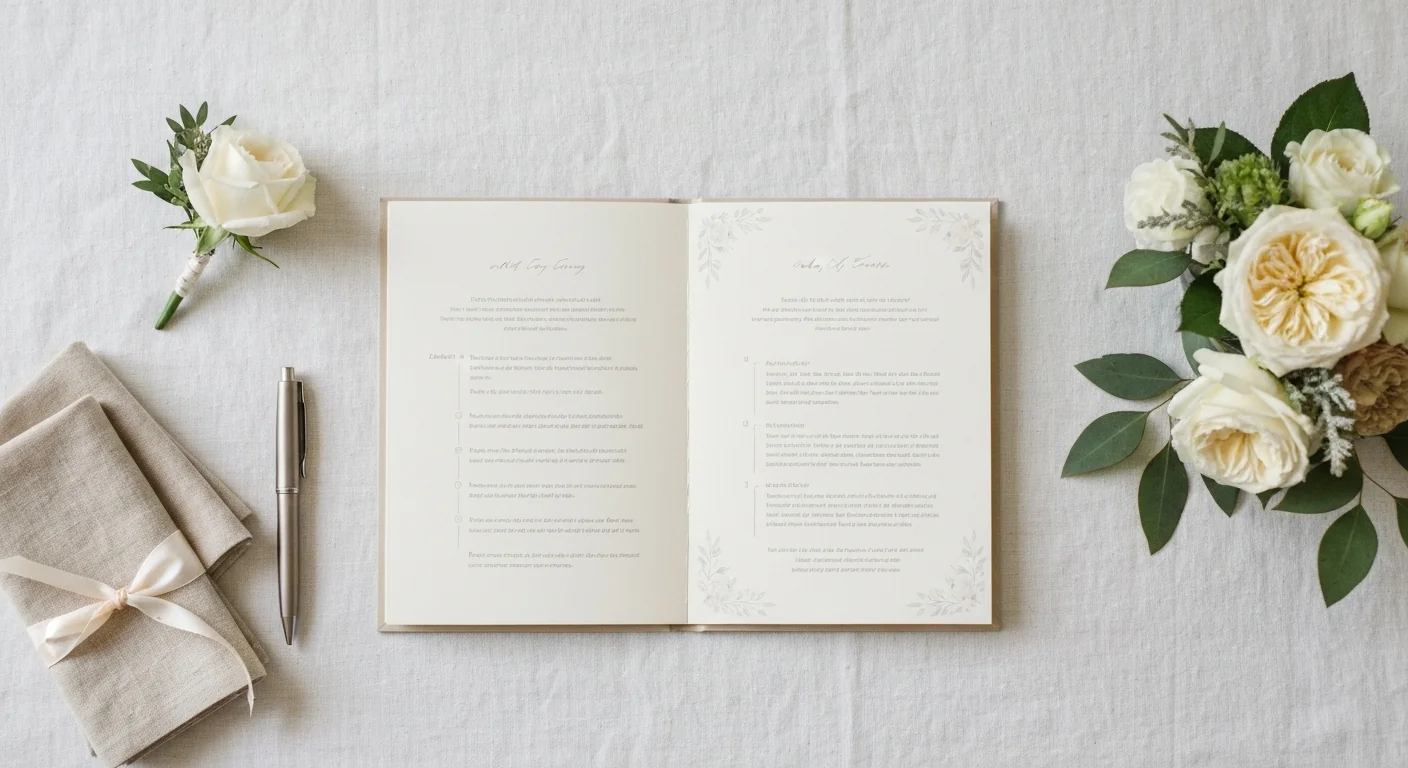
- Keep it simple. List the order of events with times, the names of participants (officiant, MC, speakers), and the couple’s names. That is enough.
- Use readable fonts. Decorative script fonts look beautiful but are hard to read at arm’s length. Use a clean serif or sans-serif for body text.
- Include both languages. For bilingual weddings, print event names in both English and Swahili.
- Add a personal touch. A short love story blurb, a favourite scripture or quote, or a note thanking guests makes the programme feel personal.
- Do not overdesign. A clean, elegant programme printed on quality card stock is better than a busy, full-colour design on cheap paper.
- Print extras. Order 10-15% more than your guest count. Guests take them as keepsakes.
Common Programme Mistakes to Avoid
Starting Late Without a Plan
Kenyan weddings rarely start on time. That is not the problem. The problem is when the MC and vendors do not know how to compress the programme when it starts late. If your ceremony begins 30 minutes late, which segments get shortened? Decide this in advance.
Too Many Speakers
Five speakers is the comfortable maximum for a reception. Beyond that, you risk losing your guests’ attention and pushing your meal service into the evening. If many people want to speak, consider having some record video messages that can be played during the cocktail hour instead.
No Buffer Time
A programme with zero gaps between events is a fantasy. Every transition — moving from church to car, from cocktail hour to seating, from speeches to meal service — takes longer than planned. Build 5-10 minutes of buffer between major segments.
Forgetting Vendor Coordination
Your programme is not just for guests. Your MC, DJ, photographer, caterer, and decorator all need copies with specific cues marked. The caterer needs to know when to begin plating. The photographer needs to know when the cake cutting happens. The DJ needs the entrance song cue. Share the programme with every vendor at least one week before the wedding.
Ignoring Sunset for Outdoor Weddings
If you are having a garden wedding and want golden-hour photos, work backward from sunset. In Kenya, sunset is roughly between 6:15 PM and 6:45 PM depending on the time of year. If you want a golden-hour photo session, schedule it for 5:00-5:45 PM and build your programme around that window.
Sharing Your Programme With Vendors
Do not just print the programme and hand it to people on the day. Share it at least one week in advance with:
- Your MC — They need to rehearse names, transitions, and timing.
- Your DJ — They need the song list matched to programme moments (entrance song, first dance song, cake cutting song).
- Your photographer/videographer — They need to know which moments are most important and when to be in position.
- Your caterer — They need exact timing for meal service.
- Your wedding planner or coordinator — If you have one, they are the keeper of the programme on the day.
- Your bridal party — They need to know when to line up, when to give speeches, and when they can relax.
Use a shared document or group chat so everyone has access to the latest version. If you make changes, communicate them immediately.
Build Your Wedding Programme Online
Create your wedding timeline, coordinate with vendors, and share your programme with your entire team — all free on Harusi Hub.
Start Planning on Harusi Hub