How to Plan a Safari Wedding in Kenya (Masai Mara, Amboseli)
Plan a once-in-a-lifetime safari wedding in Kenya — Masai Mara, Amboseli, and beyond. Top venues, realistic costs, logistics, and legal requirements.
How to Plan a Safari Wedding in Kenya (Masai Mara, Amboseli)
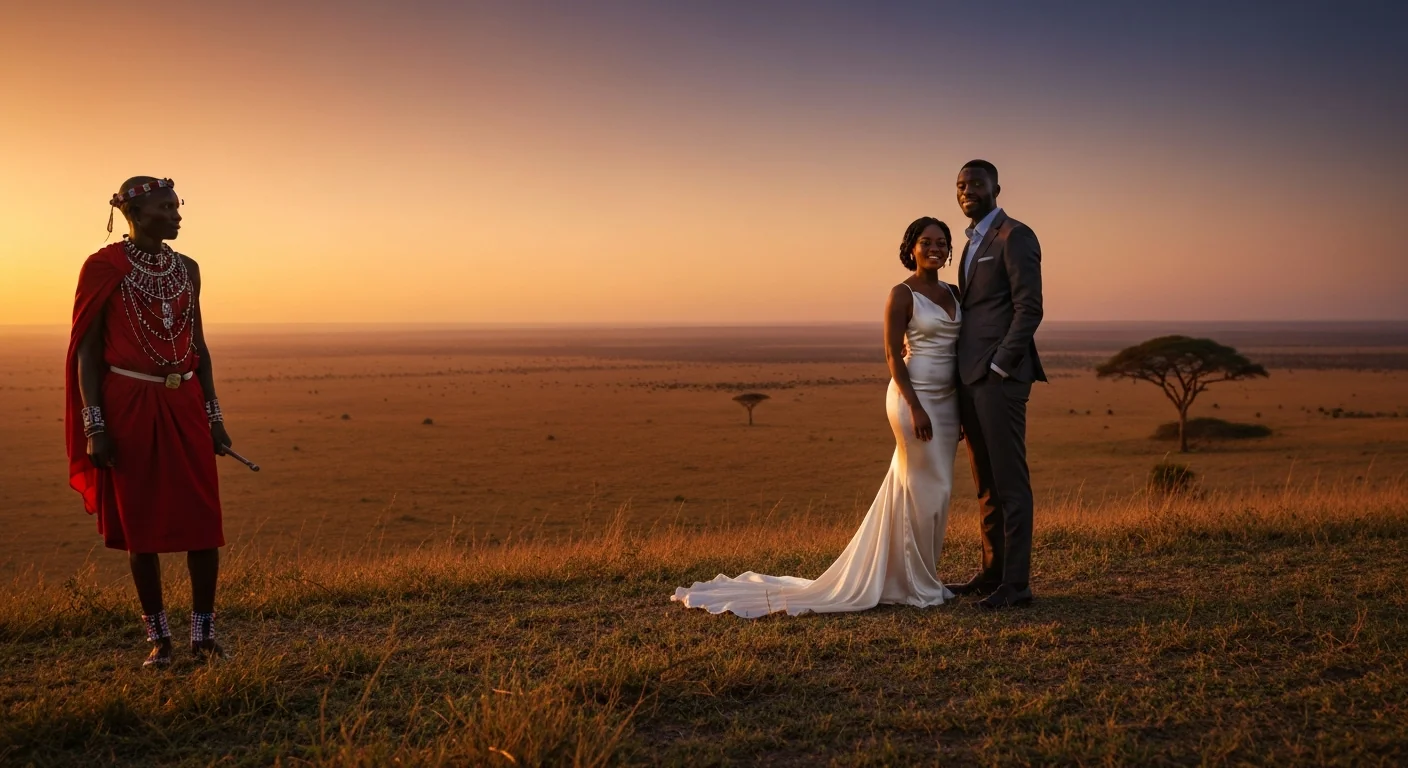
Imagine exchanging vows on the open savannah as a herd of elephants moves across the plains in the distance, and the escarpment turns gold in the afternoon light. A safari wedding in Kenya is not a metaphor. It is entirely real, and it is possible.
A safari wedding is the most dramatic wedding setting Kenya offers. More demanding to pull off than a Nairobi garden wedding or a Diani beach celebration, it rewards the extra effort with something no other venue type can deliver: the Masai Mara at sunset, Kilimanjaro rising over the Amboseli plains, the sound of the bush at night. For couples willing to invest in the logistics, it produces a celebration that guests genuinely never forget.
This guide covers everything you need to know to plan a safari wedding in Kenya — the top locations, the venues that specialise in bush celebrations, realistic costs, how to get your guests there, wildlife safety, legal requirements, and the best seasons. If you are still deciding between venue types, read our complete Kenya destination wedding guide first. If the bush is already the plan, read on.
Why a Safari Wedding in Kenya?
Kenya’s national parks and conservancies offer something no other destination wedding location in the world replicates: genuine wilderness at scale, managed by world-class camps and lodges with experienced hospitality teams. The wildlife is not decorative — it is the backdrop. The Maasai Mara hosts one of Africa’s most diverse large mammal populations. Amboseli delivers guaranteed elephant sightings and, on clear mornings, the snow-capped peak of Kilimanjaro rising from the plains. Laikipia and Samburu offer remoteness and exclusivity that even the Mara cannot match.
Beyond the landscape, a safari wedding is an opportunity to incorporate Maasai culture in a meaningful, contextually appropriate way. Maasai blessings, traditional singers and dancers, a Maasai guard of honour for the bride’s procession — these elements are available at camps with genuine community partnerships, and they add a depth to the ceremony that a standard wedding simply cannot replicate.
The trade-off is scale and cost. Safari camps are intimate by design — most hold fewer than 60 guests, and many require exclusive buyout of the entire property. Logistics require charter flights or long road transfers. The budget floor starts high. But for couples for whom the setting is the priority, no wedding venue in Kenya — or arguably on the continent — competes.
Top Safari Wedding Locations in Kenya
Masai Mara Conservancies
The Masai Mara National Reserve and its surrounding private conservancies are Kenya’s most iconic safari wedding destination. The Mara sits in the southwest, bordering Tanzania’s Serengeti, and hosts the Great Migration from July to October — hundreds of thousands of wildebeest crossing the Mara River in one of the most extraordinary wildlife spectacles on earth. Marrying here during migration season means your wedding day exists within one of the great natural events of the world.
The key distinction within the Mara is between the National Reserve (operated by the county government and open to all safari vehicles) and the private conservancies (Olare Motorogi, Naboisho, Ol Kinyei, and others) that surround it. Conservancy camps offer exclusivity, lower vehicle density, and better wildlife viewing away from the crowds. For a wedding, conservancy camps are almost always the better choice.
Amboseli National Park
Amboseli’s greatest asset is its relationship with Kilimanjaro. On a clear morning — and they are frequent — the mountain dominates the horizon from within the park, its snow-capped peak rising 5,895 metres from the flat plains below. Photographs taken at Amboseli against Kilimanjaro are simply unlike anything achievable elsewhere. The park is also Kenya’s premier elephant destination — the elephant population is so dense that sightings are essentially guaranteed, including large matriarch herds moving across open floodplains.
Amboseli is about four hours from Nairobi by road (or 45 minutes by charter flight), making it more accessible than the Mara for guests who prefer not to fly. The camps here tend to be smaller than the Mara’s, reinforcing the intimate character that suits bush weddings.
Laikipia Plateau
Laikipia is Kenya’s best-kept safari secret. The plateau in the central highlands north of Mount Kenya holds some of the country’s most exclusive conservancies — Lewa, Ol Pejeta, Ol Malo, Loisaba — with wildlife populations that rival any park in the country, and a near-complete absence of the crowds that can affect the Mara in peak season. Laikipia camps are typically small (8–16 guests), privately owned, and deeply embedded in community conservation. For a truly exclusive, private bush wedding — an intimate elopement or a celebration for a small group of close family — Laikipia is the answer.
Samburu National Reserve
Samburu sits in the semi-arid northern region and offers a different landscape from the Mara’s golden savannah — red soil, doum palms, and the Ewaso Ng’iro River running through dry bush country. The wildlife includes species found nowhere else in Kenya: Grevy’s zebra, reticulated giraffe, Beisa oryx, and gerenuk. Samburu is more remote than the Mara or Amboseli, which means fewer crowds and a stronger sense of seclusion. It is also slightly more accessible than Laikipia for first-time visitors. The Samburu community’s cultural heritage is vivid and present — traditional blessings and ceremonies have a different character here from the Maasai-dominated south.
Top Safari Wedding Venues
Angama Mara (Masai Mara)
Angama Mara sits on the edge of the Great Rift Valley escarpment, 500 metres above the Maasai Mara National Reserve. The view from the camp is the famous “Out of Africa” landscape — the one that renders guests speechless. Angama accommodates weddings for 30 or 60 guests, requiring buyout of one or both of its identical camps. Their most iconic ceremony location is the “Out of Africa Saddle” — the ridge at the escarpment edge where the entire Mara basin unfolds below you.
Maasai blessings are available at sunset in their traditional Sunset Boma. The team specialises in “beautifully simple” weddings — no overstated décor, no unnecessary ceremony. The setting does the work. Note that music at receptions is limited to a small speaker (sound travels across the valley), which actually suits the intimate aesthetic perfectly.
Capacity: 30–60 guests | Style: Exclusive buyout, escarpment-edge ceremony
Olare Mara Kempinski (Masai Mara)
Olare Mara Kempinski is the Mara’s luxury hotel brand option — full Kempinski service standards in a conservancy setting. The camp can be hired in its entirety for the wedding party. Standard packages cover three nights’ full-board accommodation including all beverages, and additional inclusions are available: camp décor, a Maasai choir, a Maasai guard of honour, Maasai elders and dancers, and a honeymoon suite.
Ceremony settings include the bush, the river, and within the camp itself. The bride can arrive in procession with a Maasai guard of honour — or on horseback, which has happened more than once.
Capacity: Up to camp capacity (approximately 30–40 guests) | Style: Luxury buyout, full Kempinski service
Mahali Mzuri (Maasai Mara)
Mahali Mzuri is Sir Richard Branson’s Virgin Limited Edition property in the Olare Motorogi Conservancy. It caters to both private elopements (just the two of you) and larger celebrations of up to 24 guests. The team creates personalised, detail-oriented events. Civil ceremonies are available, and blessings can incorporate Maasai traditions — including a locally-made beaded necklace and headdress, and Maasai wraps around the wedding clothes during the ceremony.
Capacity: 2–24 guests | Style: Ultra-intimate, ultra-luxury
Mara Intrepids Camp (Masai Mara)
Mara Intrepids is a larger, more established camp that offers a wider range of wedding sizes from very intimate to a larger party. The venue handles the legal administration end-to-end: procurement of the marriage license, transport and assistance for completing relevant forms, transport for the registrar, and complete traditional Maasai wedding attire for the couple. For couples who want the Mara backdrop but need more guests than a boutique camp allows, Intrepids offers a more practical solution.
Capacity: Intimate to approximately 60 guests | Style: Mid-range, full legal coordination included
Ol Donyo Lodge (Chyulu Hills, Amboseli Region)
For the Amboseli region, Ol Donyo Lodge in the Chyulu Hills offers one of Kenya’s most dramatic wedding backdrops: Kilimanjaro to the south, Chyulu Hills to the north, and Amboseli’s elephant herds moving through the plains below. The lodge specialises in intimate celebrations and has a rooftop star-bed platform that can be used for a ceremony under the open sky at night — unlike anything on offer at any other Kenyan wedding venue.
Capacity: Up to 30 guests | Style: Intimate, Kilimanjaro backdrop
What Does a Safari Wedding Cost?
Safari weddings in Kenya start expensive and scale up significantly from there. The core reasons are camp exclusivity requirements, fly-in guest logistics, and the premium pricing of Mara and Amboseli lodges. Here is an honest cost framework:
| Wedding Type | Guests | Estimated Budget |
|---|---|---|
| Intimate elopement (2 people) | 2 | KSh 300,000 – KSh 600,000+ |
| Small group | 10–20 | KSh 1.5M – KSh 3M |
| Mid-size bush wedding | 20–40 | KSh 3M – KSh 6M |
| Full conservancy buyout | 40–60 | KSh 7M – KSh 15M+ |
Some specific benchmarks:
- Camp rates at mid-range Mara lodges typically run USD 350–600 per person per night full-board (approximately KSh 45,000–78,000 at 2025 exchange rates). Luxury camps exceed USD 1,000 per person per night.
- Charter flights (Nairobi Wilson to Mara) cost approximately KSh 25,000–45,000 per person return on scheduled services (Safarilink, AirKenya). Private charters are significantly more.
- Wedding ceremony setup (décor, florals, champagne, coordination): typically included in buyout packages, or costed separately at KSh 150,000–KSh 500,000
- Maasai cultural elements (blessing ceremony, choir, dancers): usually included as part of premium camp packages
A realistic total for 20–30 guests at a mid-range Mara camp, including three nights’ accommodation, flights, and ceremony: KSh 3 million to KSh 6 million. For luxury conservancy camps, the figure is considerably higher.
For detailed cost tracking, use the Harusi Hub budget tool to build a line-item plan across accommodation, transport, ceremony, and décor. Our Kenya wedding budget guide covers how to allocate across categories.
Getting Your Guests to the Bush
Logistics are the most complex element of a safari wedding, and getting them right is what separates a smooth celebration from a stressful one.
Charter Flights (Strongly Recommended)
For the Masai Mara, charter flights are not a luxury — they are the practical choice. The drive from Nairobi to the Mara is 5–7 hours on rough roads, depending on the specific camp. A charter flight from Nairobi Wilson Airport takes 45 minutes and arrives directly at the camp’s airstrip. For guests travelling to a wedding, this difference is enormous.
Scheduled services (Safarilink, AirKenya) operate on fixed routes to the Mara, Amboseli, Samburu, and other destinations. They are the most cost-effective option for individual or small group bookings.
Private charters offer full flexibility — departure time, routing, and the ability to fly to remote airstrips that scheduled services do not serve. For a wedding group wanting to arrive together, a private charter is often the most elegant solution.
Important for guests: Charter aircraft on these routes have a strict 15 kg soft-sided bag limit. Communicate this clearly and early. Guests who arrive at Nairobi Wilson with hard-shell suitcases will face a problem.
Road Transfers
For Amboseli, road transfer from Nairobi is approximately 4 hours — manageable for most guests and a meaningful cost saving over charter flights. The road via Emali is generally good. For the Mara, road is possible but genuinely long, and the final section to most camps involves rough track. Road is best reserved for Amboseli and Laikipia (which has better road access than the Mara).
Nairobi Assembly Point
For large groups, consider having all guests meet in Nairobi the night before departure — at a Nairobi hotel or a private house. This gives you a single point from which to manage the charter or convoy departure, avoids the chaos of guests arriving from different directions on the day, and creates a natural start to the celebration.
Wildlife Safety for Wedding Guests
Safety is a genuine consideration at safari weddings, and it requires clear communication with guests — particularly those who have never been on safari before.
Basic rules that apply everywhere:
- Never exit a vehicle without a guide’s permission in open bush
- Do not approach wildlife on foot unless accompanied by an armed guide
- Stay inside tents and rooms after dark unless escorted
- Never run — walking away calmly is the correct response to a close wildlife encounter
Camps manage this well. Every reputable safari camp employs experienced Maasai guides and has protocols for guest movement within and around the camp. Guests are briefed on arrival. Bush walks are led by trained, armed rangers. Evening movement within camp is accompanied by staff.
Wedding guests with no safari experience: Brief them before the trip. A short note with the wedding information — “you will be at a safari camp, wildlife is real and close, here is what to do” — sets expectations and reduces anxiety. Include this information on your Harusi Hub wedding website under a “What to Know” section.
Medical cover: Ask your camp or tour operator whether Flying Doctors emergency medical cover is included in the package (it often is). If not, arrange it separately. It covers air evacuation to Nairobi in a medical emergency and is inexpensive relative to the reassurance it provides.
When to Have Your Safari Wedding
Timing matters enormously for a safari wedding in Kenya.
Peak wildlife: July to October. The Great Migration crosses the Mara River from roughly July to September, making this the most dramatic period for a Masai Mara wedding. Wildlife is concentrated, game drives are extraordinary, and guests will see more animals than at any other time of year. These months are also dry, with cool nights and warm days — excellent conditions for outdoor ceremonies. Book 12+ months in advance for this window.
Dry and clear: January to March. The short dry season delivers excellent game viewing (animals concentrate around water), clear skies, and warm weather. Slightly lower rates than the peak July–October window. Good alternative if you cannot secure the migration season.
Green season: November to June (low season). The Mara is lush and beautiful, dramatically different in character from the dry season. Rates are lower, crowds are minimal, and the photographic light is exceptional. The trade-off is that rain is possible and wildlife is more dispersed. If budget is a constraint, the green season is worth considering — but confirm your rain contingency with the camp.
Avoid April–May (long rains). Road access to some camps becomes difficult, and consistent outdoor ceremonies cannot be guaranteed.
Legal Requirements for a Bush Wedding
Getting legally married at a Kenyan safari camp requires the same process as any Kenyan marriage: you must have been resident in Kenya for at least two working days before applying for a marriage license. Most registrars recommend arriving at least five working days before your ceremony date to handle all the paperwork. The registrar travels to the camp on the ceremony day.
Important caveat: Some high-end camps, including Angama Mara, advise couples that a ceremony at their property may not constitute an official marriage in Kenya under all circumstances. They recommend being legally married in your home country before or after the Kenya celebration. Check this with your specific venue and consult our Kenya marriage registration guide and international marriage in Kenya guide for the full legal picture.
Couples coming from abroad: Confirm the requirements with the Kenyan Embassy or Consulate in your country before travel. Some camps include a dedicated representative who handles all paperwork on the couple’s behalf, which simplifies the process significantly.
Managing Your Safari Wedding Events
A safari wedding typically spans multiple days: an arrival and welcome event, the main ceremony and reception, a bush breakfast or sundowner celebration, and departure. Each occasion has its own logistics, venue (the bush, the boma, the main deck), and set of guests.
Harusi Hub’s multi-event system lets you set up each occasion separately — with individual dates, venues, and RSVP status — so guests can confirm attendance to specific events and you can track responses per occasion. The events management guide walks you through setting this up, and the planning phases guide helps you structure your timeline from booking through to the wedding day.
If you are co-planning with a partner who is in a different city or country, invite them to the planning dashboard so both of you can manage vendors, guest lists, and the budget from wherever you are.
A Practical Planning Sequence
Safari weddings reward early action. Here is a simple sequence:
- Choose your location and season first — this determines everything else
- Book your camp 12–18 months out for peak season (Jul–Oct especially)
- Confirm exclusivity terms — most camps require partial or full buyout; understand what that means for your total cost
- Arrange charter flights immediately after booking the camp — Safarilink and AirKenya group bookings require advance notice
- Communicate the luggage restrictions to guests early (15 kg, soft-sided bags)
- Sort legal requirements — residence days, registrar availability, or plan to legalise separately
- Build your wedding website with travel instructions, luggage rules, what to pack, and wildlife safety notes
- Plan your multi-day event schedule — welcome dinner, ceremony, post-ceremony activities
- Include medical cover — Flying Doctors or equivalent for all guests
For a full Kenya-specific planning checklist, use the Harusi Hub planning checklist to track every task from engagement to wedding day.
A safari wedding in Kenya is not the easiest celebration to pull off. The logistics are real, the costs are significant, and the planning requires more lead time than any other wedding type. But there is no venue in Kenya — and very few in the world — that delivers what the Masai Mara or Amboseli delivers at sunset. For couples who want a wedding that is genuinely unrepeatable, the bush is the answer.
If a coastal setting appeals to you instead, see our guide to planning a beach wedding in Kenya for a side-by-side look at what each destination demands. For a breakdown of what weddings in Kenya cost across all budget levels in 2026, read our Kenya wedding cost guide.
Plan your safari wedding — all in one place
Manage multi-day events, guest travel logistics, budget, and your wedding website — all free on Harusi Hub.
Start Planning Free