How to Write Your Wedding Vows (With Kenyan-Inspired Examples)
A step-by-step guide to writing personal wedding vows for Kenyan weddings. Includes 8+ vow examples in English and Swahili, plus religious and secular options.
How to Write Your Wedding Vows (With Kenyan-Inspired Examples)
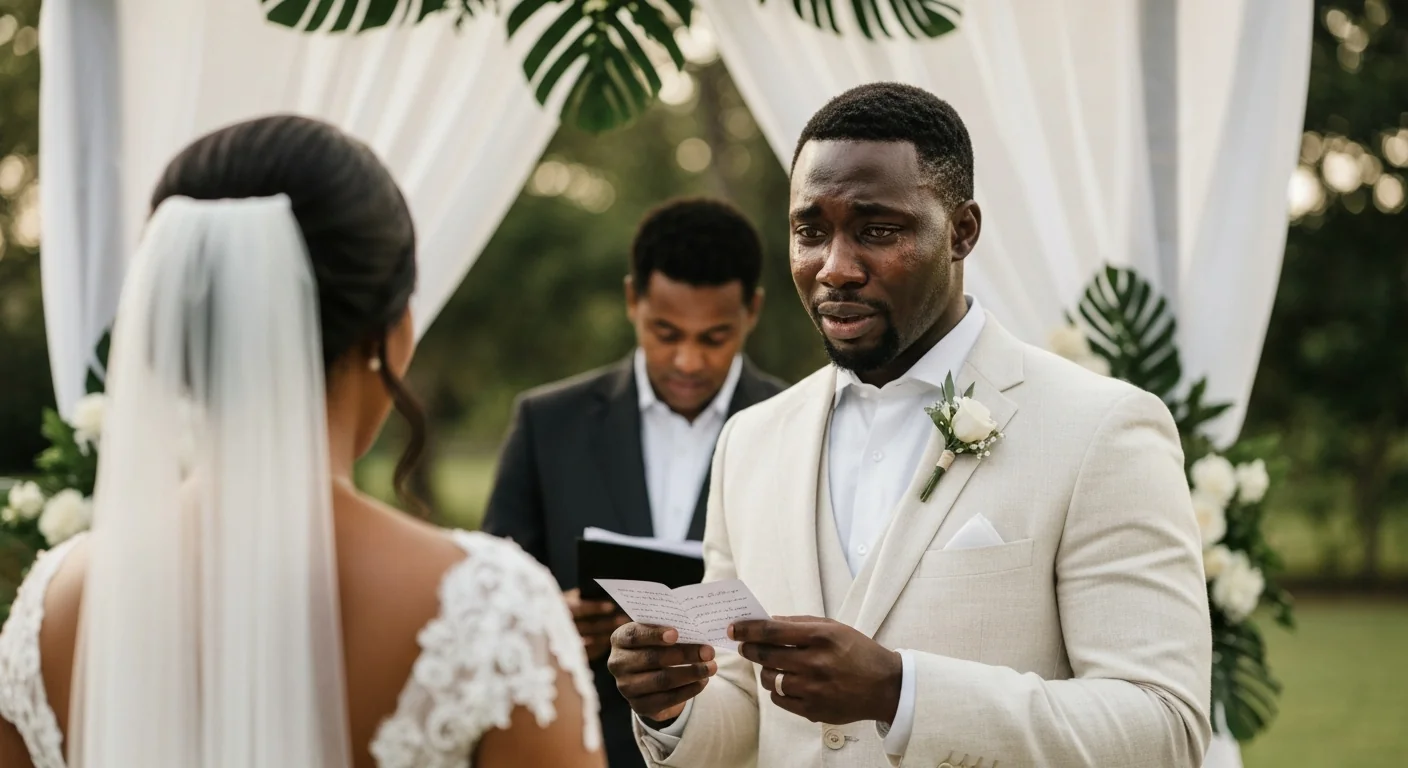
The officiant turns to you and says, “Please share your vows.” Every guest leans forward. Your partner’s eyes are on you. Your heart is hammering. And the words you are about to say — the words you wrote at 2:00 AM on your kitchen table, the words you rewrote six times, the words that still do not feel big enough — are the most important words you will ever speak.
Writing your own wedding vows is one of the most intimate and meaningful things you can do on your wedding day. It is also one of the most terrifying. Because vows are not a speech — they are a promise. And putting that promise into your own words, in front of everyone you love, requires a kind of vulnerability that most of us are not accustomed to.
In Kenya, where many weddings follow traditional church liturgy with pre-written vows, the idea of writing your own can feel unfamiliar. But more couples are choosing to personalize their vows — blending English and Swahili, weaving in cultural references, and making promises that reflect their unique relationship rather than a generic template.
This guide walks you through the process step by step, gives you eight complete vow examples covering Christian, Muslim, secular, and bilingual options, and offers practical advice on length, delivery, and getting the words right.
Should You Write Your Own Vows?
Before you begin, consider whether personal vows are the right choice for your ceremony.
Write your own vows if:
- You want the ceremony to feel deeply personal
- You and your partner are comfortable with emotional expression
- Your officiant and venue allow personal vows (some churches require traditional liturgy)
- You want a moment in the ceremony that is uniquely yours
Use traditional vows if:
- Your church or denomination requires them
- You or your partner are very private and uncomfortable with public vulnerability
- You prefer the weight and history of traditional liturgical vows
- Your officiant has specific requirements
A middle option: Many couples use traditional vows during the official ceremony and then share personal vows privately — either during the first look, in a letter exchanged before the ceremony, or at the reception. This gives you the best of both worlds.
Step 1: Start With What You Want to Say
Do not start by writing. Start by thinking. Set aside 30 minutes, sit somewhere quiet, and answer these questions:
- What do I love most about my partner?
- When did I know this was the person I wanted to marry?
- What has my partner taught me about love, patience, or life?
- What are the specific things I am committing to in this marriage?
- What makes our relationship different from anything I have experienced before?
- What do I want our life together to look like in 10, 20, 50 years?
Write your answers in rough notes. Do not worry about eloquence — just capture the raw material. The best vows come from honest answers to honest questions.
Step 2: Choose Your Structure
Every good vow follows a simple structure:
The Declaration (Who you are to me)
Open by telling your partner what they mean to you. This grounds the vow in your specific relationship.
The Acknowledgment (What I have learned)
Reflect on your journey together — how you have grown, what you have overcome, what you have discovered about love.
The Promises (What I commit to)
This is the heart of the vow. Make specific, meaningful promises — not generic ones. “I promise to always listen to you, even when I am tired” is more powerful than “I promise to love you forever.”
The Closing (My hope for us)
End with a statement about your future together. A wish, a prayer, a declaration of faith in what you are building.
Step 3: Write the First Draft
Using your notes and structure, write your first draft. Do not edit as you go — let the words flow. You will revise later. Aim for 200-350 words, which translates to about 1.5-3 minutes when spoken.
Step 4: Edit and Refine
Read your draft out loud. You will immediately hear which lines sound natural and which sound forced. Cut anything that feels generic or borrowed from a movie. The best vows sound like you — the way you actually talk to your partner.
Ask yourself:
- Does this sound like me, or like a greeting card?
- Would my partner recognize these words as mine?
- Are my promises specific and realistic?
- Is there a moment in here that will move my partner?
Step 5: Practice
Rehearse your vows out loud at least three times. Practice in front of a mirror, or record yourself on your phone and listen back. Time yourself — if you are over three minutes, trim. Know which lines might make you emotional and prepare for that moment.
Vow Example 1: Classic Personal Vow (English)
Style: Warm, sincere, and balanced between emotional and grounded.
“[Partner’s Name], I stand before you today not because I have to, but because there is nowhere else I would rather be.
You came into my life during a season when I was not looking for anyone. I was building my career, figuring out who I was, and honestly, I was not sure I believed that love like this existed outside of stories. And then there you were — patient, kind, and stubborn enough to stay when I made it difficult.
You have taught me that love is not a feeling you fall into — it is a choice you make every day. And today, I am making that choice in front of everyone who matters to us.
I promise to be your partner in every sense of the word — to share the load when life gets heavy, to celebrate with you when things go right, and to sit with you in silence when words are not enough. I promise to listen more than I speak, to be honest even when it is uncomfortable, and to never stop choosing you.
I cannot promise that our life will be easy. But I can promise that you will never face it alone. I am yours. Today, tomorrow, and for every day after that.”
Vow Example 2: Bilingual English/Swahili Vow
Style: Blends both languages naturally. Ideal for bilingual Kenyan couples.
“[Partner’s Name], leo ni siku ambayo nimekuwa nikiingoja kwa muda mrefu — today is a day I have been waiting for.
When I first met you, I did not know that you would become the most important person in my life. Lakini Mungu alijua. God knew. And He brought us together in a way that I could never have planned.
Nakupenda — I love you. Not just the version of you that the world sees, but the version that only I know. The one who worries at night. The one who laughs so hard you cannot breathe. The one who prays for our future when you think nobody is listening.
Naahidi — I promise — to love you with all that I am. Naahidi kukusimamia katika nyakati ngumu na nzuri — I promise to stand by you in hard times and in good ones. Naahidi kujenga nyumba pamoja nawe ambayo watoto wetu watajivunia — I promise to build a home with you that our children will be proud of.
Wewe ni wangu, na mimi ni wako. You are mine, and I am yours. Leo na milele — today and forever.”
Vow Example 3: Christian Vow
Style: Faith-centred, scriptural references, prayerful tone. Suitable for church ceremonies.
“[Partner’s Name], the Bible says in Ecclesiastes 4:12 that a cord of three strands is not quickly broken. Today, we are weaving that cord — you, me, and God.
I did not find you by accident. I believe with all my heart that God placed you in my path because He knew I needed someone exactly like you — someone who challenges me to grow, who loves me with grace, and who walks with me in faith.
Before God, before our families, and before everyone gathered here, I make you these promises:
I promise to love you as Christ loves the church — sacrificially, patiently, and without condition. I promise to pray for you every day, to pray with you when we face challenges, and to seek God’s guidance for our family. I promise to be faithful to you in thought, word, and deed. I promise to lead with humility and to follow when you are wiser than I am.
Our marriage is not just about us. It is a covenant before God — a sacred commitment that I do not take lightly. I choose you today, and I will choose you every day, with God as my witness and my strength.
Mungu awabariki ndoa yetu. May God bless our marriage.”
Vow Example 4: Muslim Vow
Style: Reverent, appropriate for a Nikah or Islamic wedding context. Grounded in Islamic values.
“[Partner’s Name], Bismillahir Rahmanir Rahim — in the name of Allah, the Most Gracious, the Most Merciful.
Today, before Allah and before our families, I take you as my [husband/wife]. This is not simply a contract — it is a sacred trust that I accept with my whole heart.
The Prophet Muhammad, peace be upon him, said that the best among men are those who are best to their wives. I intend to live by those words. I promise to treat you with kindness, with respect, and with the mercy that our faith teaches us.
I promise to provide for you and for our family — not just materially, but emotionally, spiritually, and in every way that matters. I promise to be patient with you, to listen to you, and to seek your counsel in the decisions that shape our lives.
I promise to build a home that is grounded in taqwa — in consciousness of Allah — and to raise our children, Insha’Allah, in the light of our faith.
You are my partner, my companion, and my greatest blessing from Allah. May He strengthen our bond, protect our union, and grant us a marriage filled with sakinah, mawaddah, and rahmah — tranquility, love, and mercy.
Ameen.”
Vow Example 5: Secular Vow
Style: Non-religious, deeply personal, and emotionally honest. Suitable for civil ceremonies or garden weddings.
“[Partner’s Name], I do not believe in fairytales. I believe in us.
I believe in the way you make me coffee without asking. I believe in the arguments we have at midnight that somehow bring us closer. I believe in the way you hold my hand in traffic when we are both stressed and late. I believe in the quiet Tuesday evenings that feel more meaningful than any holiday.
I am not promising you a perfect marriage. I am promising you a real one. One where we fight fairly and forgive fully. One where we grow as individuals and grow together. One where we build something that is ours — not based on what anyone expects, but on what we choose.
I promise to be honest with you, even when the truth is inconvenient. I promise to support your dreams as fiercely as I pursue my own. I promise to laugh with you every day and to hold you on the days when laughter does not come easily.
You are my favourite person. You are my home. And I choose you — not out of obligation, but out of the deepest, most stubborn, most certain kind of love I have ever known.”
Vow Example 6: Short and Powerful Vow
Style: Minimal, impactful, for couples who prefer brevity. Under two minutes.
“[Partner’s Name], I choose you.
I choose you on the good days and the hard days. I choose you when we agree and when we do not. I choose you when life is simple and when it is impossibly complicated.
I promise to listen. I promise to be patient. I promise to be present — not just physically, but with all of my attention and all of my heart.
You make me better. You make me braver. And I will spend the rest of my life making sure you know how loved you are.
Wewe ni wangu. You are mine. And I am yours.”
Vow Example 7: Vow with Kenyan Cultural Elements
Style: Incorporates Kenyan cultural references, community values, and the significance of family.
“[Partner’s Name], in our culture, marriage is not just about two people — it is about two families becoming one. Today, as our families join, I want you to know what I am bringing into this union.
I am bringing the values my parents taught me: that a home is built on respect, that love is shown through actions, and that family comes before everything else. I am bringing the lessons from my grandmother, who told me, ‘Choose someone who makes ordinary days feel extraordinary.’
I chose you. And every ordinary day with you has been proof that she was right.
I promise to honour you the way our elders have taught us — with patience, with loyalty, and with the understanding that marriage is a journey we walk together. I promise to welcome your family as my own, to respect your traditions, and to build new ones with you.
Naahidi kukupenda kwa upendo wa kweli — I promise to love you with genuine love. Not the kind that fades, but the kind that deepens with time, the kind that our parents and grandparents modelled for us.
Together, we will build a home that honours where we come from and embraces where we are going.”
Vow Example 8: Vow from Bride to Groom (Specifically Feminine Voice)
Style: Written from the bride’s perspective, acknowledging the significance of choosing a partner.
“[Partner’s Name], when I was a little girl, my mother told me, ‘Marry someone who makes you feel safe.’ I did not fully understand what she meant until I met you.
You are my safe place. Not because you protect me from the world — I can do that myself — but because with you, I do not have to. With you, I can be vulnerable. I can be uncertain. I can be imperfect. And you love me through all of it.
I promise to be your partner, your equal, and your biggest supporter. I promise to build our home with the same care and intention that I bring to everything I love. I promise to respect you, to trust you, and to communicate with you — even when it is easier to stay silent.
I am not giving myself away today. I am choosing to share my life with you — every part of it. The ambitions, the anxieties, the morning chaos, and the quiet evenings. All of it is yours.
Nakupenda, [Partner’s Name]. Na nitaendelea kukupenda kila siku. I love you, and I will continue to love you every day.”
Practical Tips for Vow Writing
Agree on Ground Rules With Your Partner
Before you each start writing, agree on:
- Length — Will you both aim for the same length? A two-minute vow paired with a thirty-second vow creates an awkward imbalance.
- Tone — Are you both going emotional? Humorous? A mix? You do not need to match exactly, but you should be in the same neighbourhood.
- Content boundaries — Are there topics that are off-limits? Private struggles, family issues, or deeply personal moments that should stay between you?
Do Not Share Your Vows Before the Ceremony
Hearing each other’s vows for the first time at the altar is one of the most powerful moments in a wedding. Resist the urge to share or compare in advance.
Write a Clean Final Version
On the day, bring a clean, handwritten or printed copy on a small card or beautiful paper. Do not read from your phone. A physical card looks intentional and ceremonial. Write in a font size you can read without squinting.
Keep It Under Three Minutes
Two minutes is ideal. Three minutes is the absolute maximum. Anything longer loses the audience and puts pressure on your partner to match. Edit ruthlessly — every sentence should earn its place.
Speak Slowly and Look Up
When you deliver your vows, look at your partner as much as possible. Read a line, look up, say it to them. The paper is a reference — your partner’s eyes are where the vow actually lands.
It Is Okay to Cry
Emotions are expected and welcomed. If your voice breaks, pause, breathe, and continue. Nobody is judging you for being moved at your own wedding.
Check With Your Officiant
If you are getting married in a church, mosque, or religious venue, confirm with your officiant whether personal vows are allowed and in what format. Some churches require the traditional liturgical vows to be spoken and allow personal vows as an addition. Some do not permit personal vows at all during the ceremony. Know the rules before you invest hours in writing.
For civil ceremonies at the Attorney General’s office or before a marriage registrar, you have more flexibility — but confirm the process in advance.
When to Deliver Personal Vows Outside the Ceremony
If your ceremony does not allow personal vows, you still have options:
- In a private first look — Exchange vows before the ceremony, just the two of you (and your photographer, if you want it captured)
- In a letter — Write your vows as a letter and exchange them on the morning of the wedding
- At the reception — Share an abbreviated version during your couple’s speech at the reception
- On your wedding night — Read them to each other privately after the day is over
The setting matters less than the sincerity. Your vows are for each other, regardless of who else hears them.
Plan Your Perfect Ceremony
Build your wedding timeline, organize your ceremony details, and coordinate every element — all free on Harusi Hub.
Start Planning on Harusi Hub