Kwanjula Shopping List: What to Buy (With Prices)
The complete 2026 kwanjula shopping list with current Ugandan prices in UGX — every item the groom's family must bring to a Buganda introduction ceremony, organised by category.
Kwanjula Shopping List: What to Buy (With Prices)
The bride’s family has sent the list. You are staring at it — dozens of items, some you recognise, some you have never heard of — and the question is not whether you need to buy everything on it, but where to find it all, how much it will cost, and how to make sure nothing is missing on the day. This guide is your answer.
The kwanjula shopping list is one of the most searched topics among Ugandan couples, and for good reason. Show up to the introduction ceremony without the right items and the ceremony stalls. Forget a key gift for the ssenga and the oversight will be remembered for years. Overspend without a plan and you start married life financially strained.
This guide gives you the definitive, category-by-category breakdown of every item the groom’s side is typically expected to bring to a Buganda kwanjula, with realistic 2026 prices in UGX and practical advice on where to buy and how to pack.
One critical note before you start buying anything: Always confirm the specific list with the bride’s family. Requirements vary by clan, sub-clan, and individual family expectations. The ssenga (bride’s paternal aunt) usually communicates the official list. Use this guide as your planning foundation, then verify every line with the actual family you are dealing with.
For the full cultural context behind the kwanjula ceremony, read our complete kwanjula guide.
How the List Is Organised
Kwanjula shopping items fall into distinct categories, each carrying cultural significance:
- Gifts for the bride’s father — demonstrating respect for the head of the household
- Gifts for the bride’s mother — honouring the woman who raised the bride
- Gifts for the ssenga — acknowledging the aunt’s central role
- Gifts for extended family — aunts, uncles, and clan elders
- Foodstuffs — symbolising the groom’s ability to provide
- Drinks and beverages — for the ceremony itself and as gifts
- The bride price (omutwalo) — the formal cash component
- Gate fee and ceremony fees — mandatory cash payments
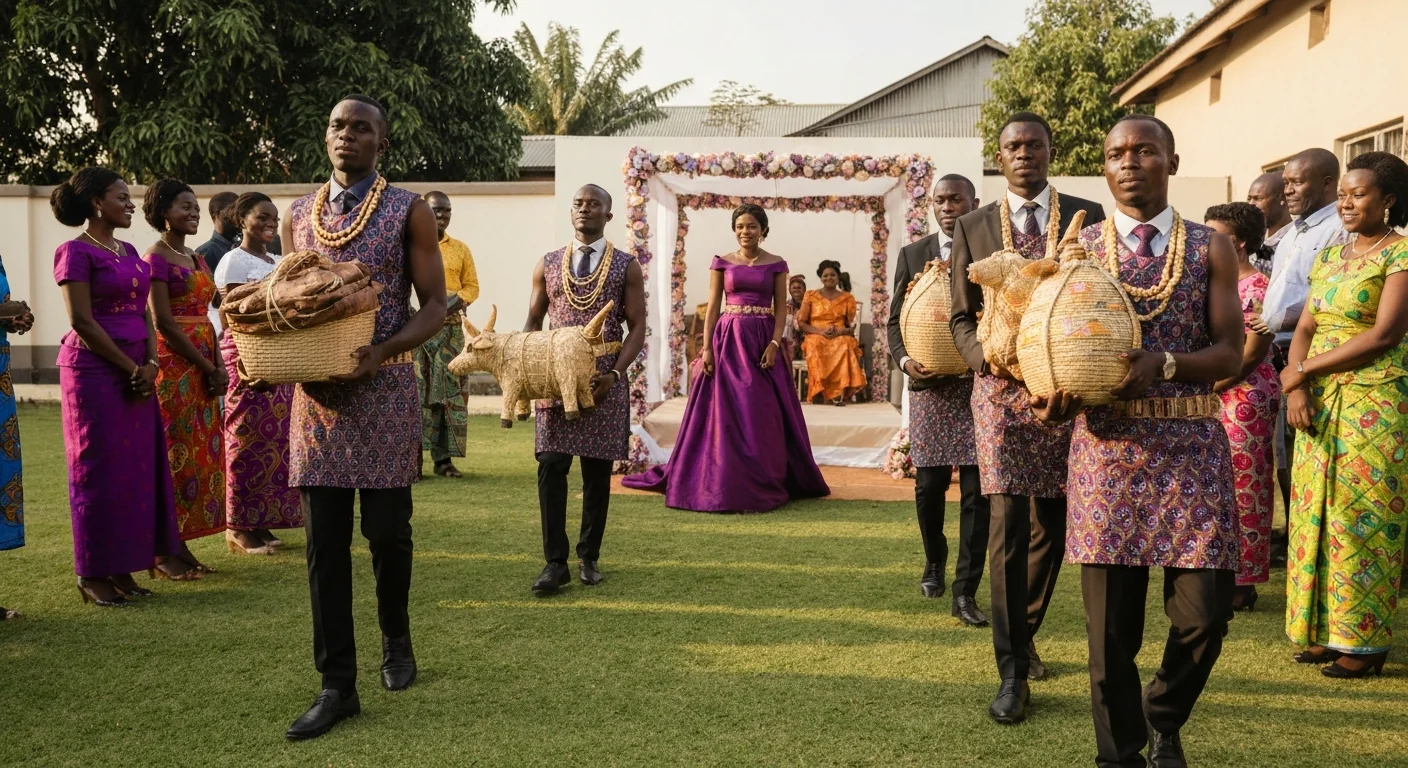
- Packing materials — suitcases, bags, and baskets for presentation
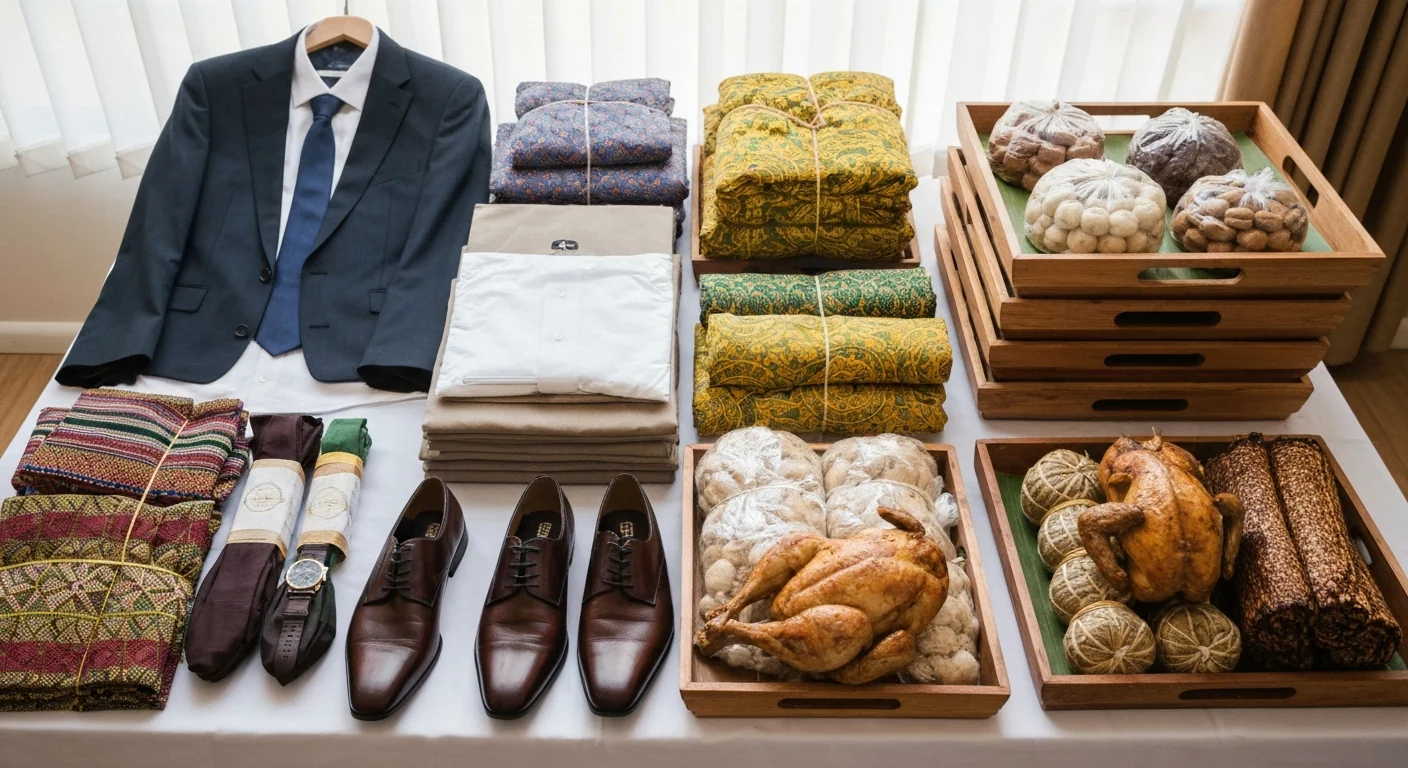
Category 1: Gifts for the Bride’s Father
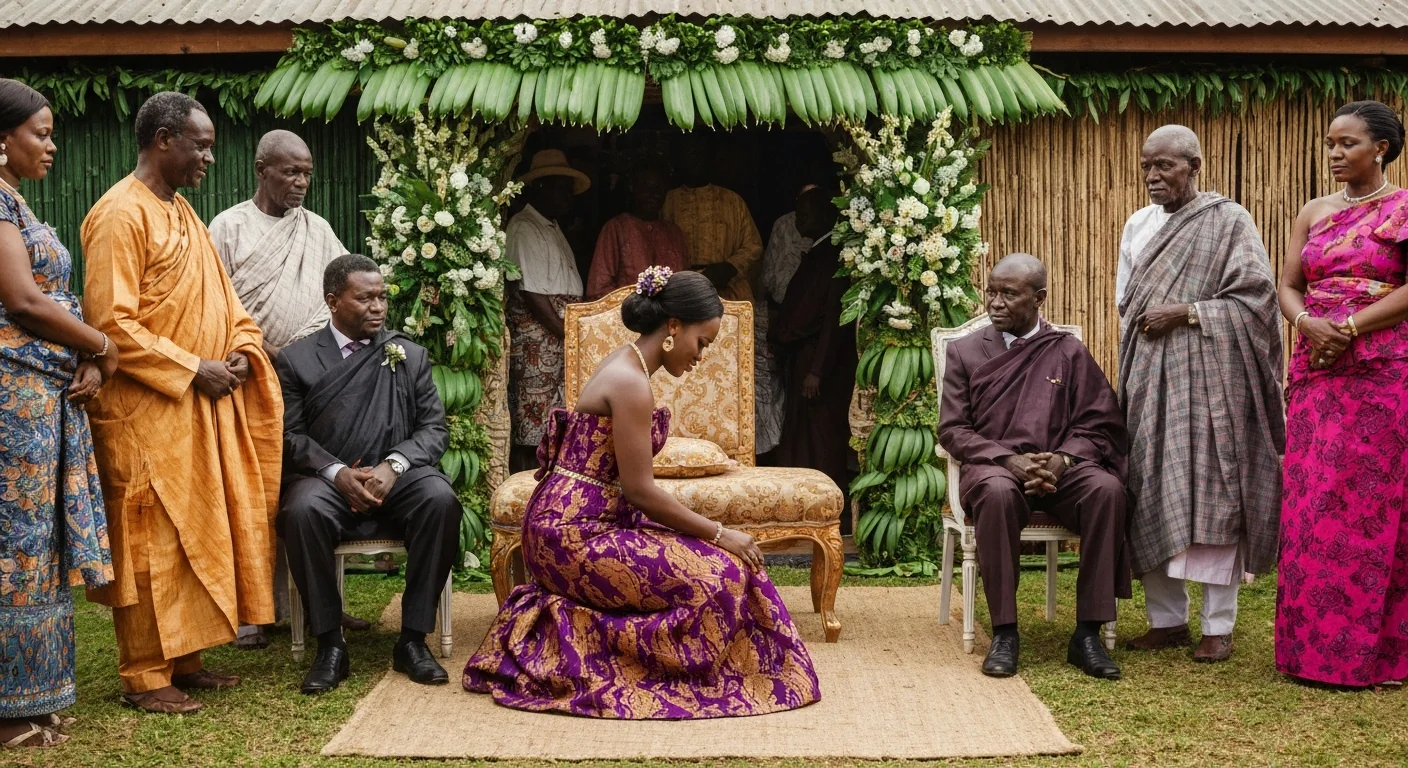
The bride’s father (or senior male relative) is the host of the kwanjula. Gifts to him are a sign of respect and a statement that the groom’s family recognises his authority and values his daughter.
| Item | Details | 2026 Price Range (UGX) |
|---|---|---|
| Kanzu (high quality) | White, well-tailored kanzu in quality fabric | 100,000 – 250,000 |
| Suit | Formal suit (2-piece or 3-piece) | 300,000 – 1,500,000 |
| Formal shoes | Leather, black or brown | 100,000 – 500,000 |
| Shirt and tie | Formal dress shirt with matching tie | 50,000 – 200,000 |
| Watch | Wristwatch (quality varies by budget) | 100,000 – 500,000 |
| Belt | Formal leather belt | 30,000 – 100,000 |
| Cash envelope | Presented during the ceremony | 200,000 – 1,000,000 |
| Coat / blazer | Sometimes requested separately from the suit | 150,000 – 500,000 |
Total for father’s gifts: UGX 1,030,000 – 4,550,000
Note: Not all families request every item on this list. Some fathers specifically request certain items (e.g., a watch of a particular brand, or shoes of a certain type). Others give a general list and let the groom’s family choose. Confirm specifics with the ssenga.
Category 2: Gifts for the Bride’s Mother
The bride’s mother receives gifts that acknowledge her central role in raising the bride. These items are typically among the most scrutinised during the ceremony — the bride’s mother and her friends will inspect the quality closely.
| Item | Details | 2026 Price Range (UGX) |
|---|---|---|
| Gomesi (high quality) | Silk or brocade, well-tailored, in a colour specified or approved by the family | 200,000 – 800,000 |
| Shoes | Formal, comfortable, matching the gomesi | 100,000 – 400,000 |
| Handbag | Quality leather or designer-style handbag | 100,000 – 500,000 |
| Kitenge / wrapper fabric | 2–3 pieces of quality printed fabric | 50,000 – 150,000 |
| Cash envelope | Presented during the ceremony | 200,000 – 1,000,000 |
| Perfume | Brand-name perfume | 50,000 – 200,000 |
Total for mother’s gifts: UGX 700,000 – 3,050,000
Tip: If in doubt about the gomesi colour or fabric, ask the ssenga. Arriving with a gomesi in the wrong colour is an avoidable embarrassment.
Category 3: Gifts for the Ssenga (Paternal Aunt)
The ssenga is the most important single individual on the bride’s side during the kwanjula. She coordinates the ceremony, advises the bride, and wields significant cultural authority. Her gifts should reflect this importance.
| Item | Details | 2026 Price Range (UGX) |
|---|---|---|
| Gomesi (high quality) | Should be visibly high-quality — the ssenga’s gomesi is seen by everyone | 150,000 – 500,000 |
| Shoes | Matching shoes | 80,000 – 300,000 |
| Handbag | Quality handbag | 80,000 – 300,000 |
| Cash envelope | Often the largest individual cash gift after the parents | 100,000 – 500,000 |
| Perfume | Brand-name | 50,000 – 200,000 |
Total for ssenga’s gifts: UGX 460,000 – 1,800,000
Important: Do not skimp on the ssenga’s gifts. She is the gatekeeper of the ceremony and her satisfaction — or dissatisfaction — sets the tone for the entire event. A happy ssenga makes everything smoother.
Category 4: Gifts for Extended Family (Aunts, Uncles, Elders)
The bride’s family typically specifies a number of aunts and uncles who should receive individual gifts. The number varies — some families name 3–5 people, others name 10 or more.
For Aunts (Bannyina)
| Item | Details | Per Person (UGX) | Typical Quantity |
|---|---|---|---|
| Gomesi | Good quality, coordinated colours | 100,000 – 300,000 | 2 – 8 |
| Shoes | Matching shoes | 50,000 – 150,000 | 2 – 8 |
| Cash envelope | Small denominations | 50,000 – 200,000 | 2 – 8 |
For Uncles (Bakulu)
| Item | Details | Per Person (UGX) | Typical Quantity |
|---|---|---|---|
| Kanzu | Standard quality | 80,000 – 200,000 | 2 – 5 |
| Cash envelope | 50,000 – 200,000 | 2 – 5 |
Total for extended family: UGX 700,000 – 5,000,000+ (depends entirely on the number of relatives named)
This is where costs escalate quickly. A family that names 8 aunts and 5 uncles at mid-range prices can push this category to UGX 3,000,000 – 5,000,000 alone. Negotiate respectfully through the spokesman if the numbers are beyond your budget.
Category 5: Foodstuffs
Foodstuffs are both practical and symbolic. They demonstrate the groom’s ability to provide for the bride and contribute to the ceremony’s hospitality. The quantities below are typical for a standard-size kwanjula — adjust based on the family’s specific requirements.
| Item | Typical Quantity | 2026 Price Range (UGX) | Where to Buy |
|---|---|---|---|
| Coffee beans (Kiboko) | 5 – 10 kg | 50,000 – 120,000 | Owino Market, Nakasero Market |
| Sugar | 10 – 25 kg | 30,000 – 75,000 | Any supermarket or wholesale shop |
| Salt | 5 – 10 kg | 10,000 – 25,000 | Any supermarket |
| Rice | 25 – 50 kg | 75,000 – 200,000 | Wholesale shops, Owino Market |
| Maize flour (posho) | 10 – 25 kg | 25,000 – 75,000 | Wholesale shops |
| Cooking oil | 10 – 20 litres | 40,000 – 100,000 | Supermarkets, wholesale |
| Groundnuts (g-nuts) | 5 – 10 kg | 30,000 – 80,000 | Nakasero Market, Owino Market |
| Dried beans | 10 – 20 kg | 30,000 – 80,000 | Nakasero Market |
| Matooke (green bananas) | 2 – 5 bunches | 30,000 – 100,000 | Nakasero Market, roadside sellers |
| Meat (goat) | 1 – 2 whole goats (or equivalent in butchered meat) | 200,000 – 600,000 | Livestock markets, Kalerwe Market |
| Chicken | 2 – 5 live chickens | 30,000 – 60,000 each | Kalerwe Market, local markets |
Total for foodstuffs: UGX 580,000 – 1,575,000
Buying tip: Buy non-perishable items (sugar, salt, rice, beans, oil) 2–4 weeks in advance to avoid last-minute rushes. Buy perishable items (matooke, meat, chickens) 1–2 days before the ceremony. Coffee beans should be freshly roasted — buy from a reputable seller in Nakasero or Owino.
Category 6: Drinks and Beverages
Drinks are a major component of the kwanjula gifts. They serve double duty — some are presented as gifts to the family, others are consumed during the ceremony itself.
| Item | Typical Quantity | 2026 Price Range (UGX) | Notes |
|---|---|---|---|
| Soft drinks (Coca-Cola, Fanta, Sprite) | 5 – 10 crates | 150,000 – 400,000 | Buy crates directly from distributors for better prices |
| Beer (Bell, Nile Special, Tusker) | 5 – 10 crates | 200,000 – 500,000 | Some families specify particular brands |
| Bottled water | 5 – 10 cartons | 50,000 – 120,000 | Essential, especially for upcountry ceremonies |
| Juice (assorted) | 3 – 5 crates | 75,000 – 200,000 | Minute Maid, Splash, or similar |
| Wine | 2 – 6 bottles | 40,000 – 300,000 | Quality varies — ask if the family has preferences |
| Whiskey / spirits | 1 – 3 bottles | 50,000 – 300,000 | Often specifically requested for the father or uncles |
| Traditional brew (omwenge) | If requested | 20,000 – 50,000 | Some traditional families still request local brew |
Total for drinks: UGX 585,000 – 1,870,000
Important: Buy drinks in crates from distributors (not individual bottles from retail shops) to save 20–30%. For Kampala, check with distributors along Jinja Road or in the Industrial Area.
Category 7: Bride Price (Omutwalo) and Ceremony Fees
Bride Price
| Tier | Amount (UGX) |
|---|---|
| Budget | 500,000 – 1,000,000 |
| Mid-range | 1,000,000 – 3,000,000 |
| Premium | 3,000,000 – 10,000,000+ |
The bride price is negotiated between the families through the spokesmen. It is presented in a sealed envelope during the ceremony. The amount is culturally sensitive — some families set it modestly as a matter of principle, others view it as a significant financial moment.
Gate Fee (Ensimbi z’Omulyango)
| Tier | Amount (UGX) |
|---|---|
| Standard | 100,000 – 500,000 |
| Premium families | 500,000 – 1,000,000 |
The gate fee is paid in cash upon arrival at the bride’s family’s compound. Have it ready in the exact amount — do not expect change.
Identification Penalty (if the groom picks the wrong bride)
Budget UGX 50,000 – 200,000 in cash for the identification game. If the groom picks the wrong woman, there is a penalty payment each time. This is a fun, expected part of the ceremony — have the cash ready.
Total for cash components: UGX 650,000 – 11,200,000+
Category 8: Packing and Presentation Materials
How you present the gifts matters. Items should be packed neatly in appropriate containers — not thrown into plastic bags.
| Item | Details | 2026 Price Range (UGX) |
|---|---|---|
| Suitcases | Large suitcases for clothing gifts (gomesi, suits, kanzu) | 50,000 – 200,000 each |
| Gift baskets (ekisero) | Traditional woven baskets for foodstuffs | 10,000 – 30,000 each |
| Gift bags | Decorative bags for smaller items | 5,000 – 15,000 each |
| Wrapping paper / ribbon | For wrapping individual items | 20,000 – 50,000 total |
| Trays | For presenting drinks and specific items | 10,000 – 30,000 each |
Total for packing materials: UGX 200,000 – 600,000
Presentation tips:
- Pack gomesi in individual garment bags inside suitcases
- Wrap shoes in tissue paper
- Present cash envelopes in quality envelopes (not plain white — get something elegant)
- Foodstuffs look best in traditional baskets lined with banana leaves or clean fabric
- Drinks should be in their original crates, clean and neatly stacked
Category 9: Attire for the Groom’s Delegation
The groom’s delegation must be well-dressed in coordinated traditional attire. The groom’s family typically covers the cost.
| Item | Details | Per Person (UGX) | Typical Quantity |
|---|---|---|---|
| Kanzu (men) | Coordinated quality, matching fabric | 80,000 – 250,000 | 5 – 20 |
| Jacket (men) | Matching jackets worn over kanzu | 100,000 – 400,000 | 5 – 20 |
| Gomesi (women) | Coordinated colour and fabric | 100,000 – 300,000 | 5 – 15 |
| Groom’s kanzu | Highest quality — the groom stands out | 150,000 – 350,000 | 1 |
| Groom’s jacket | Premium, well-fitted | 200,000 – 800,000 | 1 |
| Shoes (groom) | Formal, polished | 100,000 – 400,000 | 1 |
Total for delegation attire: UGX 1,500,000 – 10,000,000+ (heavily dependent on delegation size)
Cost-saving tip: The delegation attire is one of the largest variable costs. A delegation of 10 people at mid-range costs UGX 2,000,000 – 4,000,000. A delegation of 25 people can push this to UGX 6,000,000 – 10,000,000. Keep your delegation size manageable.
Complete Shopping List Summary
Here is the full picture at three budget tiers:
| Category | Budget (UGX) | Mid-Range (UGX) | Premium (UGX) |
|---|---|---|---|
| Father’s gifts | 1,030,000 | 2,500,000 | 4,550,000 |
| Mother’s gifts | 700,000 | 1,500,000 | 3,050,000 |
| Ssenga’s gifts | 460,000 | 1,000,000 | 1,800,000 |
| Extended family gifts | 700,000 | 2,500,000 | 5,000,000 |
| Foodstuffs | 580,000 | 1,000,000 | 1,575,000 |
| Drinks and beverages | 585,000 | 1,200,000 | 1,870,000 |
| Bride price + fees | 650,000 | 2,500,000 | 11,200,000 |
| Packing materials | 200,000 | 400,000 | 600,000 |
| Delegation attire | 1,500,000 | 4,000,000 | 10,000,000 |
| Spokesman fee | 200,000 | 500,000 | 1,000,000 |
| Photography | 300,000 | 800,000 | 1,500,000 |
| Transport | 200,000 | 600,000 | 1,000,000 |
| Grand Total | 7,105,000 | 18,500,000 | 43,145,000 |
Where to Buy in Kampala
Fabric and Gomesi
- Owino Market (St. Balikuddembe Market) — the largest market in East Africa. Enormous selection of fabrics for gomesi. Prices are negotiable and significantly lower than retail shops. Go with someone who knows the market.
- Wandegeya — multiple tailors and fabric shops specialising in gomesi and kanzu.
- Kampala Road fabric shops — higher-end options for silk and brocade fabrics.
- Garden City Mall / Acacia Mall — for higher-end, ready-made options.
Tailoring tip: Allow 2–4 weeks for custom gomesi tailoring. Rush jobs cost more and quality suffers. A good gomesi tailor in Wandegeya or Owino charges UGX 30,000 – 80,000 for tailoring alone (fabric is separate).
Kanzu
- Wandegeya — the go-to area for kanzu. Multiple shops and tailors specialising in kanzu of all quality levels.
- Old Kampala — several kanzu specialists along Namirembe Road.
Suits and Formal Wear
- Forest Mall, Lugogo — several menswear shops with formal suit options.
- Garden City Mall — higher-end options.
- Custom tailors — Kampala has excellent tailors who can make a suit in 1–2 weeks for UGX 400,000 – 1,000,000 (fabric included).
Foodstuffs and Provisions
- Nakasero Market — the best central market for quality foodstuffs. Clean, well-organised, with good quality produce. Slightly higher prices than Owino but better experience.
- Owino Market — cheapest prices for bulk foodstuffs, but navigating the market requires patience.
- Kalerwe Market — excellent for livestock (goats, chickens) and fresh produce.
- Supermarkets (Shoprite, Carrefour, Capital Shoppers) — convenient for packaged goods (sugar, salt, oil, rice) but prices are 10–20% higher than market.
Drinks
- Distributors along Jinja Road / Industrial Area — wholesale prices for crates of soda, beer, water, and juice. Buying in bulk from distributors saves 20–30% compared to retail.
- Supermarkets — convenient but more expensive for bulk purchases.
Suitcases and Packing Materials
- Owino Market — cheapest suitcases and bags.
- Lugogo Mall / Garden City — better quality suitcases at higher prices.
- Kampala Road shops — various options for gift bags, wrapping materials, and baskets.
Packing Checklist
Use this as your final check before loading the vehicle on the morning of the kwanjula. Check off each item as it is packed:
Clothing Gifts
- Father’s kanzu
- Father’s suit (jacket, trousers, shirt, tie)
- Father’s shoes
- Father’s belt and watch
- Mother’s gomesi
- Mother’s shoes and handbag
- Mother’s kitenge/wrapper
- Mother’s perfume
- Ssenga’s gomesi
- Ssenga’s shoes and handbag
- Ssenga’s perfume
- Aunts’ gomesi (count: ___)
- Aunts’ shoes (count: ___)
- Uncles’ kanzu (count: ___)
Cash Envelopes
- Father’s envelope (amount: ___)
- Mother’s envelope (amount: ___)
- Ssenga’s envelope (amount: ___)
- Extended family envelopes (count: ___ / total: ___)
- Bride price envelope (amount: ___)
- Gate fee (amount: ___)
- Identification penalty cash (amount: ___)
Foodstuffs
- Coffee beans (___ kg)
- Sugar (___ kg)
- Salt (___ kg)
- Rice (___ kg)
- Maize flour (___ kg)
- Cooking oil (___ litres)
- Groundnuts (___ kg)
- Dried beans (___ kg)
- Matooke (___ bunches)
- Meat / goat
- Chickens (count: ___)
Drinks
- Soft drinks (___ crates)
- Beer (___ crates)
- Water (___ cartons)
- Juice (___ crates)
- Wine (___ bottles)
- Spirits (___ bottles)
Delegation Attire
- Groom’s kanzu and jacket
- Groom’s shoes
- Male delegation kanzu and jackets (count: ___)
- Female delegation gomesi (count: ___)
Logistics
- Packing materials (suitcases, baskets, bags, wrapping)
- Spokesman confirmed and briefed
- Photographer confirmed
- Transport arranged for delegation
- Directions to venue confirmed
- Emergency cash (for unexpected requests)
Common Mistakes to Avoid
1. Starting shopping too late. Begin non-perishable shopping 4–6 weeks before the ceremony. Gomesi tailoring needs 2–4 weeks. Do not leave everything to the last week.
2. Not confirming the list with the ssenga. The official requirements come from the bride’s family. Shopping based on assumptions leads to missing items or wrong specifications.
3. Buying cheap when quality matters. The gomesi for the mother and ssenga will be inspected closely. A visibly cheap gomesi is worse than no gomesi. Invest in quality for the key items; save on bulk foodstuffs and drinks.
4. Forgetting the cash. Envelopes, gate fee, bride price, identification penalty — it adds up to significant cash. Go to the bank the day before and get clean notes in appropriate denominations. Do not show up needing change.
5. Poor packing. Items stuffed into plastic bags look disrespectful. Use proper suitcases, baskets, and gift packaging. Assign specific delegation members to carry specific items so nothing is lost or forgotten during the ceremony.
6. Not budgeting for delegation attire. This is one of the biggest overlooked costs. Dressing 15 people in matching kanzu and gomesi easily costs UGX 3,000,000 – 6,000,000.
7. No backup plan for perishable items. If the matooke is overripe or the goat is sickly, you need a backup. Buy perishable items with enough time to replace them if needed.
Final Notes
The kwanjula shopping list can feel overwhelming — dozens of items, multiple categories, significant cost. But couples who approach it systematically, start early, confirm requirements with the bride’s family, and delegate shopping tasks across trusted family members find that it comes together well.
The key is planning. Make your list, set your budget per category, assign responsibilities, set deadlines, and track everything in one place. The morning of the kwanjula should be about excitement and celebration — not panicked runs to Owino Market for a forgotten bag of coffee beans.
Track Your Kwanjula Shopping Budget
Use Harusi Hub's free budget tracker to manage your kwanjula shopping alongside your church and reception expenses. Record every purchase, track what is left to buy, and keep your partner updated in real time.
Start Your Free Budget