Ugandan Wedding Traditions: Kwanjula (Introduction) Complete Guide
Everything you need to know about the kwanjula introduction ceremony in Uganda — history, ceremony flow, roles, dress code, gift requirements, costs in UGX, and how modern couples are adapting this tradition.
Ugandan Wedding Traditions: Kwanjula (Introduction) Complete Guide
The kwanjula is the heartbeat of a Ugandan marriage. Before the white gown, before the church vows, before the reception speeches — there is this: the groom’s family standing at the gates of the bride’s home, seeking permission to enter, carrying gifts that say “we value your daughter, and we are serious.” No Ugandan marriage is complete without it, and no couple should attempt to plan one without understanding exactly what it involves.
The kwanjula — also spelled okwanjula — is the formal introduction ceremony in Buganda culture where the groom’s family visits the bride’s family to formally ask for her hand in marriage. While the term “kwanjula” is specifically Luganda (from the Baganda people of central Uganda), the concept exists across nearly every Ugandan ethnic group. The Banyankole call it kuhingira, the Bakiga call it okuhingira, and the Basoga call it okwanjula — but the essence is the same across all communities.
This guide focuses primarily on the Buganda kwanjula, which is the most widely practiced and elaborate version, while noting key differences in other traditions. Whether you are Muganda or marrying into a Muganda family, this is what you need to know.
The History and Meaning of Kwanjula
The kwanjula is rooted in the Kiganda concept that marriage is not a union between two individuals — it is a covenant between two clans. In pre-colonial Buganda, marriages were strategic alliances that connected families, consolidated land, and strengthened communities. The introduction ceremony was the formal mechanism through which these alliances were negotiated and sealed.
The word “kwanjula” comes from the Luganda verb okwanjula, meaning “to introduce” or “to bring out into the open.” The ceremony is literally the act of bringing the relationship out of private courtship and into the public, formalised space of family and clan.
Historically, the process began long before the ceremony itself. The groom’s father would send emissaries to investigate the bride’s family — their clan, their reputation, their lineage — to ensure the union was appropriate. Marriages within the same clan (ekika) were and remain strictly prohibited in Buganda. Every Muganda belongs to one of the 52 clans, and marrying within your own clan is considered taboo (kivve).
Today, the kwanjula retains this formal, clan-based character while adapting to modern realities. Couples who meet in universities, workplaces, or online still go through the full traditional process — because in Ugandan culture, a marriage without a proper introduction is considered incomplete.
Key Roles in the Kwanjula
Understanding who does what is essential. The kwanjula is a highly structured ceremony with specific roles assigned to specific people. Getting the roles wrong — or not filling them — can delay or derail the ceremony.
The Bride’s Side
The Ssenga (Paternal Aunt)
The ssenga is the most important figure in the bride’s preparation and the ceremony itself. She is the bride’s father’s sister — and her role is both practical and deeply cultural.
Before the kwanjula, the ssenga:
- Advises the bride on marriage, relationships, and marital expectations (this advisory role is centuries old and taken very seriously)
- Helps the bride prepare emotionally and practically for the ceremony
- Coordinates with the bride’s family on logistics
- Coaches the bride on ceremony protocol
During the kwanjula, the ssenga:
- Acts as the main coordinator on the bride’s side
- Leads the bride out during the identification ritual
- Introduces the bride’s entourage
- May test the groom’s spokesman with questions or challenges
The ssenga is not optional. If the bride’s actual paternal aunt is unavailable, a senior female relative or trusted elder woman is appointed to fill the role.
The Bride’s Father (or Senior Male Relative)
The bride’s father is the host of the ceremony. He receives the groom’s delegation, accepts or rejects the gifts, and formally grants or withholds permission for the marriage. If the father is deceased or unavailable, the senior male relative on the bride’s side (paternal uncle, elder brother) assumes this role.
The Bride’s Mother
The bride’s mother typically plays a supporting role — welcoming guests, overseeing catering, and being present for key moments. In many families, she does not speak during the formal proceedings but her approval is understood to be essential.
The Groom’s Side
The Muko (Groom)
The groom is called the muko. On the day of the kwanjula, the muko is expected to be humble, respectful, and largely silent. The groom does not speak for himself during the formal proceedings — his spokesman does all the talking. The groom’s job is to look sharp, follow instructions, and identify his bride when called upon.
The Spokesman (Omuteesa / Omusika)
The groom’s spokesman is the voice of the groom’s family throughout the ceremony. This must be a person who is:
- Eloquent and confident in Luganda (or the relevant language)
- Knowledgeable in Kiganda cultural protocol
- Quick-witted (the bride’s family will test him)
- Respected within the community
The spokesman negotiates on behalf of the groom’s family, presents the gifts, responds to the bride’s family’s questions and challenges, and keeps the groom’s delegation organised. A poor spokesman can embarrass the entire family. A great one earns respect that lasts generations.
Many families hire professional spokesmen — experienced cultural practitioners who specialise in conducting introduction ceremonies. Fees range from UGX 200,000 to UGX 1,000,000+ depending on the spokesman’s reputation.
The Groom’s Parents
The groom’s parents attend as the senior members of the delegation. The groom’s father typically presents the key gift to the bride’s father. The groom’s mother may present gifts to the bride’s mother.
The Groom’s Entourage
The groom brings a delegation of family members, friends, and clan representatives. The size of the delegation is negotiated in advance — the bride’s family specifies how many people the groom’s side may bring. Typical delegations range from 20 to 100 people.
Planning Timeline for a Kwanjula
4–6 Months Before
- Initial family discussions. The groom’s family contacts the bride’s family (usually through a designated intermediary) to express intent and begin preliminary discussions.
- Clan verification. Confirm that the bride and groom belong to different clans. This is a non-negotiable requirement in Buganda.
- Set the date. The bride’s family proposes a date. The groom’s family confirms.
- Budget planning. Begin estimating costs for gifts, transport, attire, and logistics.
- Identify the spokesman. The groom’s family selects (or hires) their spokesman.
2–3 Months Before
- Receive the requirements list. The bride’s family, through the ssenga, sends a list of required items. This list is the foundation of your shopping.
- Begin shopping. Some items (fabric for gomesi, specific cultural items) need time to source.
- Arrange attire. Gomesi need to be tailored, kanzu purchased. Start fittings.
- Organise transport. Arrange vehicles for the delegation, especially if travelling upcountry.
- Hire spokesperson. If using a professional, book early — the best spokesmen are booked months in advance.
2–4 Weeks Before
- Finalise all shopping. Every item on the list must be purchased and checked.
- Confirm delegation list. Know exactly who is attending from the groom’s side.
- Rehearsal. The groom’s side (especially the spokesman and key members) should rehearse the ceremony flow.
- Pack items. Organise all gifts into categories for presentation during the ceremony.
- Confirm logistics. Transport routes, timing, parking arrangements.
Day Before
- Final item check. Verify every single item against the list. Missing items cause public embarrassment.
- Outfit preparation. Press and prepare all attire.
- Delegate roles. Assign specific members of the groom’s entourage to carry specific items during the ceremony.
- Rest. The ceremony can run 4–8 hours. You need energy.
Dress Code
The kwanjula has a specific and non-negotiable dress code.
The Bride
The bride wears a gomesi (busuuti) — the traditional Ugandan dress characterised by its distinctive pointed shoulders, square neckline, and floor-length cut tied with a wide sash (kitambala) at the waist. The fabric colour is usually chosen by the bride and her ssenga, coordinated with the family’s theme for the day.
Common fabric choices:
- Silk or brocade — the most prestigious and expensive option
- Cotton blend (kitenge) — colourful and affordable
- Kente-inspired — increasingly popular for its visual impact
The bride typically has at least two gomesi — one for the main ceremony and a second for the reception portion of the day. Shoes are flat or low-heeled (the bride kneels frequently during the ceremony).
The Groom
The groom wears a kanzu — a long, white, flowing tunic that reaches the ankles — paired with a suit jacket over it. The jacket is typically dark (black, navy, or charcoal). Some grooms add a matching waistcoat.
The kanzu must be clean, well-pressed, and properly fitted. A poorly fitting kanzu looks sloppy and reflects badly on the groom and his family.
The Groom’s Entourage
Male members of the groom’s delegation wear kanzu with matching jackets. Female members wear gomesi in coordinated colours. The groom’s family typically chooses a colour theme and fabric, and all members dress accordingly.
The Bride’s Family
The bride’s family and guests typically dress in gomesi (women) and kanzu (men), often in a coordinated colour different from the groom’s side. The ssenga’s gomesi is usually particularly elaborate.
The Ceremony Flow: Step by Step
The kwanjula follows a specific order that has been refined over centuries. While individual families may adapt certain elements, the core structure is remarkably consistent.
Step 1: Arrival and the Gate
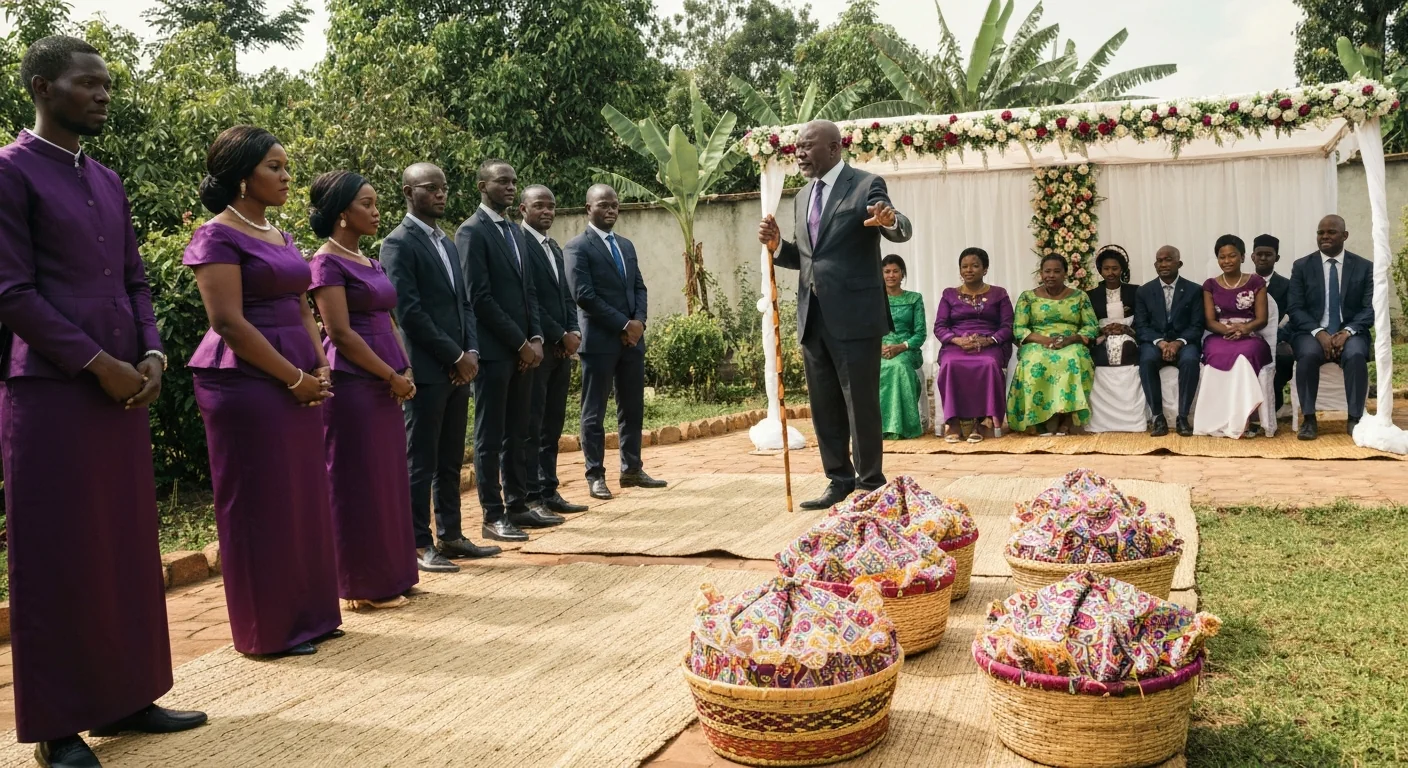
The groom’s delegation arrives and is stopped at the gate of the bride’s family compound. They do not enter freely. The bride’s family sends a gatekeeper (often young men or the ssenga’s representatives) to ask who the visitors are and what they want.
The spokesman responds formally, explaining that they have come in peace and with purpose. There is often a gate fee (ensimbi z’omulyango) — a negotiated cash payment that the groom’s side must pay before being allowed to enter. This can range from UGX 100,000 to UGX 500,000 or more.
Step 2: Seating and Welcome
Once admitted, the groom’s delegation is seated in a designated area, usually on one side of the tent or gathering space. The bride’s family sits on the opposite side. The arrangement is formal and deliberate — the two families face each other.
The bride’s family formally welcomes the visitors. Drinks and sometimes light refreshments are served.
Step 3: Formal Introductions
The groom’s spokesman rises and formally introduces the delegation. Each member of the groom’s side is introduced by name, relationship, and clan. The bride’s side reciprocates.
This exchange establishes the identity of both families and confirms that the correct clans are represented.
Step 4: Statement of Intent
The spokesman formally states why the delegation has come: they have seen a flower (the bride) in this home, and they wish to take her to their home. The language is poetic, formal, and steeped in cultural metaphor.
The bride’s father (or senior male) responds — sometimes with questions, sometimes with humour, sometimes with a period of deliberation. This exchange can be brief or extended, depending on the family’s style.
Step 5: Presentation of Gifts
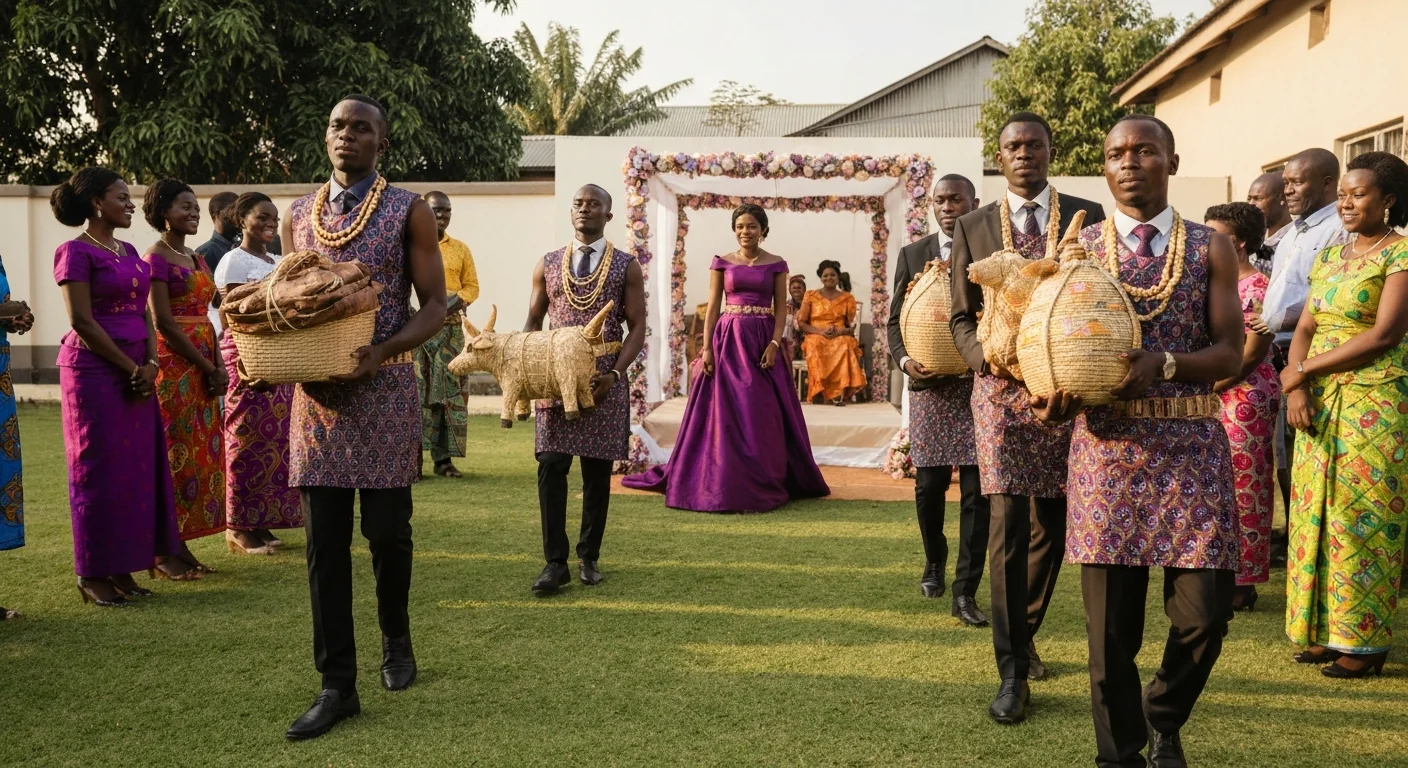
This is the centrepiece of the kwanjula. The groom’s delegation presents the gifts that the bride’s family has requested. Items are brought forward in stages and categories:
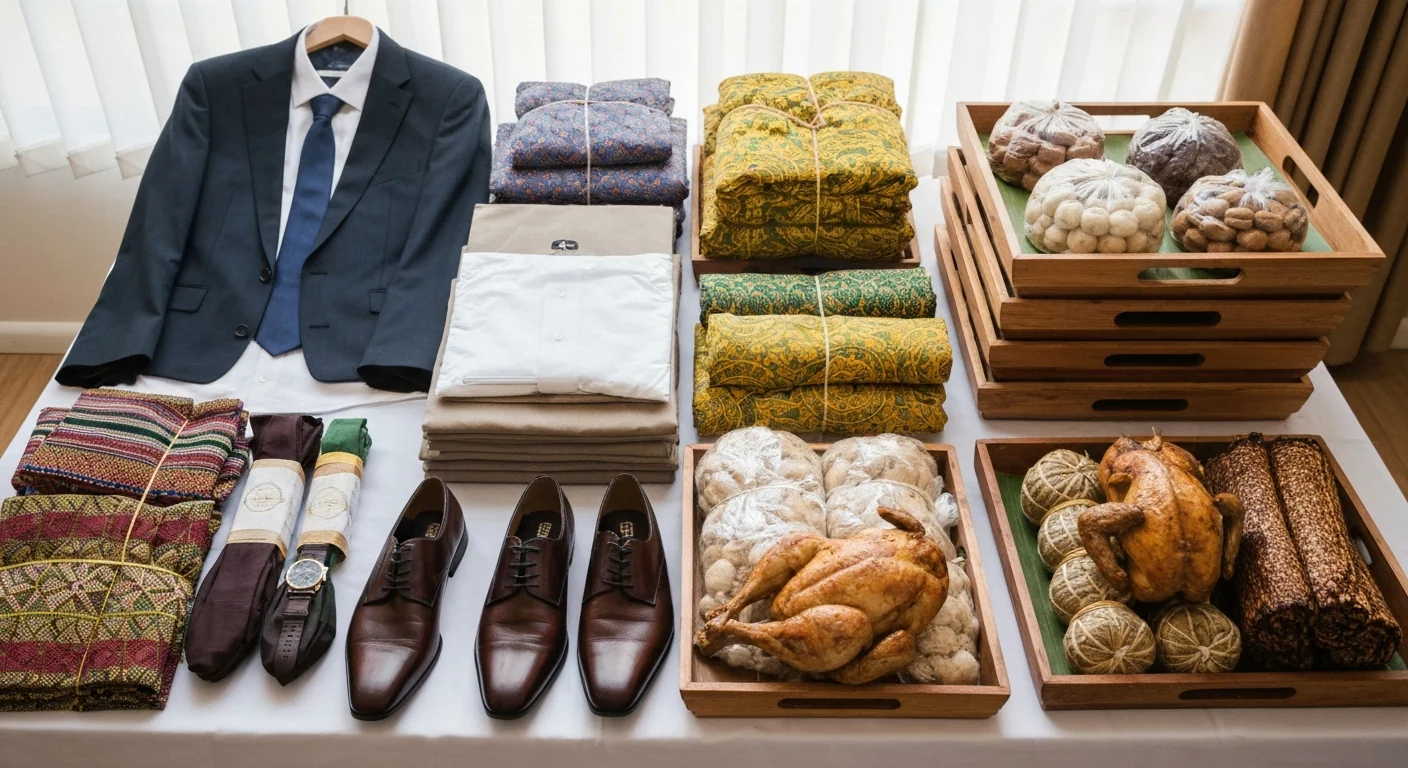
- Gifts for the father (envelopes, kanzu, suit, shoes, items as requested)
- Gifts for the mother (gomesi, shoes, handbag, kitchenware, items as requested)
- Gifts for the ssenga (gomesi, shoes, envelope)
- Gifts for the aunts and uncles (gomesi, kanzu, envelopes)
- General family gifts (foodstuffs — coffee, sugar, salt, rice, drinks, meat)
- The bride price (omutwalo) — the cash component
Each item is presented publicly, inspected, and acknowledged. If an item is missing or deemed inadequate, the bride’s family will say so — publicly. This is not meant to humiliate but to maintain standards. A well-prepared groom’s family has everything on the list and then some.
Step 6: Identification of the Bride (Okulaba Omuwala)
This is the most entertaining and emotionally charged moment of the kwanjula. The ssenga presents a group of women — usually the bride’s sisters, cousins, and friends — all dressed identically in matching gomesi. The groom must identify his bride from among them.
If the groom picks the wrong woman (which happens for comedy purposes — the women deliberately try to confuse him), there is a penalty, usually a cash payment. The crowd roars with laughter. When he finally identifies the correct woman, the celebration erupts.
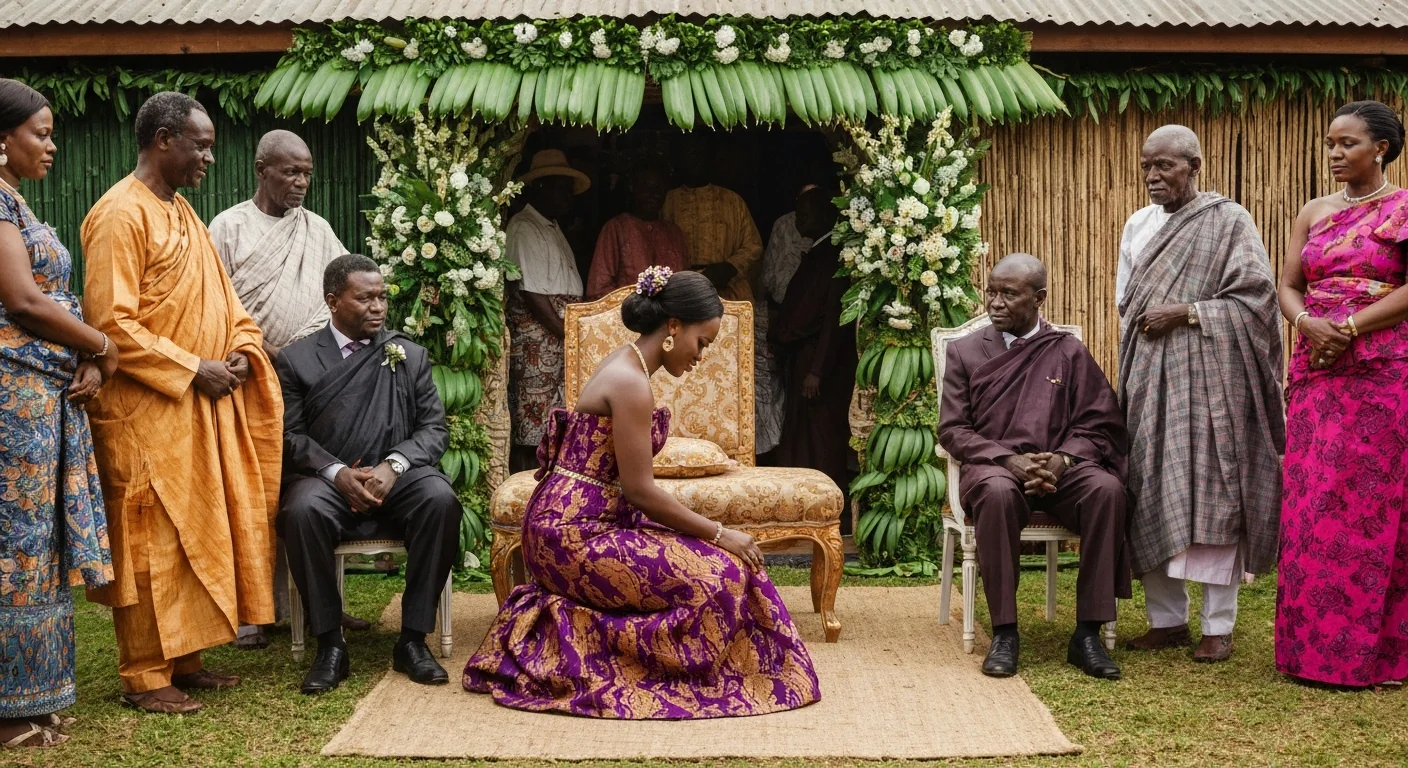
After identification, the bride kneels before her father, who gives his blessing. This is often the most emotional moment of the day.
Step 7: The Bride’s Consent
The bride is asked directly whether she accepts the groom and his family. Her consent is essential — the ceremony cannot proceed without it. In traditional Buganda, the bride was expected to show hesitation before accepting (a sign of modesty), but in modern ceremonies, the bride’s enthusiastic “yes” is met with cheering.
Step 8: Speeches and Blessings
Elders from both families offer speeches, advice, and blessings. The bride’s father formally gives his permission. The ssenga gives final advice to the couple. Religious leaders may offer prayers.
Step 9: Celebration
The formal portion of the ceremony gives way to celebration — music, dancing, food, and socialising. Traditional Kiganda music, including the kadongo kamu guitar style, is commonly played alongside modern music.
Kwanjula Costs in 2026
The kwanjula is not a minor expense. Here is a realistic 2026 cost breakdown for a Buganda kwanjula:
| Category | Budget Range (UGX) |
|---|---|
| Gifts for bride’s parents (envelopes, attire, accessories) | 1,000,000 – 5,000,000 |
| Gifts for ssenga and aunts | 500,000 – 2,000,000 |
| Bride price (omutwalo) | 500,000 – 5,000,000+ |
| Gate fee (ensimbi z’omulyango) | 100,000 – 500,000 |
| Foodstuffs and drinks (coffee, sugar, rice, meat, beverages) | 500,000 – 2,000,000 |
| Gomesi for bride’s side (contribution) | 500,000 – 2,000,000 |
| Attire for groom and delegation (kanzu, jackets) | 500,000 – 3,000,000 |
| Transport for delegation | 200,000 – 1,000,000 |
| Spokesman fee | 200,000 – 1,000,000 |
| Photography and videography | 300,000 – 1,500,000 |
| Miscellaneous and contingency | 200,000 – 1,000,000 |
| Total | 4,500,000 – 24,000,000+ |
The range is enormous because family expectations vary dramatically. Some families are modest and practical; others treat the kwanjula as a statement of wealth and status. The bride’s family sets the requirements, and the groom’s family must meet them.
For the detailed shopping list with individual item prices, see our kwanjula shopping list with prices.
Modern Adaptations
The kwanjula has evolved significantly in recent decades, particularly among urban Kampala couples. Here are the most common modern adaptations:
Hired venues instead of the family home. Many families now hold the kwanjula at a garden venue, hotel, or event space rather than the family home, especially if the family is based in Kampala and the ancestral home is upcountry. This adds venue hire costs (UGX 500,000 – 3,000,000) but simplifies logistics.
Combined introduction and send-off. Some families combine the kwanjula with the give-away (okugabiriza) to reduce the number of separate events. This is increasingly accepted but not universal.
Digital coordination. WhatsApp groups for both families are now standard for planning. The shopping list often arrives as a shared document rather than a handwritten note.
Professional event management. Decorators, caterers, and event planners now regularly service kwanjula events, bringing the same level of polish as a reception.
Photography and videography. Professional documentation of the kwanjula is now expected — most couples want the same quality of coverage as their church wedding.
Cash equivalents for traditional items. Where certain traditional items are hard to source in urban areas, cash equivalents are often accepted. However, this must be explicitly agreed upon — do not assume.
Common Mistakes to Avoid
1. Not getting the list early enough. The bride’s family’s requirements list is your master document. Get it as early as possible — ideally 3 months before the ceremony. Last-minute shopping leads to overpaying and missing items.
2. Choosing a weak spokesman. The spokesman makes or breaks the ceremony. If he stumbles, gets confused, or cannot handle the bride’s family’s testing, the groom’s side is embarrassed. Invest in a good spokesman.
3. Insufficient quantities. If the list says 10 kilograms of sugar, do not bring 8. If it says a crate of soda, do not bring half a crate. Meeting the minimum is the absolute floor — exceeding it slightly shows generosity.
4. Wrong attire. Showing up in a suit instead of a kanzu, or wearing a gomesi that is too casual, shows disrespect for the tradition. Follow the dress code precisely.
5. Underestimating the emotional weight. The kwanjula is not a transaction. It is a deeply emotional event for both families — especially the bride’s parents, who are formally releasing their daughter. Approach it with genuine respect and humility, not just as a checklist to complete.
6. Not rehearsing. The groom’s delegation should rehearse the ceremony flow, the gift presentation order, and the identification process. Walking in unprepared is obvious and uncomfortable.
7. Ignoring transport logistics. If the kwanjula is upcountry (outside Kampala), the groom’s delegation may need to travel 2–6 hours. Plan transport for the entire delegation, budget for fuel, and leave early enough to arrive on time. Arriving late is disrespectful.
Kwanjula Etiquette: The Unwritten Rules
- The groom kneels when presenting himself. Kneeling is a sign of respect in Buganda culture. The groom kneels when greeting the bride’s parents and at key moments during the ceremony.
- Do not haggle aggressively. The gift negotiation is a cultural exchange, not a marketplace bargain. The spokesman can negotiate respectfully, but being stingy or combative is a serious offence.
- Bring more than asked. Exceeding the requirements (even slightly) demonstrates generosity and earns the groom’s family lasting goodwill.
- Respect the ssenga’s authority. The ssenga runs the ceremony on the bride’s side. Do not challenge or undermine her.
- No alcohol before or during the formal proceedings. The celebration comes after. Showing up tipsy is one of the most disrespectful things a groom or his delegation can do.
- Phone etiquette. During the formal proceedings, phones should be on silent. The only people taking photos should be the designated photographer.
Kwanjula for Non-Ugandans
If you are a foreigner marrying a Ugandan, the kwanjula is not optional — it is expected and important. Here is how to approach it:
- Learn the basics of the language. You do not need to be fluent, but knowing how to greet elders in Luganda (or the relevant language) goes a long way.
- Hire an experienced spokesman. This is even more critical when the groom is not Ugandan. The spokesman bridges the cultural gap.
- Ask questions respectfully. The bride’s family will generally be understanding and accommodating — but only if you show genuine effort and respect.
- Do not try to modernise the ceremony. The kwanjula follows a format that has worked for centuries. Respect it fully.
- Budget generously. Showing financial commitment is one of the clearest ways to demonstrate seriousness.
The kwanjula is one of the most beautiful cultural ceremonies in East Africa. It is colourful, emotional, deeply structured, and profoundly meaningful. Couples who invest the time to understand and plan it properly find that it becomes one of the most memorable days of their lives — often more meaningful than the church wedding itself.
Planning Your Kwanjula?
Track your kwanjula shopping list, manage your budget across all wedding events, and coordinate with your partner and families — all in one place on Harusi Hub.
Start Planning on Harusi Hub