Nigerian Wedding Traditions: Yoruba, Igbo & Hausa Ceremonies
A comprehensive guide to Nigerian wedding traditions — from Yoruba engagement lists and the alaga ceremony to Igbo wine-carrying and Hausa Kamu rituals. Everything you need to know about three-ceremony Nigerian weddings, aso-ebi, money spraying, and how traditions are evolving in the diaspora.
Nigerian Wedding Traditions: Yoruba, Igbo & Hausa Ceremonies
Nigerian weddings are not a single event. They are a series of ceremonies, each with its own language of ritual, dress, and meaning — and they are among the most joyful, visually spectacular, and culturally rich celebrations anywhere in the world. This guide takes you through the three major traditions — Yoruba, Igbo, and Hausa — and the customs that unite them all.
Nigeria is a country of extraordinary cultural depth. With over 250 ethnic groups and more than 500 languages spoken within its borders, it is less a single culture than a continent of cultures gathered under one flag. Nowhere is that richness more visible than in the country’s weddings.
The three dominant ethnic groups — Yoruba (concentrated in the Southwest), Igbo (Southeast), and Hausa-Fulani (North) — each have wedding traditions that are entirely distinct. The attire is different, the rituals are different, the music is different, the order of events is different. Yet all three share a common understanding: marriage is not the union of two individuals. It is the union of two families, and it deserves to be celebrated accordingly.
If you are Nigerian, marrying into a Nigerian family, or planning a celebration that draws from these traditions, this guide is for you. If you are simply curious about one of Africa’s most vibrant wedding cultures, welcome — you are in for something extraordinary.
The Three-Ceremony Structure
Most Nigerian couples — regardless of ethnic background — observe three distinct ceremonies before they are fully, officially, and culturally married. Understanding this structure is essential to understanding Nigerian weddings.
1. The Traditional Wedding
This is the cultural heart of the marriage. It is the ceremony conducted according to the specific rites of the couple’s ethnic group — the engagement list presentation, the bride price negotiation, the rituals unique to Yoruba, Igbo, or Hausa tradition. The traditional wedding is where the families formally meet, gifts are exchanged, and the union is recognised within the community. It is usually the most colourful, the most elaborate in costume, and the most emotionally significant for the families involved.
2. The Religious Ceremony
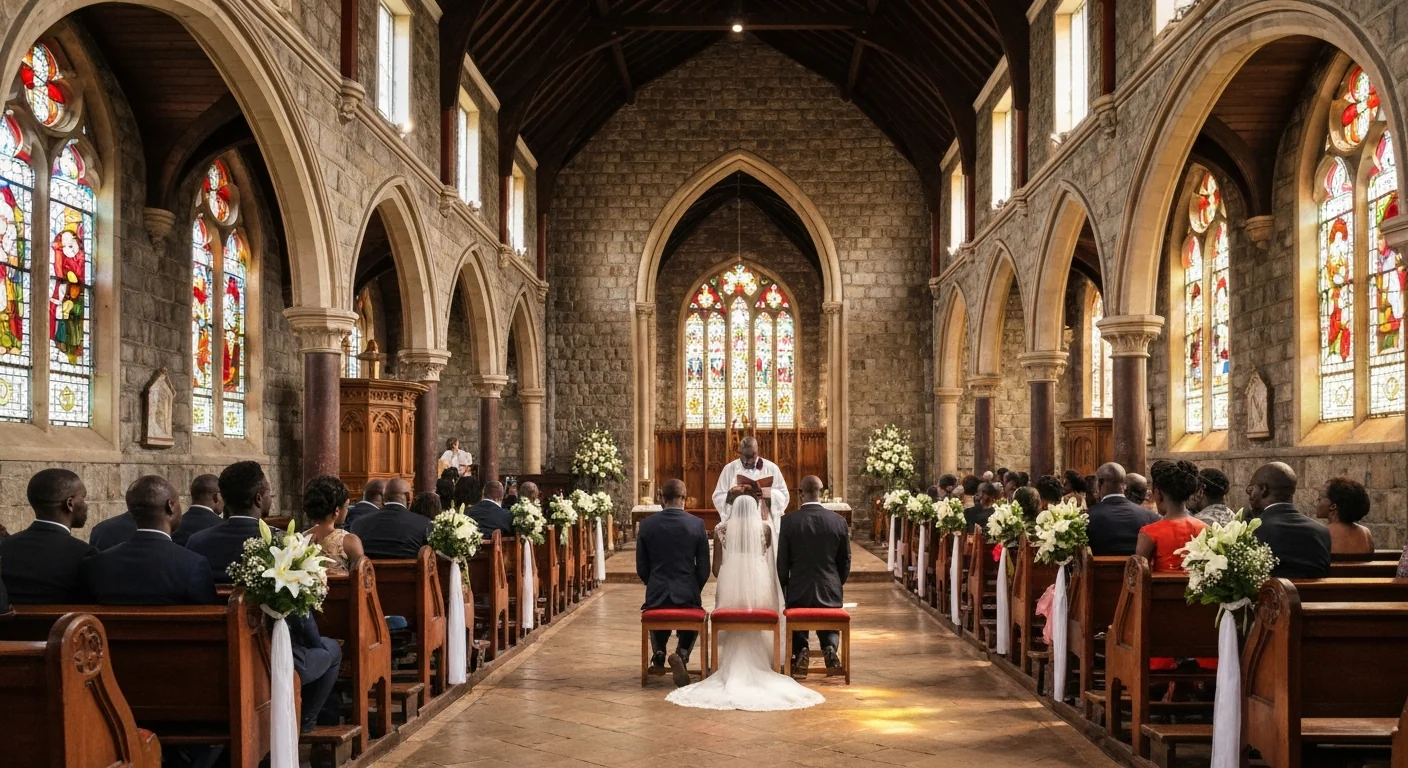
For the vast majority of Nigerians, faith is central to identity. Christian Nigerians — who make up roughly half the population — typically have a church wedding (Anglican, Catholic, or Pentecostal), complete with vows, prayers, and a choir. Muslim Nigerians solemnise their marriage through a Nikkah (or Fatihah) conducted by an imam. This ceremony carries deep spiritual weight and, for many families, is the moment the couple is considered truly joined before God.
3. The White Wedding / Reception
The white wedding is the international reception — the couple in Western wedding attire (white gown, suit), dancing, elaborate food, and the spectacular, joyous party that Nigerian receptions are famous for worldwide. The white wedding typically takes place after the religious ceremony and may be held on the same day or a different weekend. It is the social statement: the celebration of the couple by their wider community, friends, colleagues, and the entire social network of both families.
Why all three? Because each one serves a different function. The traditional wedding satisfies culture and ancestry. The religious ceremony satisfies faith and spirituality. The white wedding satisfies community and celebration. To most Nigerian families, skipping any one of these is not merely unconventional — it is incomplete.
For couples managing all three events across different venues and weekends, keeping track of RSVPs, vendors, and timelines across ceremonies is one of the biggest logistical challenges of Nigerian wedding planning. A multi-event planning tool can make the difference between smooth coordination and chaos.
Yoruba Wedding Traditions
The Yoruba people of southwestern Nigeria — including the states of Lagos, Ogun, Oyo, Osun, Ondo, and Ekiti — have one of the most elaborate and theatrically rich wedding traditions in the world. A Yoruba traditional wedding (called the engagement ceremony or igbeyawo) is equal parts ritual, performance, comedy, and celebration. Every element is intentional, steeped in meaning, and delivered with unmistakable energy.
The Eru Iyawo: What the Groom’s Family Must Bring
Before the ceremony can begin, the groom’s family must fulfil the eru iyawo — the engagement list. This is a detailed inventory of items that the bride’s family requires as part of the formal marriage proposal. The list varies by family, region, and social standing, but typically includes:
- Clothing and fabric: Aso-oke cloth, lace, and other quality fabrics for the bride and key members of her family
- Jewellery: Gold earrings, necklaces, and bangles
- Food items: Palm wine, orogbo (bitter kola), obi (kola nut), atare (alligator pepper), honey
- Practical goods: Luggage sets, handbags, shoes, kitchen items
- Cash contributions: Often a specified amount toward the bride price
- Bible or Quran: Depending on the family’s faith
The eru iyawo is presented publicly, often displayed on decorated tables for both families to see. It is inspected by the bride’s family representatives, and its acceptance signals that negotiations have been successful. The presentation of the list is not just a transaction — it is a theatrical event in itself, with the alaga (MC) commentating, the crowd responding, and the groom’s family performing with proud ceremony.
The Alagas: The Two Female MCs Who Run the Show
Perhaps the most distinctive feature of a Yoruba traditional wedding is the alaga system — two female master-of-ceremonies who co-host the event on behalf of each family. The alaga is not merely an announcer. She is a cultural authority, a comedian, a praise-singer, a negotiator, and a performance artist all at once.
Alaga Iduro (the Standing Alaga) represents the groom’s family. Her title, “iduro,” means “standing” — she stands throughout proceedings on behalf of the groom’s side, advocating for them, announcing their gifts, and guiding them through the rituals they must perform.
Alaga Ijoko (the Sitting Alaga) represents the bride’s family. Her title, “ijoko,” means “sitting” — she sits with the bride’s family, defending their interests, evaluating the groom’s performance, and passing judgement on whether the groom’s family has done enough at each stage.
The interplay between the two alagas is one of the great pleasures of a Yoruba wedding. They trade banter, challenge each other, laugh at the groom’s family’s attempts to satisfy the bride’s family’s demands, and keep the energy of the room electric throughout. A good alaga is a gift. A great alaga turns a wedding into a memory no one ever forgets.
The alagas lead the entire ceremony: announcing each stage, directing the groom’s family through the required prostrations, interpreting events for guests, and ensuring that every tradition is properly observed.
Dobale: The Prostration of Respect
When the groom and his family formally enter the ceremony and present themselves to the bride’s family, they do not simply walk in and sit down. The groom and the male members of his delegation perform dobale — a full prostration on the floor as a sign of respect to the bride’s family.
For a Yoruba man, prostrating (lying flat or kneeling low) before elders is the deepest gesture of respect in the culture. By performing dobale before his future in-laws, the groom signals that he enters this marriage with humility, that he acknowledges the honour the bride’s family is giving him, and that he will respect his new family.
The alaga iduro often accompanies the prostration with praise — celebrating the groom’s family for their correctness in observing tradition. The alaga ijoko, meanwhile, evaluates the performance with theatrical scrutiny, sometimes demanding the prostration be held longer or repeated before declaring herself satisfied.
The Tasting of the Four Elements
One of the most powerful rituals of the Yoruba traditional wedding is the tasting of four elements — a ceremony in which the couple is invited to meditate on the full emotional range of married life before they commit to it. The bride and groom each taste four distinct flavours:
- Lemon or lime: Representing sourness — the hard times, the disagreements, the difficult seasons every marriage will face
- Vinegar: Representing bitterness — the moments of hurt, disappointment, or pain that will inevitably arise
- Cayenne pepper: Representing heat and passion — the fire, the intensity, the desire that keeps a marriage alive
- Honey: Representing sweetness — the joy, the tenderness, the love that underpins everything
By tasting all four together, the couple is not simply performing a ritual. They are making a conscious acknowledgment: marriage is all of these things, and they enter it with eyes open. It is, in its own way, a more honest statement about marriage than any vow — a recognition that love is not just honey, but also the sour, the bitter, and the heat that makes life interesting.
The Letter Reading
The ijoko ceremony involves the formal reading of the bride’s acceptance of the marriage. The bride, typically dressed in exquisite traditional attire and often flanked by her female friends, listens as a letter is read on her behalf — a formal declaration of her willingness to marry the groom. The letter is often poetic, sometimes humorous, and ends with the bride’s symbolic acceptance, often marked by her being led toward the groom by her father or an elder.
Aso-Ebi: Matching Fabrics as Identity
At every Yoruba traditional wedding, the families announce their allegiances through fabric. The bride’s family selects one colour and material; the groom’s family selects another. Everyone attending on each side is expected to appear in their family’s aso-ebi. The visual effect — a sea of coordinated colour on one side, a different coordinated colour on the other — is one of the defining images of a Nigerian wedding. (We’ll go deeper on aso-ebi below.)
The Gele and Aso-Oke
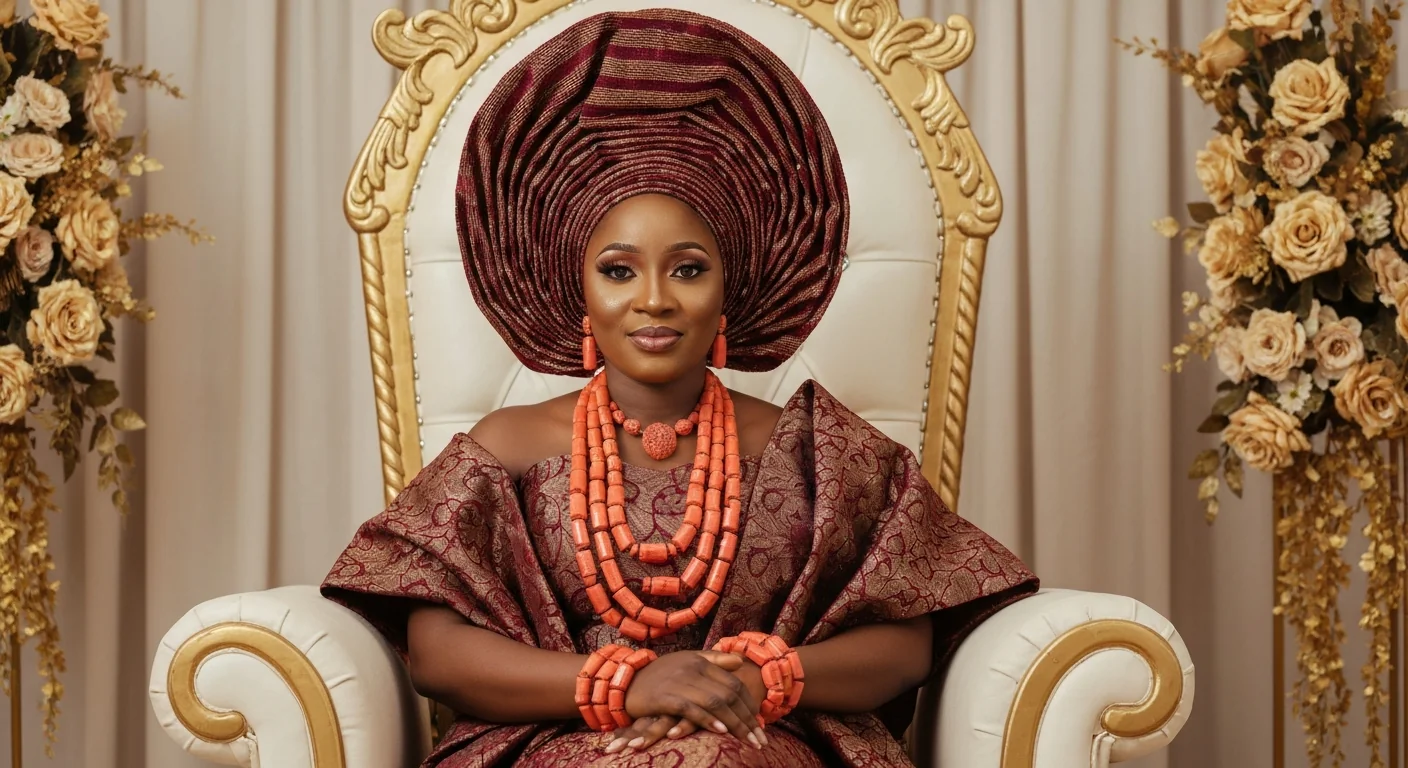
The signature attire of a Yoruba bride is built around two elements. The gele is the hand-tied headwrap — an architectural feat in fabric, tied from strips of stiff material into shapes that range from elegant swoops to dramatic crowns. Tying a gele is a skill; the best gele-tiers are hired specifically for weddings. The aso-oke is the handwoven prestige cloth — typically in rich colours of teal, burgundy, gold, or deep purple — used for the bride’s and groom’s outfits and for key items like the ipele (shoulder sash). Together, the gele and aso-oke make the Yoruba bridal look one of the most recognised and admired in African fashion.
Money Spraying
At the reception, when the couple takes to the dance floor, the crowd rises to spray money. Guests approach the couple, hold up crisp naira notes, and rain them down — onto the couple’s heads, their shoulders, the floor around them. The spraying is an act of blessing, of generosity, of public celebration. We’ll cover the full tradition of money spraying in its own section below.
Igbo Wedding Traditions
The Igbo people of southeastern Nigeria — in Anambra, Imo, Enugu, Ebonyi, and Abia states — approach marriage with a combination of solemnity, community participation, and unmistakable festivity. The Igbo traditional wedding, centred on the Igba Nkwu (wine-carrying ceremony), is one of the most distinctive and moving wedding rituals on the African continent.
Iku Aka: The Formal Inquiry Visit
The Igbo marriage process begins long before any ceremony. The first formal step is Iku Aka — literally, “knocking on the door.” The groom and a small delegation of his family visit the bride’s family to formally announce his intentions. This is not a casual visit; it is a structured protocol.
The groom’s family presents kola nuts, palm wine, and sometimes schnapps (a customary offering in many Igbo ritual settings). The bride’s family receives them, deliberates privately, and sends back their response. If the answer is favourable, the families proceed to the next stage: a more formal meeting involving extended family (Umunna) on both sides, where the groom’s character, family background, and suitability are discussed at greater length.
The Iku Aka and subsequent meetings can unfold over weeks or months. They are not mere formality — they are due diligence, cultural due process, and the beginning of a relationship between two family lines that will persist long after the wedding day.
Bride Price Negotiation
Following the formal acceptance, the two families negotiate the bride price (ime ego). Unlike some other traditions, Igbo bride price negotiation is conducted openly between family representatives, sometimes with considerable good-humoured bargaining. The bride price is not purely transactional — in Igbo understanding, it is a demonstration of the groom’s seriousness, a form of gratitude to the bride’s family, and a symbolic recognition of the bride’s value to her family.
The agreed bride price, along with a list of customary gifts (which may include livestock, food items, drinks, and specific items requested by the bride’s family), is presented at the traditional ceremony.
Igba Nkwu Nwanyi: The Wine-Carrying Ceremony
The climax of the Igbo traditional wedding is Igba Nkwu Nwanyi — “the wine-carrying of a woman.” It is also sometimes called the palm wine ceremony, and it is simultaneously the most beautiful, the most suspenseful, and the most beloved moment of the entire event.
Here is how it works: the bride is given a cup of palm wine. She must carry it through the assembled guests — who may number in the hundreds — and find her groom, who has hidden himself among the crowd. When she finds him, she kneels before him and offers him the cup. He drinks. In that act, she has publicly chosen him, and he has publicly accepted her. Their union is confirmed.
The theatre of this moment is extraordinary. The crowd watches as the bride navigates the room, leaning into faces, being misdirected by mischievous guests. The groom may be disguised by his friends, tucked among strangers, or standing in plain sight where no one expects him. When the bride finally finds him — and the moment she kneels and he drinks — the room erupts.
It is worth understanding what this ritual communicates: the bride’s journey with the palm wine is an active, public act of choosing. The Igba Nkwu is not a ceremony in which the bride is received passively. She is the one who seeks, who finds, who offers. It is her declaration.
The Kola Nut: Blessing and Hospitality
Throughout the Igbo traditional wedding, the kola nut (ọjị) plays a central ceremonial role. The kola nut is the sacred symbol of Igbo hospitality and blessing. At the beginning of proceedings, an elder breaks the kola nut while praying for the couple, the families, and all gathered guests. The broken pieces are shared among the elders present. Without this blessing, nothing proceeds.
Palm wine is similarly central — offered at multiple points in the ceremony as an act of welcome, honour, and ritual completion.
The Male MC
Unlike the Yoruba tradition with its two female alagas, Igbo traditional weddings are typically MC’d by a male host who moderates the proceedings, announces each stage, directs the groom’s family through their presentations, and keeps the ceremony on track. His role is more managerial than theatrical — though the best Igbo MCs bring plenty of personality to the role.
Hausa Wedding Traditions
In the predominantly Muslim north of Nigeria, the Hausa-Fulani wedding traditions are deeply shaped by Islamic practice. The ceremonies are more private, more gender-separated, and more spiritually austere than their Yoruba or Igbo counterparts — but they are no less rich in meaning, ritual, and beauty.
The Proposal: Kola Nuts and Sweets
The first formal step in a Hausa marriage is the groom’s family visiting the bride’s family to express his intention. They come bearing gifts of kola nuts and sweets — a traditional offering that signals the seriousness of the proposal and invites the bride’s family’s consideration. The bride’s family deliberates, often consulting religious leaders and extended family, before formally accepting.
Fatihah: The Islamic Marriage Vow
The legal and religious heart of the Hausa wedding is the Fatihah — the Nikkah ceremony conducted according to Islamic rites. Traditionally, the Fatihah took place at the mosque after Friday prayers (Jumu’ah), attended only by men: the groom, his father, witnesses, and male members of the community. The imam recites verses from the Quran, the mahr (dower — a gift from the groom to the bride, required under Islamic law) is confirmed, and the marriage is solemnised in the presence of witnesses.
The bride does not typically attend the Fatihah. She gives her consent separately, through her wali (guardian, usually her father) who represents her interests in the ceremony. In more contemporary practice, some families have adapted to allow women to be present in a separate section, though the fully gender-separated format remains common.
Kunshi: The Female Bridal Preparation
While the men are at the Fatihah, the women are gathered for kunshi — a female-only celebration that functions as the Hausa equivalent of a bridal shower. Friends, aunties, older women of the family, and age-mates of the bride gather to prepare her: singing traditional songs, applying henna, offering blessings and advice, and celebrating her last hours as a single woman.
Kunshi is intimate, warm, and community-rooted. It is one of the spaces where Hausa wedding culture is most vividly expressed — away from public ceremony, in the circle of women who will form the bride’s support network throughout her marriage.
Kamu: The Catching of the Bride
Kamu (or Kamun Amarya, meaning “catching the bride”) is one of the most distinctive and joyful events in the Hausa wedding sequence. In this ritual, the bride is playfully “captured” by the groom’s female relatives — aunties and older women from his family who have come to receive her. The bride’s own female relatives and friends attempt to “protect” her, leading to a lively, theatrical tug-of-love.
The Kamu symbolises the transition of the bride from her birth family to her new family. It is celebratory rather than solemn — full of laughter, song, and affectionate performance. After the Kamu, the bride is formally received by the groom’s family.
Kayan Lefe: The Bridal Trousseau
One of the most generous and visually impressive aspects of the Hausa wedding is the Kayan Lefe — the bridal trousseau provided by the groom’s family. Unlike many bridewealth traditions where gifts go to the bride’s family, the Kayan Lefe is specifically for the bride herself, intended to set her up for her new life.
The Kayan Lefe is assembled by the groom’s female relatives — his aunties, sisters, and mother — and can include:
- Clothing, fabrics, and accessories (shoes, bags, jewellery)
- Cosmetics and beauty items
- Bedding, pillows, and household linens
- Kitchen equipment and cookware
- Furniture for the couple’s new home
The Kayan Lefe is transported to the bride’s family home before the wedding, often in a procession that serves as a public display of the groom’s family’s generosity and commitment. The more elaborate the Kayan Lefe, the more honour it brings to the groom’s family.
The tradition communicates something important: the groom’s family is not only taking a daughter — they are caring for her, providing for her, ensuring she enters her new home as a woman of standing and comfort.
Aso-Ebi Culture: The Outfit That Tells a Story
Across all three Nigerian wedding traditions — and indeed across Nigerian culture more broadly — aso-ebi is the unifying visual language of solidarity and belonging. To understand aso-ebi is to understand something essential about how Nigerians relate to each other at celebrations.
What Aso-Ebi Means
Aso means “cloth” and ebi means “family” in Yoruba. Aso-ebi, literally “family cloth,” refers to a shared fabric worn by a group of people at a celebration to signal their unity and their relationship to the celebrants. It originated among the Yoruba but has long since spread to Igbo, Hausa, and other Nigerian communities — and indeed to much of West Africa.
At a typical Nigerian wedding, the bride’s family selects one fabric (a specific colour and pattern of lace, ankara, or aso-oke). The groom’s family selects a different fabric. Close friends may be assigned their own aso-ebi. Each group that wears the fabric is making a public statement: I am on this side. I belong here. I am celebrating these people.
The History
Aso-ebi has roots going back to Yoruba age-grade associations, where members would dress in matching outfits to demonstrate their fraternal bond. It gained wider social traction in the 1920s during Nigeria’s post-World War I economic boom, when the ability to buy and distribute matching fabric became a mark of prosperity. By the 1950s, women’s organisations (egbes) were routinely attending ceremonies in matching dress, and aso-ebi had become a cornerstone of Nigerian social life.
The Economics and Etiquette
In modern Nigerian weddings, aso-ebi is a significant economic undertaking. The couple’s family buys the fabric wholesale and sells pieces to guests who wish to participate — at a price that typically reflects the prestige of the fabric and sometimes contributes to wedding costs. Guests who choose to buy aso-ebi are making a financial gesture of support as well as a social one.
The costs can be substantial. High-end lace or imported aso-oke can cost tens of thousands of naira per yard, and guests may need several yards. For large Nigerian weddings with multiple aso-ebi groups across both families, the coordinated visual effect is spectacular — but it requires real financial commitment from everyone involved.
The Social Pressure
Aso-ebi is not without its complications. Those who cannot afford the fabric may feel excluded. In some settings, access to food, souvenirs, or prime seating is informally tied to whether a guest is wearing aso-ebi. This has drawn criticism from commentators who argue that the tradition, while beautiful in origin, has in some circles become a mechanism for social sorting.
Modern Aso-Ebi
Contemporary Nigerian weddings have evolved aso-ebi in exciting directions. Ankara (the bold, block-printed cotton fabric beloved across West Africa) is increasingly used alongside or instead of traditional lace. Brides often assign different aso-ebi to different friend groups. The rise of Instagram has made aso-ebi a fashion event — couples hire stylists to curate cohesive looks, and the best-dressed aso-ebi groups regularly go viral. In diaspora weddings, aso-ebi has become a way for Nigerian communities abroad to assert cultural identity at celebrations held in London, Houston, Toronto, or Johannesburg.
Money Spraying: The Nigerian Reception Tradition
If there is one image that defines the Nigerian wedding reception for the outside world, it is this: a couple dancing, and a crowd pressing forward to hold up crisp banknotes and rain them down. Money spraying is Nigerian, it is joyful, and it is one of the most misunderstood traditions in African wedding culture.
Origins
Money spraying is believed to have originated among the Yoruba in the early 20th century, emerging after paper currency was introduced to Nigeria. The practice grew from the tradition of “spraying” praise-singers and musicians with money during performances — a gesture that said: your artistry is worth rewarding, and I want everyone to see that I appreciate you.
During Nigeria’s oil boom of the 1960s and 1970s, the practice transformed. Prosperity made display possible, and money spraying at weddings became a way to publicly demonstrate wealth, generosity, and the scale of the couple’s social standing. The more guests pressed forward to spray money, the greater the honour conferred on the couple.
How It Works
At the reception, when the couple takes to the dance floor — particularly for the first dance, the couple’s special dance, or when a popular song plays — guests approach to spray money. Banknotes are held up, placed on the couple’s forehead, pressed against their arms, or literally thrown into the air to flutter down around them. Designated assistants (often young relatives) follow close behind, collecting the bills from the floor.
The spraying is participatory and spontaneous. There is no fixed moment — though certain songs and dances traditionally invite it. The MC may announce that “spraying is now open.” The couple’s close friends and family typically initiate, and others follow. At large Nigerian receptions, the total amount sprayed can be substantial.
What It Means
Money spraying is not charity. It is blessing. It is the community saying collectively: we see you, we celebrate you, we want your life to be abundant. The physical act of throwing money — of giving it freely, publicly, and joyfully — communicates generosity in the most visible way possible.
For the couple, the money collected goes toward practical beginnings: honeymoon costs, household setup, or savings. But the meaning transcends the financial. It is a communal investment in the couple’s future, performed with dance and joy rather than in an envelope.
Modern Variations and Controversy
In recent years, money spraying has evolved. Some couples now use dollar, pound, or euro notes at diaspora weddings — giving the tradition a cosmopolitan sheen. QR codes and mobile payment prompts have appeared at some ultra-modern receptions for guests who do not carry cash.
The Nigerian government has periodically attempted to regulate or restrict money spraying, citing concerns about defacement of currency. But the tradition has proven remarkably resilient — it is too deeply embedded in Nigerian social culture to be easily legislated away.
Modern Nigerian Weddings: How Traditions Are Evolving
Nigerian wedding traditions are not static. They are living, breathing practices that adapt to migration, technology, economics, and generational change — while maintaining a remarkable fidelity to their essential meanings.
The Diaspora Effect
Millions of Nigerians live and celebrate outside Nigeria — in the United Kingdom, the United States, Canada, and across Europe. For these communities, the traditional wedding takes on additional significance: it is not just a cultural rite, it is an act of cultural preservation, a way of staying connected to an identity that geography has made distant.
Diaspora Nigerian weddings often compress all three ceremonies into a single weekend (or even a single day), making the logistics more challenging but also more concentrated in their emotional power. A planning checklist that breaks the preparation into phases — from engagement list preparation to reception vendor bookings — helps couples stay on track when multiple ceremonies are unfolding in rapid succession. Traditional attire is sourced from Nigeria, alaga women fly in specifically for the ceremony, and Yoruba or Igbo MCs manage events in languages that many of the younger guests understand imperfectly but feel deeply.
The result is often a wedding that is more consciously curated than its homeland counterpart — and, if anything, more insistent on tradition precisely because tradition must be actively maintained rather than simply inherited.
Social Media and the “Wedding Industrial Complex”
Nigerian weddings have been transformed by Instagram, TikTok, and YouTube. What was once a community event is now also a content production. Couples hire multiple photographers, videographers, and dedicated “Instagram photographers” whose job is to capture real-time content for social media. The aso-ebi groups are colour-coordinated not just for family harmony but for visual impact on a grid. The groom’s entrance, the bride’s reveal, the money-spraying — all are choreographed with an awareness that millions of people may eventually watch.
Platforms like BellaNaija Weddings have made certain Nigerian weddings genuinely viral events, and the pressure to “perform” a wedding that looks as good online as it feels in person is real. This has driven up costs significantly — professional wedding photography alone at a Lagos A-list wedding can run into several million naira.
Cost Inflation
The visibility of high-end Nigerian weddings on social media has had a democratising effect on aspiration and an inflating effect on expectations. The combination of elaborate aso-ebi, three ceremonies across multiple venues, professional videography, live bands, celebrity MC appearances, and catering for hundreds of guests makes a full Nigerian wedding one of the more expensive propositions in African wedding culture.
Families are increasingly finding creative ways to manage costs — simplifying the eru iyawo list, holding the traditional and religious ceremonies on the same day, or moving the white wedding to a more intimate setting. A wedding budget tracker that lets you allocate and monitor spending across multiple ceremonies can help couples see exactly where the money is going and where savings are possible. The underlying principle, though, remains unchanged: however it is done, it must be done with dignity, joy, and family.
Fusion and Interethnic Weddings
As Nigeria urbanises and young Nigerians increasingly marry across ethnic lines, fusion weddings are becoming more common. A Yoruba-Igbo wedding might feature both the alaga system and the Igba Nkwu wine-carrying. An Igbo-Hausa couple might blend the palm wine ceremony with elements of the Fatihah. These intercultural celebrations are a living document of Nigeria’s diversity — moments where traditions meet, negotiate, and create something new.
Planning a Nigerian-Inspired Wedding with Harusi Hub
Planning a three-ceremony Nigerian wedding is a genuine logistical undertaking. You are coordinating separate venues, guest lists, vendors, attire, and timelines across events that may span multiple weekends — all while managing family expectations on two sides.
Whether you are planning a Yoruba traditional followed by a church wedding and reception, an Igbo Igba Nkwu across two days, or a Hausa ceremony in the north and a white wedding in Lagos, the coordination challenge is real. Harusi Hub’s multi-event wedding planner is built for exactly this — manage your traditional, religious, and white wedding events from a single dashboard, track RSVPs across all three, and keep both families in the loop without losing your mind.
If you are also exploring other African wedding traditions, our African wedding traditions guide covers ceremonies across the continent — from Kwanjula in Uganda to Ruracio in Kenya to the traditions we have explored here today.
Nigerian weddings are extraordinary. They are loud and beautiful and exhausting and joyful. They take multiple days, multiple outfits, and the coordination of two families who have never met before. And they produce the kind of memories — the alaga’s sharp wit, the moment the bride finds her groom in the crowd, the rain of banknotes on the dance floor — that people carry with them for the rest of their lives.
That is what they are designed to do.
Planning a multi-ceremony wedding?
Manage your traditional, religious, and white wedding — all from one dashboard.
Start Planning Your Wedding