How Much Does Ruracio Cost in 2026? Realistic Budget Guide
How much does ruracio cost in 2026? Realistic budget breakdown for Kikuyu dowry — shopping list, transport, venue, catering, photography, and cash gifts.
How Much Does Ruracio Cost in 2026? Realistic Budget Guide
Someone at church asked how much your ruracio will cost. You smiled and said “we haven’t looked into it yet.” The truth? You have no idea — and you’re quietly terrified.
Every Kikuyu man planning a ruracio eventually hits the same wall: there is no fixed price. No government rate card. No menu you can just hand to someone and say “we’ll take the medium package.” The cost of ruracio depends on the bride’s family, her level of education, her clan, and the negotiation that happens on the day.
But “it depends” is not a budget. This guide gives you realistic numbers — based on real 2026 Kenyan prices — across every cost category involved in doing a ruracio properly. You’ll walk away with a clear picture of what a low-cost ruracio looks like, what a full-scale ceremony costs, and where the money actually goes.
For the specific items you need to buy, see our dedicated ruracio shopping list for 2026. For the full cultural context and what to expect at each stage of the ceremony, read our complete guide to Kikuyu ruracio wedding traditions.
What Makes Ruracio Expensive?
Most people assume the livestock is the biggest cost. It often is — but the total cost of ruracio is more than goats and cows. When you add up transport, food, clothes for the groom’s entourage, cash envelopes, photography, and unexpected day-of requests, a ceremony that looked like a KSh 200,000 event on paper can land closer to KSh 400,000 on the bank statement.
Here is what the full cost picture looks like.
Cost 1: The Dowry (Bride Price)
This is the central negotiation — and the number that varies the most. The Kikuyu bride price is traditionally counted in goats, with the number agreed between the two families’ spokesmen. In 2026, most families convert the agreed livestock into cash on the day.
What affects the dowry amount:
- Her level of education. A woman with a university degree typically commands KSh 50,000–100,000 more than one without.
- Her profession. Doctors, lawyers, and engineers attract higher bride prices.
- Her family’s standing and what was paid for her mother. The Kikuyu tradition is that the amount her father paid for her mother forms the baseline.
- Urban vs. rural. Nairobi and central Kenya families tend to negotiate higher amounts than more rural areas.
- Clan customs. Some clans have higher traditional minimums than others. In parts of Kiambu, requirements can reach 120 goats plus cows.
What to budget:
| Scenario | Estimated Dowry Range |
|---|---|
| Simple, modest family | KSh 50,000–150,000 |
| Average urban family | KSh 150,000–300,000 |
| Educated professional bride | KSh 250,000–500,000 |
| High-expectation / prominent family | KSh 400,000–800,000+ |
The viral KSh 824,000 ruracio budget that circulated on Kenyan social media covered the core dowry items alone — and notably did not include transport, catering, accommodation, or photography.
The instalment tradition: Kikuyu dowry is traditionally never paid in full at the first ceremony. Paying in full too quickly can even be seen as culturally inappropriate — the ongoing “debt” gives the groom a reason to visit his in-laws. You can legitimately plan to pay 60–70% on the day and negotiate a payment plan for the rest.
Cost 2: The Full Shopping List
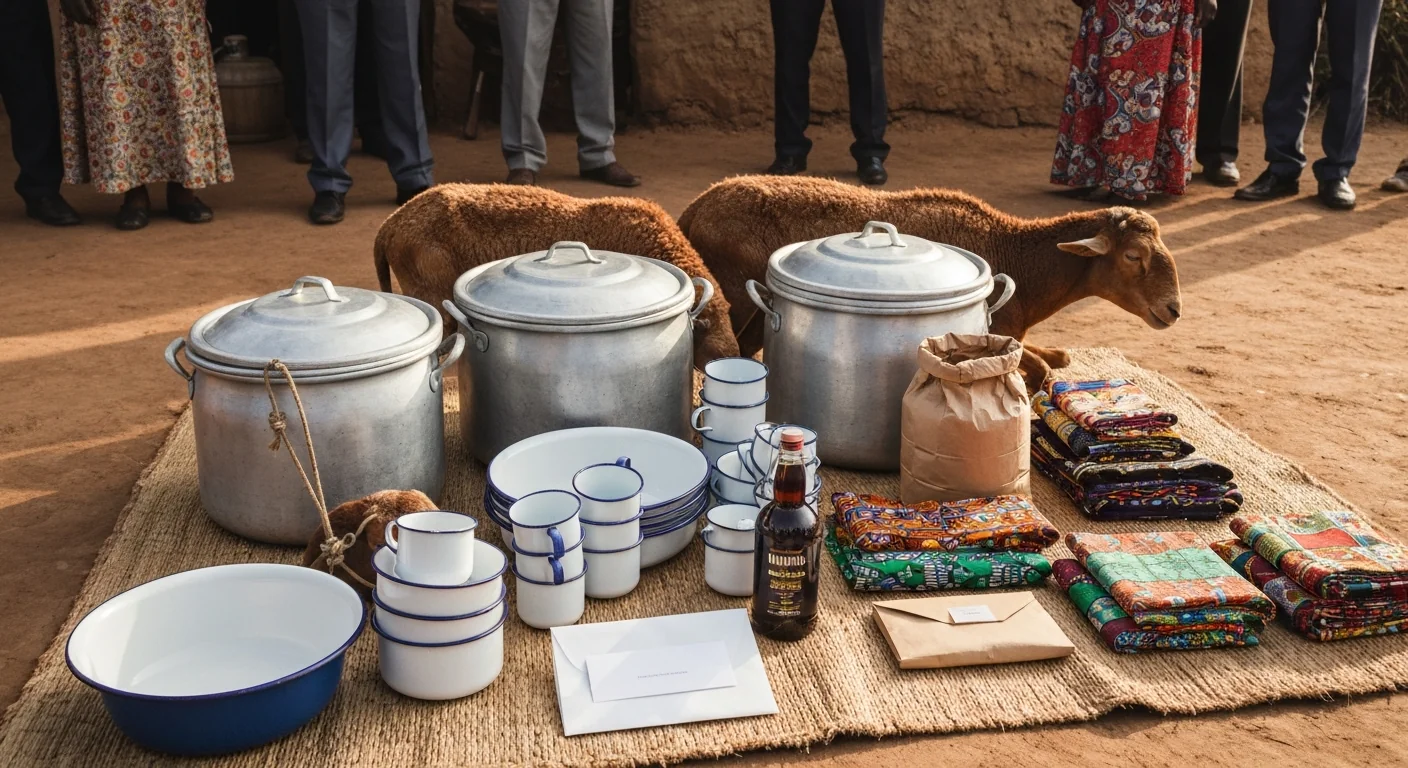
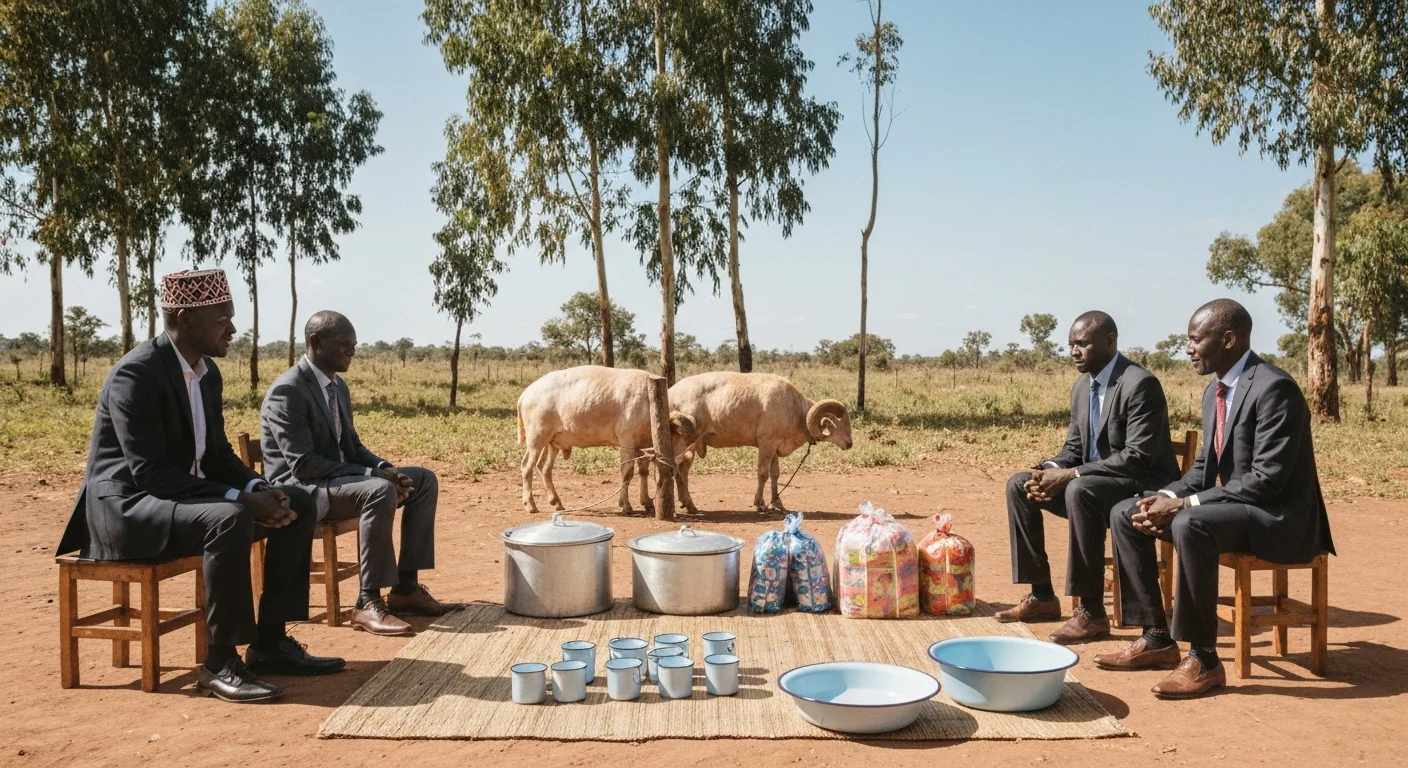
Beyond the core dowry payment, the groom’s family must bring physical items to the ceremony. These include livestock, household goods, clothes for the bride’s family, foodstuffs, drinks, and cash envelopes for specific family members.
| Shopping Category | Budget Range |
|---|---|
| Livestock (live animals or cash equivalent) | KSh 50,000–400,000 |
| Household goods (sufurias, basin, cups, water tank) | KSh 15,000–35,000 |
| Items for male elders (blankets, sheets, coat, hat, walking stick) | KSh 10,000–25,000 |
| Clothing for bride’s parents, grandparents, siblings | KSh 30,000–80,000 |
| Foodstuffs (flour, sugar, tea, rice, oil) | KSh 5,000–12,000 |
| Drinks and beer (honey beer, sodas, crates) | KSh 15,000–35,000 |
| Cash envelopes (gate pass, elders, mother, father, spokesman) | KSh 30,000–80,000 |
| Shopping list subtotal | KSh 155,000–667,000 |
For a full item-by-item breakdown with specific 2026 prices, quantities, and sourcing tips, see our complete ruracio shopping list.
Cost 3: Transport
Transport is the cost that most ruracio planners underestimate. Consider everyone who needs to travel:
- The groom’s core family delegation (10–30 people typically)
- The extended family and friends who accompany the delegation
- The livestock (if bringing live animals)
- Return transport at the end of a long day
What transport typically costs in 2026:
| Transport Scenario | Estimated Cost |
|---|---|
| Fuel for private vehicles (Nairobi–Central Kenya return) | KSh 8,000–20,000 per vehicle |
| Hired matatu for groom’s group | KSh 10,000–25,000 per vehicle |
| Luxury van or people carrier hire | KSh 20,000–50,000 |
| Livestock transport (goat truck) | KSh 5,000–15,000 |
| Total transport (small delegation, local) | KSh 15,000–40,000 |
| Total transport (large delegation, upcountry) | KSh 40,000–100,000+ |
If the ruracio is upcountry and most of the groom’s family is in Nairobi, accommodation the night before is an additional cost — budget KSh 5,000–15,000 per room for guest houses or budget hotels in towns like Nyeri, Murang’a, Thika, or Limuru.
Cost 4: Food and Catering for the Groom’s Team
Ruracio is an all-day event — often running from 10am well into the evening. The bride’s family handles the cooking for everyone at the venue, but the groom’s side often needs to sort their own delegation’s food and refreshments for the journey, and sometimes a separate meal for the entourage.
Food costs for the groom’s team:
| Item | Estimated Cost |
|---|---|
| Breakfast / snacks before departure | KSh 2,000–8,000 |
| Water and soft drinks for the delegation (travel) | KSh 2,000–5,000 |
| Evening meal or stopover food on the way home | KSh 5,000–20,000 |
| Contribution to the day’s food (sometimes expected) | KSh 10,000–30,000 |
Some families are explicitly told to bring additional food contributions beyond the ceremonial foodstuffs — whole cooked dishes, meat, or a specific contribution to that day’s cooking. Confirm this with the family in advance.
Cost 5: Outfits for the Groom’s Team
How the groom’s delegation looks matters. The bride’s family will be watching, photographing, and forming opinions. A well-dressed delegation signals that the groom’s family is serious and capable.
Common outfit expectations:
- Groom: Kikuyu traditional outfit (skin/leather garments, or modern interpretation with kanzu and cultural elements) — KSh 5,000–20,000
- Groom’s mother: Full traditional outfit — KSh 8,000–20,000
- Groom’s father: Full traditional or formal outfit — KSh 8,000–20,000
- Other delegation members: Coordinated attire (matching colours, lesos, or agreed dress code) — KSh 2,000–8,000 per person
Total for outfits (delegation of 15–30 people): KSh 40,000–150,000+
Many families agree on a group colour scheme and each delegation member buys their own outfit. In this case the groom’s family only covers the core family members’ clothing. Agree on the arrangement early to avoid last-minute drama.
Cost 6: Photography
Ruracio is a day you will want documented. The symbolic moments — the gate negotiations, the identification of the bride, the handover of items, the elders’ speeches — happen once. Hiring a photographer ensures you have a record of all of it.
Ruracio photography rates in Kenya (2026):
| Package Type | Coverage | Estimated Cost |
|---|---|---|
| Entry-level / emerging photographer | 4–6 hours, 200–300 edited photos | KSh 15,000–35,000 |
| Mid-range photographer | Full day (8–10 hours), 400–600 edited photos | KSh 35,000–70,000 |
| Established / specialist photographer | Full day, video highlights, album | KSh 70,000–120,000+ |
Look for photographers who have specifically shot ruracio before — they’ll know when to be in position for the key moments and how to navigate the day’s flow without interrupting the ceremony. Search within your community network or on Instagram using #ruraciophotography.
If adding videography, budget an additional KSh 20,000–60,000 for a separate videographer or dual package.
Cost 7: Venue (If Not at the Family Home)
Most ruracio ceremonies take place at the bride’s family home — there is no separate venue hire. But if the family is in Nairobi or does not have a suitable compound, some couples rent a venue.
Venue options for ruracio in Kenya (2026):
| Venue Type | Estimated Cost |
|---|---|
| Church hall or community centre | KSh 8,000–25,000 |
| Hired tent and grounds at a private home | KSh 20,000–50,000 |
| Garden venue (Karen, Kiambu, Ruiru) | KSh 40,000–120,000 |
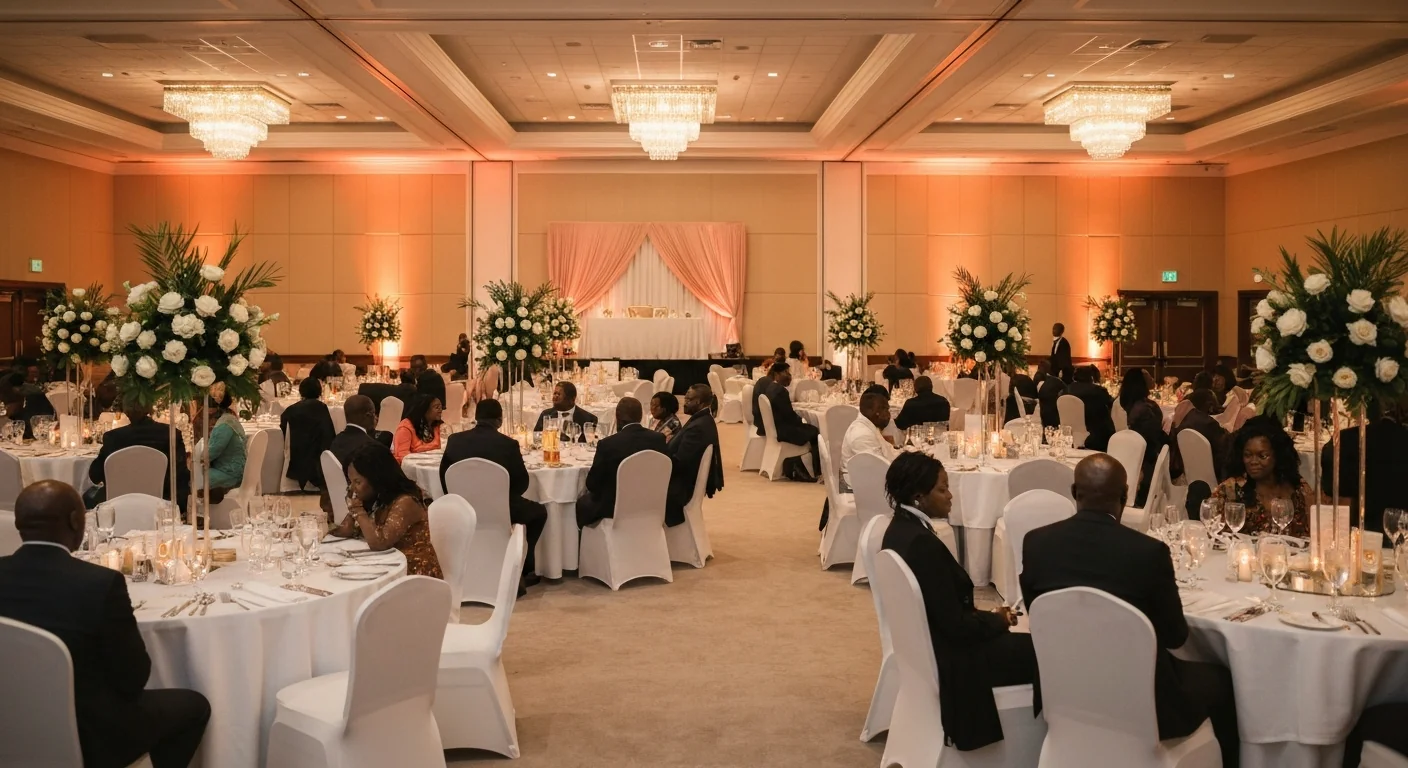
| Hotel with outdoor space (Nairobi) | KSh 60,000–200,000 |
Tent hire for a home ceremony: If the family home doesn’t have enough covered space, renting a tent (10m x 15m, covering 80–120 guests) typically costs KSh 15,000–40,000 including chairs and basic tables.
Cost 8: Entertainment
Ruracio is a celebration as much as it is a negotiation. Music, dancing, and general atmosphere are part of the day.
| Entertainment Option | Estimated Cost |
|---|---|
| Sound system hire | KSh 10,000–25,000 |
| DJ (half day) | KSh 15,000–35,000 |
| Live band or traditional performers | KSh 40,000–120,000 |
| MC (optional — many families use their own spokesman) | KSh 10,000–30,000 |
Many families keep entertainment simple — a sound system, traditional music, and family members who are known to sing and dance. This is entirely acceptable and does not look cheap. The important thing is that there’s energy in the air when the delegation arrives.
How Much Does Ruracio Cost in Total? Realistic 2026 Budgets
Here is how the numbers stack up across three real-world budget scenarios.
| Cost Category | Budget Ruracio | Mid-Range Ruracio | Full-Scale Ruracio |
|---|---|---|---|
| Dowry / bride price | KSh 80,000 | KSh 200,000 | KSh 400,000+ |
| Shopping list items | KSh 60,000 | KSh 150,000 | KSh 300,000+ |
| Transport | KSh 15,000 | KSh 40,000 | KSh 80,000 |
| Food for groom’s team | KSh 5,000 | KSh 20,000 | KSh 40,000 |
| Outfits (core family) | KSh 20,000 | KSh 60,000 | KSh 120,000 |
| Photography | KSh 20,000 | KSh 45,000 | KSh 90,000 |
| Venue / tent | KSh 0 | KSh 25,000 | KSh 80,000 |
| Entertainment | KSh 10,000 | KSh 25,000 | KSh 60,000 |
| Contingency (10%) | KSh 21,000 | KSh 56,500 | KSh 117,000 |
| TOTAL | ~KSh 231,000 | ~KSh 621,500 | ~KSh 1,287,000+ |
Most Nairobi families doing a standard ruracio land somewhere between KSh 300,000 and KSh 600,000 when all costs are honestly counted. High-expectation families and professional brides can push that significantly higher.
Tips for Managing Ruracio Costs
1. Have the conversation about expectations early. The biggest cost surprises come from misunderstanding what the family expects. After Kumenya Mucii, the groom’s family should have a private debrief to understand what category of ceremony this is — a modest family event or a major clan gathering.
2. Negotiate with honesty, not bluster. The Kikuyu dowry system is designed to be negotiated. Families expect the groom’s spokesman to push back. But negotiating in bad faith — agreeing to amounts you cannot pay and then disappearing — destroys the relationship. Be honest about your capacity and negotiate a realistic plan, including a payment timeline for instalments.
3. The instalment system is your friend. Paying 50–70% on the day and scheduling the rest over 6–12 months is completely normal and culturally acceptable. This lets you celebrate properly without destroying your savings before the white wedding.
4. Don’t forget the white wedding is coming. Many couples treat ruracio as their primary budget focus and then run out of money for the church wedding. Ruracio is one piece of a bigger financial picture. Read our Kenya wedding budget guide to see how ruracio fits into the total cost of getting married.
5. Track every shilling from day one. When you are managing shopping lists across seven categories plus cash envelopes plus transport costs, things get lost. A dedicated budget tracker stops money from “disappearing” into day-of decisions. See how managing your wedding planning in one place makes this much easier across all the moving parts.
How to Budget for Ruracio Using Harusi Hub
Harusi Hub’s budget tracker is purpose-built for exactly this kind of complexity. You can set up your budget as a separate event (ruracio) distinct from your main wedding budget, then add each line item across all eight cost categories covered in this guide. If you’re running ruracio and a white wedding as separate events, the manage your wedding events guide shows you how to track them side by side.
As you buy items and make payments, mark each one off and record the actual amount spent. The tracker shows you in real time how your actual spend compares to your estimate — so you know before the day whether you need to adjust anything.
Head to Dashboard > Budget to get started. If you are also planning a white wedding, you can run both budgets simultaneously and see combined totals or switch between events.
This also connects well to your side hustle fundraising plans if you’re raising money to cover ruracio costs — track contributions alongside expenses to see the full picture.
Build Your Ruracio Budget — For Free
Track every item, every shilling, every payment across all your ruracio categories — and go into the day knowing exactly where you stand.
Start Planning Free