Ruracio Shopping List 2026: Everything to Buy (With Prices)
The complete 2026 ruracio shopping list with current Kenyan prices — every item the groom's family must bring to a Kikuyu dowry ceremony, by category.
Ruracio Shopping List 2026: Everything to Buy (With Prices)
You’ve proposed, she’s said yes, and the families have done Kumenya Mucii. Now comes the question every groom’s family dreads: “So what exactly do we need to buy?”
The ruracio shopping list is one of the most searched topics in Kenyan weddings — and for good reason. Show up without the right items and the day grinds to a halt. Overspend without a plan and you’re starting married life in debt. This guide gives you the definitive, category-by-category breakdown of every traditional item the groom’s side is expected to bring, with realistic 2026 prices for each.
One critical note before you start buying anything: always confirm the specific list with the bride’s family and their elders. Requirements vary significantly by clan, sub-location, and family expectations. Use this guide as your planning foundation — then verify every line with the actual family you’re dealing with.
For the full cultural context behind each stage of the ceremony, read our complete guide to Kikuyu ruracio wedding traditions.
What Goes on a Ruracio Shopping List?
Ruracio shopping items fall into several distinct categories. Each category carries its own cultural weight, and the quantity of items within each is negotiated between the families — often through a formal spokesman (muthuuri wa kiama) on the groom’s side.
Broadly, items are divided between:
- Items for the men (Athuri) — senior male elders of the bride’s family
- Items for the women (Atumia) — the bride’s mother, aunties, and female elders
- Livestock — the core of the dowry, still central even in modern ceremonies
- Household goods — practical items that demonstrate the groom’s ability to provide
- Foodstuffs and drinks — for the ceremony itself and as symbolic gifts
- Cash envelopes — for specific family members at defined points in the ceremony
Category 1: Livestock
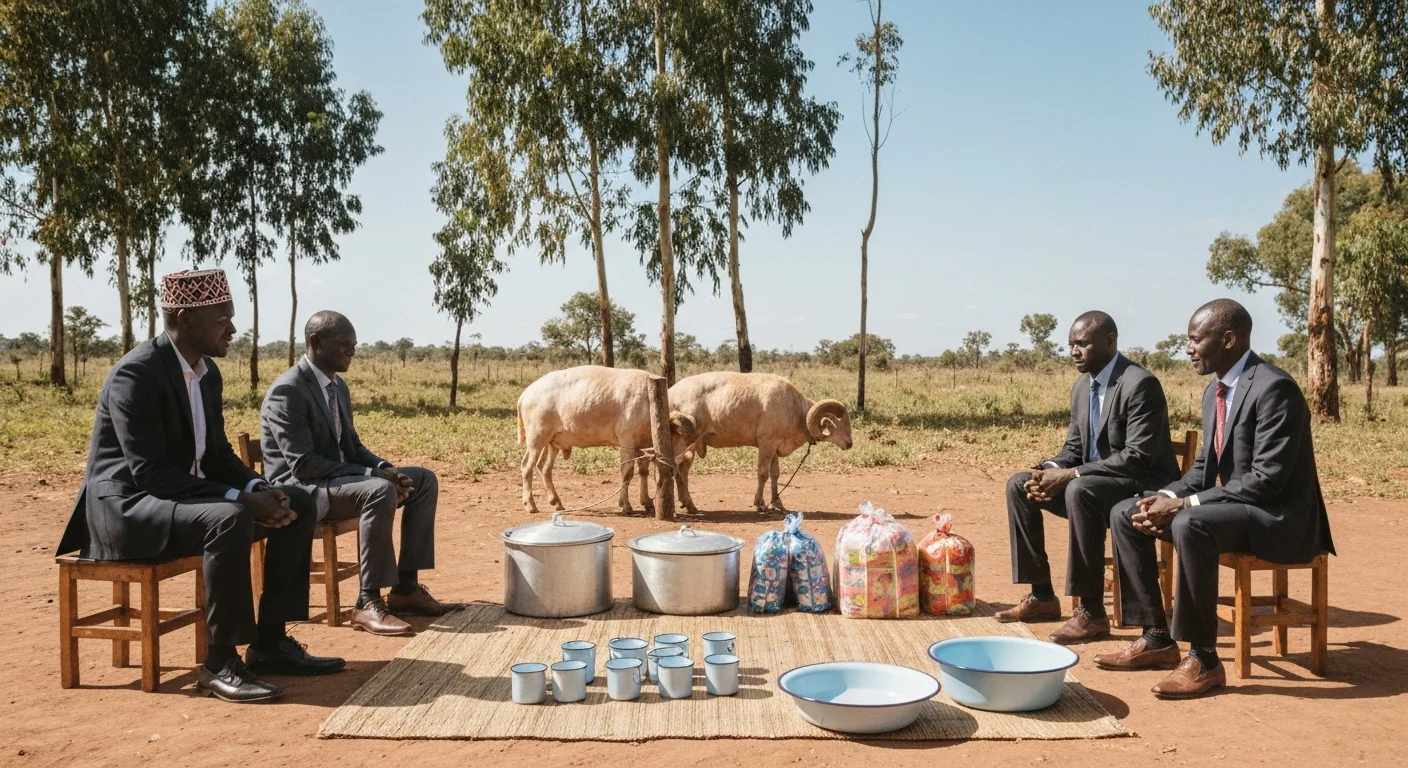
Livestock is the traditional centrepiece of the ruracio. Even in urban families where no one keeps animals, the number of goats and cows is formally agreed and then converted into cash on the day. The livestock negotiation is what the spokesmen spend most of the morning arguing about.
| Item | Traditional Name | What It Is | Typical Quantity | 2026 Price Range |
|---|---|---|---|---|
| Fattened ram | Ngoima | Large, well-fed male sheep — must look impressive | 2 | KSh 8,000–15,000 each |
| He-goat | Thenge | Standard male goat | Negotiated (often 5–20+) | KSh 6,000–12,000 each |
| Ewe | Mwati | Female sheep, given at Kuhanda Ithigi stage | 1 | KSh 5,000–10,000 |
| Small he-goat | Harika | Young male goat, given at Kuhanda Ithigi | 1 | KSh 4,000–8,000 |
| Heifer | Mori | Young female cow | 1–3 (negotiated) | KSh 40,000–80,000 each |
| Additional goats | Mburi | The bulk of the bride price in goat-form | Negotiated (10–100) | KSh 6,000–12,000 each |
Important: The two Ngoima (fattened rams) brought on ruracio day must be visibly well-fed and healthy. Arriving with thin or sickly goats is a serious social offence and will be called out publicly by the elders. Budget time to source good animals — farmers markets in Limuru, Githunguri, and Thika Road are the best places to find quality livestock.
On monetisation: Most urban families now convert the agreed goat number into cash. If the family agrees on 30 goats and the going rate is KSh 8,000 per goat, that’s KSh 240,000 in cash delivered in an envelope. Confirm whether the family wants live animals or cash equivalents early in the planning process.
Category 2: Household Goods for the Women (Atumia)
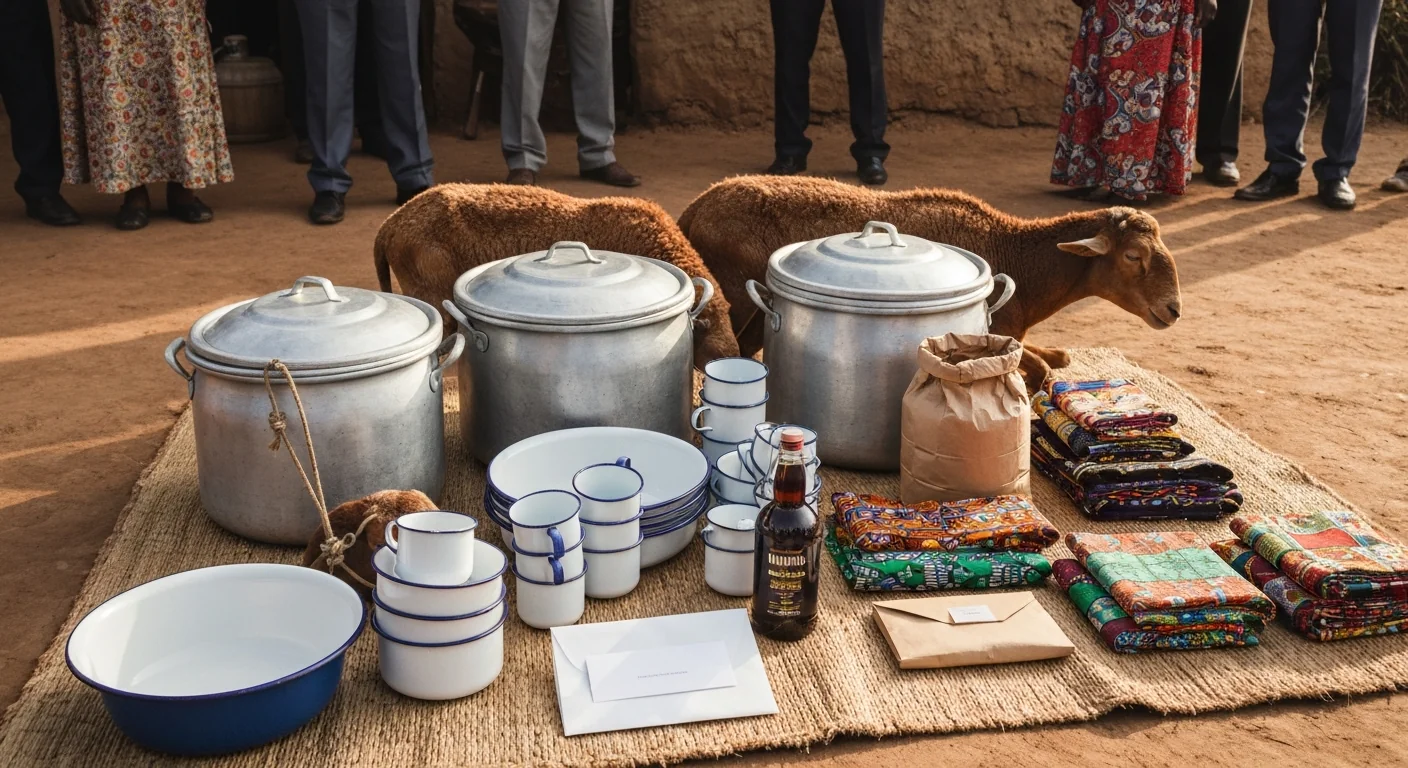
These items go to the bride’s mother and the senior women of the family. They are practical items that symbolise the groom’s ability to maintain a home.
| Item | Traditional Name | Details | Quantity | 2026 Price Range |
|---|---|---|---|---|
| Large cooking pot | Rurinja / Sufuria kubwa | Heavy aluminium sufuria, 30–50L | 1–2 | KSh 2,500–5,000 each |
| Metal basin | Basin ya Mabati | Large washing basin | 1–2 | KSh 800–2,000 each |
| Metal cups (dozen) | Ikombe cia Mabati | A set of 12 enamel cups | 1 set | KSh 600–1,200 per set |
| Cooking pots set | Nyungu | Traditional clay or modern pots | 1 set | KSh 1,500–3,500 |
| Calabashes | Ciihuri | Decorative and traditional | 2–4 | KSh 300–800 each |
| Water tank (small) | Itangi ria mai | Plastic water storage tank | 1 | KSh 5,000–12,000 |
| New rope | Mukwa | Symbolic gift, braided rope | 1 | KSh 200–500 |
| Axe | Ithanwa | Small hand axe | 1 | KSh 500–1,500 |
| Weaving basket | Kyondo | Kikuyu woven basket | 1–2 | KSh 800–2,000 each |
| Lesos / Kangas | Lesos | Colourful wrap cloths | 4–6 | KSh 300–600 each |
Where to buy: Nairobi’s Eastleigh and Gikomba markets have the best prices on household goods and kitchenware. Kamukunji Market specialises in metalware. For lesos and kangas, Ngara Market or Marikiti have the widest selection.
Category 3: Items for the Men (Athuri)
The male elders of the bride’s family also receive specific gifts. These items acknowledge the role of the father, grandfathers, and senior male relatives.
| Item | Details | Quantity | 2026 Price Range |
|---|---|---|---|
| Blankets (Murengeti) | Thick, quality blankets — one each for both grandfathers and the father | 2–4 | KSh 1,500–4,000 each |
| Bedsheets / Macuka | Pairs of bedsheets for the father | 2 pairs | KSh 1,500–3,500 per pair |
| Coat / Jacket | A quality coat for the bride’s father | 1 | KSh 3,000–8,000 |
| Hat | Traditional or formal hat for the grandfather | 1–2 | KSh 500–2,000 |
| Walking stick | For the grandfather | 1 | KSh 500–2,000 |
| Sword | Njora — ceremonial item | 1 | KSh 1,000–3,000 |
Note: The blankets hold particular significance. Both grandmothers of the bride are traditionally given blankets. Arrive with good-quality blankets — thin, cheap ones will be noticed and discussed. Look for heavy wool or thick cotton blankets at Nakumatt or Tuskys-style general stores, or large fabric shops along Kirinyaga Road in Nairobi.
Category 4: Clothes for the Bride’s Family
Beyond the symbolic items, the groom’s family is expected to bring clothing for key members of the bride’s household. This is one of the bigger variable costs and should be confirmed with the family in advance.
| Recipient | Item | 2026 Price Range |
|---|---|---|
| Bride’s mother | Full outfit (dress, headscarf, shoes) | KSh 8,000–20,000 |
| Bride’s father | Full outfit (suit or kanzu, shoes) | KSh 10,000–25,000 |
| Bride’s grandmother (maternal) | Outfit | KSh 5,000–12,000 |
| Bride’s grandmother (paternal) | Outfit | KSh 5,000–12,000 |
| Bride’s aunties (key) | Lesos or outfits | KSh 1,500–4,000 each |
| Bride’s siblings | Outfits (negotiated — not always required) | KSh 2,000–6,000 each |
Budget range for clothing: KSh 30,000–80,000+ depending on family size and expectations. City Market and Gikomba have options for budget shoppers; Westlands and Sarit Centre have boutiques for families who prefer new, quality clothing.
Category 5: Foodstuffs
Foodstuffs are brought by the groom’s family as symbolic gifts — they represent provision and care. These are separate from the catering for the day itself (which is the bride’s family’s responsibility).
| Item | Quantity | 2026 Price Range |
|---|---|---|
| Wheat flour (unga ngano) | 5–10 x 2kg bags | KSh 200–280 per 2kg bag |
| Maize flour (unga wa mahindi) | 3–5 x 2kg bags | KSh 150–200 per 2kg bag |
| Sugar | 3–5 x 2kg packets | KSh 250–320 per 2kg packet |
| Tea leaves | 3–5 boxes (500g each) | KSh 350–600 per box |
| Rice | 5–10 kg | KSh 150–250 per kg |
| Cooking oil | 2–4 litres | KSh 350–500 per litre |
| Salt | 2–3 packets | KSh 50–100 per packet |
| Bread | 5–10 loaves | KSh 65–100 per loaf |
| Fresh fruits | Bananas, oranges — ceremonial bunches | KSh 500–2,000 total |
| Vegetables | Assorted basket | KSh 500–1,500 total |
Note: These foodstuffs are not negotiated — they are a standard expression of goodwill. Buy from a supermarket (Quickmart, Naivas, Carrefour) for consistent quality and clear receipts. Some families present the foodstuffs in a decorated basket or hamper to make a visual impression on arrival.
Category 6: Drinks and Beer
Drinks are central to the ruracio — both for the ceremony’s formal rituals and for the general celebration.
| Item | Purpose | Quantity | 2026 Price Range |
|---|---|---|---|
| Njohi ya uuki (honey beer) | Traditional beer for elders — essential | 2–4 litres | KSh 1,500–3,000 per litre |
| Njohi ya njurio (asking beer) | Beer for formal speeches — can be commercial | 4–6 crates | KSh 2,800–4,000 per crate |
| Sodas (assorted) | For women elders (replaces traditional brew) | 4–8 crates | KSh 1,500–2,500 per crate |
| Water (bottled) | General | 2–4 cases | KSh 800–1,500 per case |
| Muratina / traditional brew | Fermented sugar cane drink — clan dependent | 2–4 litres | KSh 500–1,500 per litre |
Sourcing honey beer: Njohi ya uuki (traditional honey beer) is the hardest item to source because it must be made in advance and is not commercially available. Ask within the Kikuyu community — families who maintain traditional practices often know someone who brews it. Alternatively, a clan elder can advise on an acceptable substitute.
Category 7: Cash Envelopes
Cash gifts are distributed at specific points during the ceremony to specific family members and roles. The amounts are partly negotiated, partly customary. These are in addition to the main bride price payment.
| Recipient | Occasion | Typical Amount |
|---|---|---|
| Gate pass (aunties) | Paid at the gate to gain entry | KSh 500–5,000 |
| Identifying the bride (if wrong guess) | Penalty for picking the wrong woman | KSh 1,000–5,000 per mistake |
| Mbeca cia athuri | Cash for senior male elders | KSh 5,000–20,000 per elder |
| Mbeca cia atumia | Cash for senior female elders | KSh 3,000–10,000 per elder |
| Bride’s mother | Special gift (separate from outfit) | KSh 5,000–20,000 |
| Bride’s father | Formal thanks | KSh 5,000–30,000 |
| Spokesman’s fee (bride’s side) | Payment to the formal negotiator | KSh 3,000–10,000 |
Always bring more cash than you think you’ll need. Unexpected requests come up during the ceremony and it is deeply embarrassing for the groom’s spokesman to say “we don’t have it.” Keep a buffer of at least KSh 10,000–20,000 above your calculated envelope amounts.
Full Ruracio Shopping List Summary Table
| Category | Estimated Budget Range |
|---|---|
| Livestock (goats, sheep, heifer) | KSh 50,000–400,000+ |
| Household goods (women) | KSh 15,000–35,000 |
| Items for male elders | KSh 10,000–25,000 |
| Clothes for bride’s family | KSh 30,000–80,000 |
| Foodstuffs | KSh 5,000–12,000 |
| Drinks and beer | KSh 15,000–35,000 |
| Cash envelopes | KSh 30,000–80,000 |
| TOTAL (excluding transport & catering) | KSh 155,000–667,000+ |
For the full cost of doing a ruracio — including transport, catering, outfits for the groom’s team, photography, and accommodation — read our detailed ruracio cost breakdown for 2026.
Where to Buy Ruracio Items in Nairobi
For livestock: Limuru Market, Githunguri, Thika Road livestock dealers, or Ngong Road. Book the animals a week ahead and arrange transport.
For household goods and kitchenware: Gikomba Market, Kamukunji, City Market, Eastleigh.
For clothing: Gikomba for budget options; Westlands, Sarit Centre, or Two Rivers for new boutique clothing.
For foodstuffs: Carrefour, Naivas, Quickmart, or Marikiti Market for fresh produce.
For traditional items (honey beer, calabashes, kyondo, rope): The Kikuyu community network is your best resource. Ask elders in the family or the groom’s spokesman — they will know specific traders who specialise in these items.
Tracking Your Ruracio Shopping Budget
With dozens of items across seven categories, a ruracio shopping list is genuinely complex to manage. The easiest way to stay organised is to treat it exactly like any other project budget — every item gets a line, an estimated cost, and a confirmed cost once you’ve bought it.
Harusi Hub’s budget tracker lets you log every ruracio item as a line entry, assign it to a category, and track what you’ve bought versus what’s still outstanding. Learn how to set up your wedding budget and track each line item in the guide. You can also use the planning checklist tool to make sure nothing falls through the cracks in the weeks leading up to the ceremony. You can export the shopping list as a CSV to share with your planning team or committee.
For a broader look at managing everything that goes into the ruracio preparation, see our guide to managing your wedding planning in one place.
Once ruracio is done, you’ll likely move straight into planning the white wedding — check out our complete Kenya wedding budget guide for everything that comes next. If you’re planning both events together, our guide on planning a traditional and white wedding weekend covers how to coordinate both ceremonies without doubling your budget.
Track Your Ruracio Shopping in One Place
Log every item, category, and payment — so nothing gets forgotten and you know exactly where your budget stands.
Start Planning Free