Ghanaian Wedding Traditions: Knocking, Engagement & White Wedding
A complete guide to Ghanaian wedding traditions — from the knocking ceremony (Kokoo Ko) and the engagement list to Kente cloth, the white wedding reception, Adowa dancing, and how the diaspora is reimagining it all.
Ghanaian Wedding Traditions: Knocking, Engagement & White Wedding
A Ghanaian wedding is not one event. It is three acts — each with its own protocols, its own wardrobe, its own emotional peak — woven together into a celebration that honours ancestors, binds two families, and announces a new union to the world. Before any white gown is worn or any church bell rings, there is the knock at the door, the engagement list, and the Kente cloth. This guide walks you through every stage.
Ghanaian weddings are among the most layered and intentional in Africa. They move through a structured sequence: first, the knocking ceremony, in which the groom’s family formally announces their intention; then the traditional engagement, in which gifts are exchanged and vows are made in cultural dress; and finally the white wedding, where the church ceremony and the grand reception bring everything to a jubilant close.
Each stage is distinct, meaningful, and non-negotiable in most Ghanaian families. Together they create a wedding experience that typically unfolds across two days or more, involving both families deeply in every decision and every moment. Planning tools that support multiple events — with separate guest lists, budgets, and RSVPs for each ceremony — can help keep a multi-day celebration like this organised.
Whether you are Ghanaian, marrying into a Ghanaian family, attending a Ghanaian wedding for the first time, or exploring African wedding traditions more broadly, this guide covers everything you need to know.
The Knocking Ceremony (Kokoo Ko)
Before any engagement list is drawn up, before any Kente cloth is chosen, before a wedding date is set — there is the knock.
The knocking ceremony, known in Akan as Kokoo Ko (meaning “to knock”) or Opon-akyi bo, is the formal introduction of the groom’s family to the bride’s family. The name captures the tradition precisely: the groom’s family literally comes to knock on the door of the bride’s family home to announce their son’s intention to marry their daughter.
In Ghanaian culture, a man does not simply ask a woman to marry him and proceed to plan a wedding. The families must first meet. The groom’s family must present themselves, state their intentions with respect, and seek permission. No traditional Ghanaian marriage can proceed without this step.
Who Attends the Knocking Ceremony
The groom’s family sends a delegation, typically led by a respected elder or spokesperson (known as the okyeame in Akan). The delegation includes the groom’s parents, key relatives, and the groom himself. The group is formal in dress and manner — arriving to make a good first impression matters enormously.
The bride’s family receives them at their home, with the bride initially absent. The conversation happens between the families first.
Items Required for the Knocking
The groom’s family does not arrive empty-handed. The gifts brought to the knocking ceremony are non-negotiable tokens of respect and serious intent. Common items include:
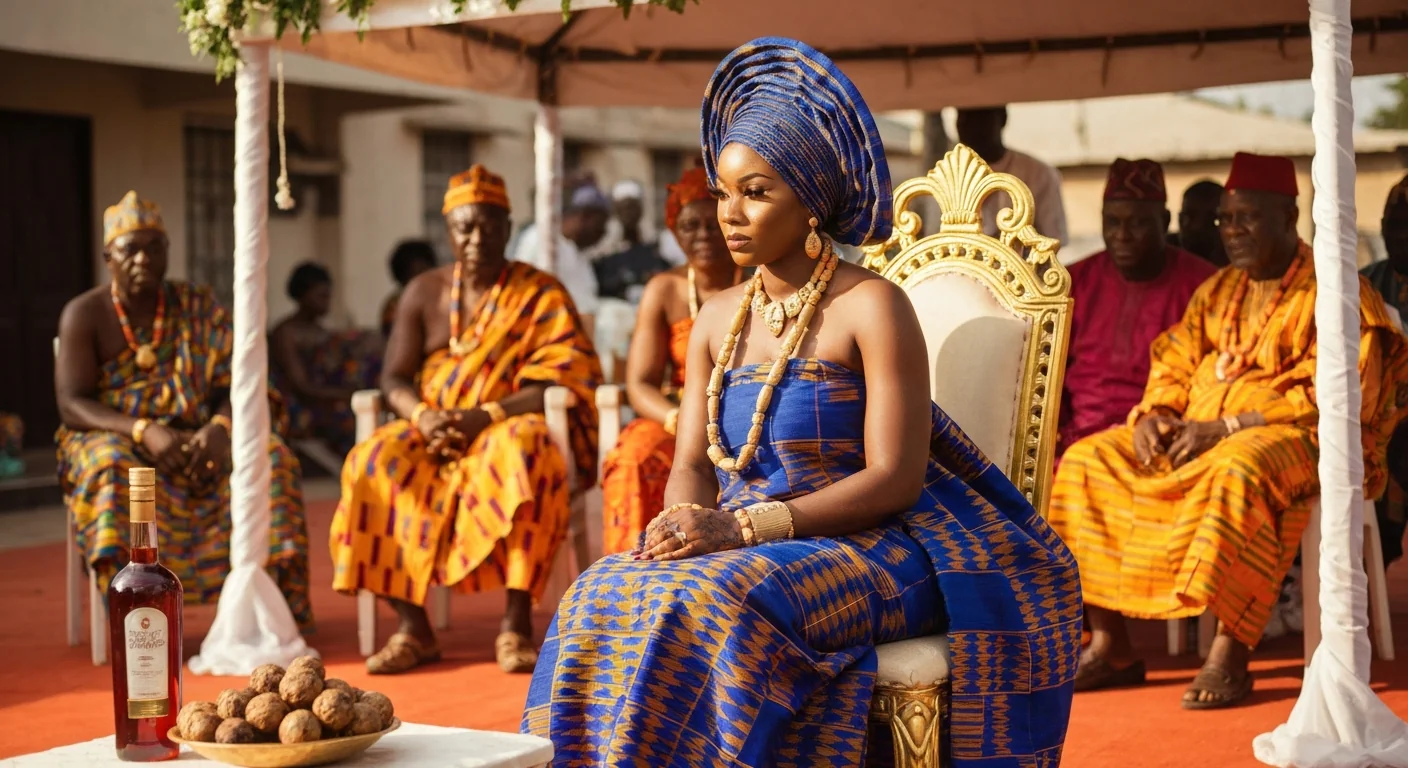
- Schnapps (or gin): Known as tri nsa (head drinks), schnapps is the most iconic item of the knocking ceremony. Typically two to three bottles are brought, representing the seriousness of the visit. Schnapps also serves a ritual function — it is used later to pour libation.
- Palm wine: Another traditional drink that signals cultural rootedness and generosity.
- Kola nuts: These bitter nuts carry deep ceremonial significance across West Africa. In the context of the knocking ceremony, presenting kola nuts signals a formal, serious, and respectful visit.
- Money: Cash gifts presented to the bride’s family as part of the formal greeting.
- Drinks and foodstuffs: Some families also bring yams, soft drinks, and other provisions depending on ethnic group and family expectation.
What Happens If the Family Says No
The knocking ceremony is a request, not a demand. If the bride’s family is not pleased with the groom’s family — or if the bride herself does not consent — the proposal can be declined at this stage.
The acceptance or rejection of the kola nuts and drinks is the symbolic moment of decision. If the bride’s family accepts the items and shares the kola, they have opened the door. Each family member bites the kola nut as a sign of agreement and welcome. The bride is then called in and asked whether she consents to the marriage. Her “yes” — spoken in front of both families — is the moment the knocking ceremony becomes a success.
If the family is not ready to give an answer, they may ask the groom’s family to return another time. If the answer is no, the items are typically not accepted and the groom’s family is turned away with courtesy but finality.
When the knocking succeeds, the families fix a date for the next stage — the engagement ceremony — and the bride’s family begins preparing the engagement list.
The Engagement Ceremony
The traditional engagement ceremony (sometimes called the traditional wedding or customary marriage) is the cultural and legal heart of a Ghanaian marriage. It is the event most Ghanaians consider the “real” wedding — the one that unites the families, satisfies cultural law, and honours the ancestors.
It is almost always the more elaborate, colourful, and emotionally loaded of the two ceremonies.
The Engagement List
After the knocking ceremony, the bride’s family prepares an engagement list — a written document detailing every item the groom’s family must bring to the engagement ceremony in order to complete the marriage. The list is sent to the groom’s family ahead of time, giving them time to gather everything.
While the specific contents of the list vary between ethnic groups (Akan, Ewe, Ga, Fante, etc.) and between families, a typical Akan engagement list includes:
For the bride:
- A full set of Kente cloth (the most important item — see below)
- Wax print fabric (typically 6 or more pieces)
- Gold jewellery — earrings, necklaces, and bracelets
- A suitcase packed with clothing, shoes, and personal items
- An engagement ring
- An engagement Bible
- Perfume and cosmetics
For the bride’s mother:
- A piece of fabric (wax print or Kente)
- Money
- Sandals or shoes
For the bride’s father:
- Money
- A bottle of whiskey or schnapps
- Ankara (African print) clothing
For the bride’s brothers and male cousins (Akonta Sekan):
- A sum of money — this represents compensation to the bride’s brothers for “releasing” their sister and losing her protection within the household
General items:
- Bottles of schnapps and palm wine for libation
- Additional foodstuffs and drinks for the celebration
- Cash payments for specific ceremonial fees
- Money for the bride to invest in a business (sometimes)
- Cooking utensils for the new home
The list is not intended to be punishing — it is a cultural expression of the bride’s value and her family’s pride in her. Negotiation between families is normal and expected. The groom’s side may request that certain items be reduced or substituted; the bride’s family may agree or hold firm on specific items.
The Ceremony Itself
On the day of the engagement, the groom’s family arrives at the bride’s family’s home or a rented venue, carrying all the items from the engagement list. They are led by the family spokesperson.
Libation: The ceremony typically opens with the pouring of libation — schnapps or palm wine is poured onto the ground by a designated elder while prayers and invocations are offered to the ancestors and to God. In Ghanaian tradition, no major event begins without first acknowledging the ancestors. Their blessing is sought for the union.
Presentation of items: The groom’s family presents the engagement list items one by one, often with explanation and ceremony. The bride’s family inspects each item, and the spokesperson confirms that the requirements have been met.
The bride’s entrance: One of the most anticipated moments of the ceremony is the bride’s entrance. She does not simply walk in — in many Ghanaian traditions, she enters the room covered, or surrounded by a group of women, and is then “revealed” to the groom. The groom must identify his bride from among the women — sometimes multiple women are brought out, and the groom must choose correctly. When he identifies her, the room erupts.
The bride’s father’s speech: Once the items are accepted, the bride’s father (or a senior male spokesperson on her family’s side) delivers a formal speech — blessing the union, speaking on the bride’s character, welcoming the groom’s family, and offering wisdom for the marriage ahead. This speech is one of the most moving moments of the entire wedding process.
Ring exchange: The groom places an engagement ring on the bride’s finger in front of both families. In many modern ceremonies, the bride also places a ring on the groom’s finger.
Money gifting: Guests shower the couple with money throughout the ceremony — tucking notes into the bride’s Kente cloth or placing money into trays held by attendants. This is an act of communal blessing and financial support for the new couple.
Celebration: The ceremony closes with music, food, and dancing — the families eating together as a unified group for the first time.
Kente Cloth: The Heart of Ghanaian Wedding Attire
No element of a Ghanaian wedding carries more cultural weight than Kente cloth. It is the item at the top of every engagement list. It is what the bride and groom are photographed in. It is the visual identity of the Ghanaian traditional ceremony.
If you want to understand Ghanaian weddings, you must understand Kente.
Origins: The Ashanti and Ewe Weavers
Kente cloth originated among the Ashanti (Asante) people of Ghana’s Ashanti Region, with the town of Bonwire widely regarded as the historic centre of Kente weaving. According to Ashanti oral tradition, the craft was learned from a spider — watching the spider’s web, weavers reverse-engineered the interlocking pattern technique that defines Kente.
The cloth was originally woven exclusively for Ashanti royalty. A king wearing Kente was wearing his lineage, his authority, and his connection to the ancestors. Over time, Kente became more widely available, though it retained its ceremonial prestige.
The Ewe people of southeastern Ghana also developed their own distinct Kente tradition — Ewe Kente uses a wider variety of figurative patterns and looser weave structures, and differs visually from the more geometric Asante Kente.
Over 300 Patterns, Each With Meaning
An experienced Asante weaver may know over 300 distinct Kente patterns — each with a name, a meaning, and an appropriate context. Patterns are created in two ways:
Warp patterns — the vertical stripes of colour that run the length of the cloth — are named after proverbs, historical events, or important chiefs and queen mothers.
Weft designs — the horizontal elements woven into the cloth — are often named after plants, animals, or objects that the design resembles.
Some of the most recognised patterns and their meanings:
- Sika Fre Mogya — “Gold calls for blood” — symbolises the responsibility to share monetary success with family
- Obaakofoo Mmu Man — represents democratic rule and collective leadership
- Emaa Da — represents novel creativity and wisdom gained from experience
- Nkyemfre — repeating triangular shapes symbolising unity in strength
- Babadua — named for a bamboo-like plant, one of the most classic and widely worn patterns
Colour Symbolism
Kente colours are never random. Each colour carries traditional meaning:
| Colour | Meaning |
|---|---|
| Gold/Yellow | Royalty, wealth, high status |
| Green | Growth, renewal, the richness of the land |
| Red | Political strength, the blood of ancestors |
| Blue | Peace, harmony, love |
| Black | Maturity, spiritual energy, the African continent |
| White | Purity, festivity, purification |
Choosing Kente for Your Wedding
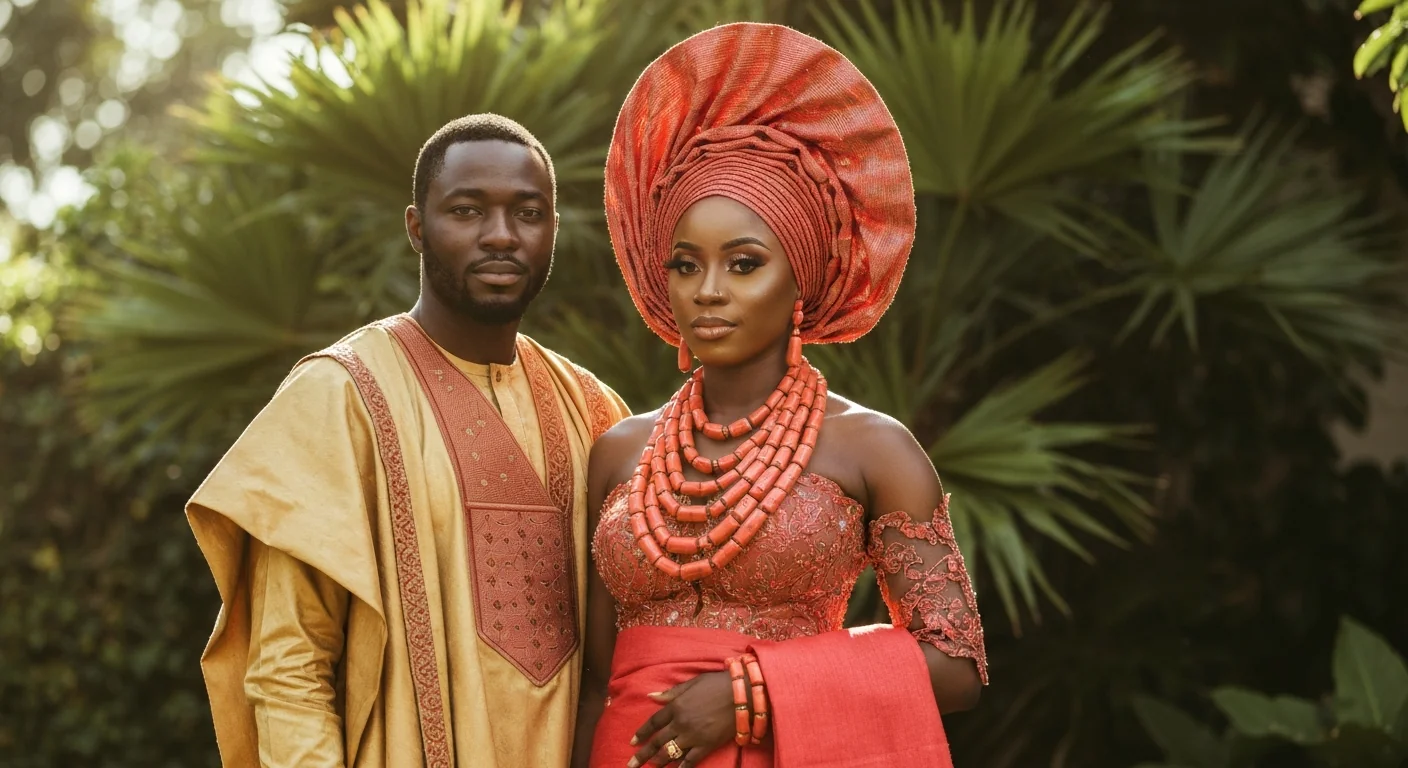
For a Ghanaian engagement ceremony, the couple traditionally wears matching Kente — the same pattern and colour family, worn in coordinated but gender-appropriate styles. The bride’s Kente is typically wrapped as a skirt-and-top ensemble, often styled with off-shoulder draping. The groom wears his Kente toga-style, draped over one shoulder.
The wedding party — family members from both sides — also typically wear Kente or wax print in coordinated colours, creating the iconic visual of a Ghanaian traditional wedding: a sea of brilliant, complementary patterns.
When choosing Kente for a wedding:
- Consider the meaning of the pattern — some patterns are associated with royalty, others with prosperity, others with love. A knowledgeable weaver or Kente vendor can advise.
- Commission early — authentic, handwoven Kente takes time. Commission your wedding Kente weeks or months in advance. Machine-printed Kente imitations are widely available but lack the cultural and textural depth of the handwoven original.
- Budget accordingly — authentic handwoven Kente ranges from affordable market pieces to expensive artisan commissions. For a wedding, invest in quality; these pieces last a lifetime and are often passed down.
Kente in Modern Fashion
Kente has transcended ceremonial wear to become a global fashion statement. Designers incorporate Kente into tailored jackets, evening gowns, accessories, and streetwear. It has appeared on international runways and on the backs of dignitaries worldwide. For Ghanaian diaspora couples, incorporating Kente into a Western-style reception look — a Kente-detail wedding gown, a Kente bow tie on a suit, Kente heels — is a way of carrying culture into every aspect of the celebration.
For those who want to learn more about styling African fabrics for weddings, our African wedding attire guide covers the broader landscape of African fashion choices.
The White Wedding and Reception
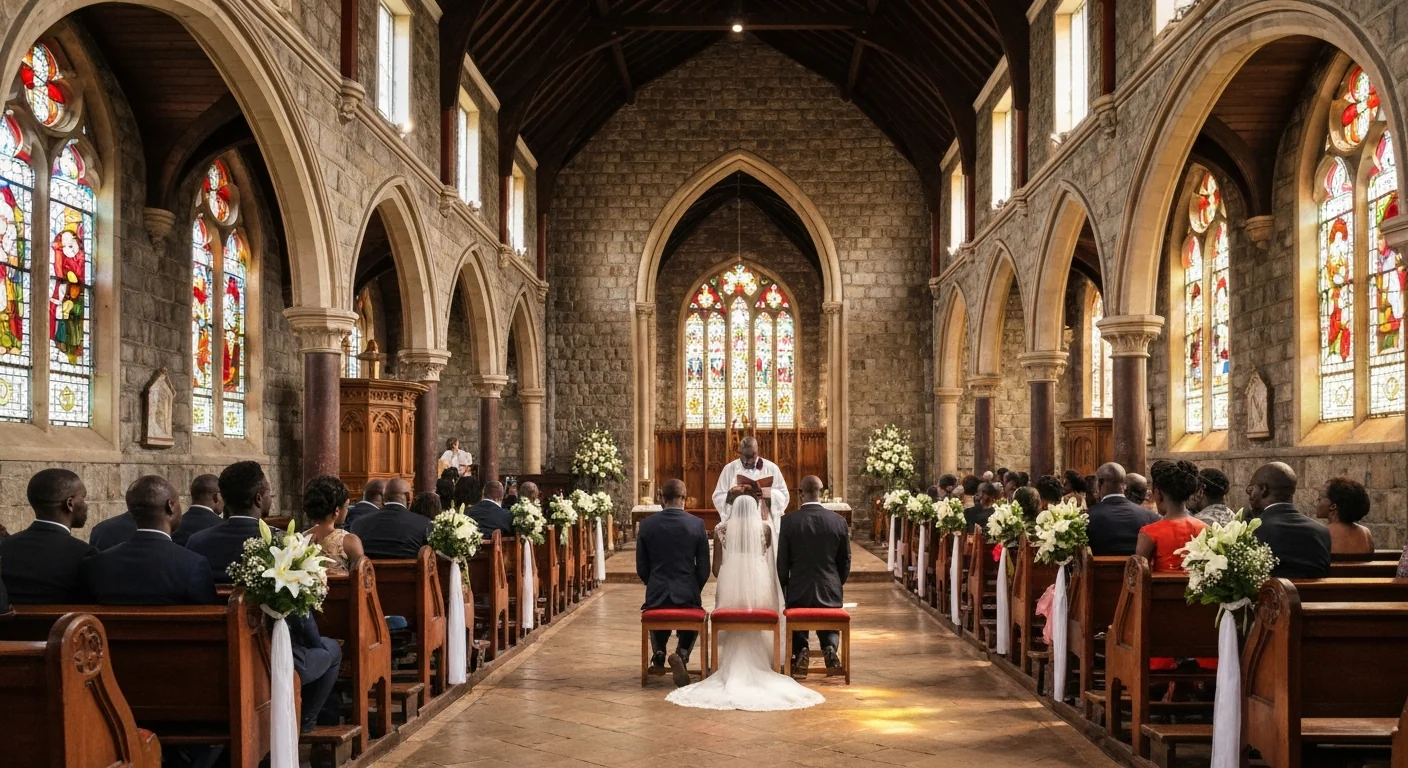
After the traditional engagement ceremony comes the white wedding — the Christian church ceremony followed by a grand reception. For the majority of Ghanaians, who are Christian, the white wedding is a spiritual completion of the union that was culturally formalised at the engagement.
The Church Ceremony
Ghana’s Christian community is diverse — Catholic, Protestant, Pentecostal, and charismatic denominations all have strong followings, each with their own wedding ceremony formats. What they share is the significance of the church vows as a public, spiritual commitment.
The bride wears a white wedding gown — often elaborate, with a full train and beaded detailing. Many Ghanaian brides will change outfits at least twice during the wedding day: white gown for the church, Kente for the reception, and sometimes a third outfit for the final dances.
The church ceremony includes Scripture readings, the exchange of vows, rings blessed by the officiant, and prayers for the couple’s life together. Depending on the denomination, there may be additional rites — communion, anointing, special prayer circles.
The Reception
Ghanaian wedding receptions are long, loud, joyful, and spectacular. They are not cocktail parties — they are full-evening productions with a programme, a master of ceremonies, speeches, performances, and dancing that continues until the venue’s closing time.
The grand entrance: The couple’s entrance to the reception hall is an event in itself. Preceded by their bridal party and often accompanied by a live band or DJ pumping high-energy Afrobeats or highlife, the couple walk in to the roar of the crowd.
Speeches: Parents, the best man, the maid of honour, and chosen friends deliver speeches. The father of the bride’s speech at the white wedding echoes the gravity of his speech at the engagement — he is presenting his daughter to the world as a married woman.
Food: No Ghanaian reception ends without a proper feast. The food at Ghanaian weddings is a serious matter:
- Jollof rice — the West African dish that needs no introduction, and the subject of friendly regional rivalry. Ghanaian jollof, cooked in the party pot over firewood, has a devotional following. It is smoky, slightly charred at the bottom, and deeply flavoured.
- Fufu with soup — pounded cassava and plantain, served with light soup, groundnut soup, or palm nut soup. Fufu at a wedding is a signal of cultural pride.
- Banku with tilapia — fermented corn and cassava dough served with grilled whole tilapia, a Ghanaian staple at celebrations
- Kelewele — spiced fried plantain, often served as a snack
- Omo tuo — rice balls served with groundnut soup
Money spraying: One of the most joyful traditions of a Ghanaian reception is the money spray. Guests shower the couple with banknotes during the first dance — literally raining money onto the newlyweds as a communal blessing of prosperity. Friends and family members take turns approaching the couple to spray money, often accompanied by cheers and laughter. The money is collected by attendants and presented to the couple.
The Adowa Dance
The Adowa is the traditional Akan dance most associated with Ghanaian weddings and celebrations. It is a graceful, expressive dance performed to the sound of talking drums and traditional instruments, with movements that draw on hand gestures and slow, deliberate steps that communicate emotion and story.
At weddings, the Adowa is performed during the traditional engagement ceremony and often makes an appearance at the reception as well. Watching a skilled Adowa performer — or a grandmother who has danced it all her life — is one of the most genuinely moving things you will see at a Ghanaian wedding.
Highlife music and Afrobeats dominate the reception dance floor, but the Adowa always has its moment. It is the link between the modern party and the ancestral tradition.
Modern Ghanaian Weddings
The Diaspora Dimension and the Year of Return
The Ghanaian diaspora is large, global, and deeply connected to its homeland. Ghanaian communities thrive in the United Kingdom (particularly London), the United States (New York, Washington D.C., Houston), Canada, Germany, and the Netherlands. For diaspora Ghanaians, the wedding is often the event that most forcefully reconnects them with their cultural identity.
This connection was dramatically amplified by Ghana’s Year of Return 2019 — a government-led initiative marking 400 years since the first enslaved Africans arrived in America, inviting the global African diaspora to return to Ghana. The campaign brought hundreds of thousands of visitors to Ghana in 2019, sparked a wave of emotional homecomings, and had a measurable effect on diaspora attitudes toward celebrating life’s milestones in Ghana.
In its wake, destination weddings in Ghana became an aspirational choice not just for Ghanaians returning home, but for African Americans and other diaspora communities seeking to connect with the motherland. The Year of Return even saw organised mass traditional wedding ceremonies on Ghanaian soil for diaspora couples.
Destination Weddings in Ghana
For diaspora couples marrying in Ghana, the country offers genuinely extraordinary wedding backdrops:
Accra — the capital city combines modern luxury hotels and event centres with vibrant cultural life. Venues range from beachfront resorts on the Atlantic coast to rooftop event spaces, hotel ballrooms, and garden venues. Accra’s wedding industry is professional and well-developed, with experienced planners, photographers, and caterers used to handling both local and diaspora weddings.
Cape Coast and Elmina — for couples seeking a wedding with deep ancestral resonance, Cape Coast and Elmina carry unique weight. Home to the historic slave castles — UNESCO World Heritage Sites — that marked the departure point for millions of enslaved Africans, these coastal towns are places of profound cultural and emotional significance for the diaspora. Weddings held here take on a layer of healing and reclamation that couples describe as life-changing.
Kumasi — the historic capital of the Ashanti Kingdom, Kumasi is the cultural heart of Ghanaian tradition. For Ashanti couples or those seeking to immerse fully in the Kente and Adowa tradition, Kumasi weddings are deeply rooted experiences.
Social Media and Rising Expectations
Ghanaian weddings have become a dominant genre on Instagram, TikTok, and YouTube. Accounts dedicated to Ghanaian wedding content — the perfectly matched Kente ensembles, the money spray moment, the Adowa circle, the jollof rice reveal — have built enormous audiences both within Ghana and globally.
This visibility has raised expectations and inspired creativity. Couples now invest more deliberately in wedding photography and videography, hire professional MCs and choreographers, and plan their ceremony entrances and outfit reveals as performance moments. The influence of social media has also accelerated cross-cultural borrowing — Nigerian Afrobeats, Kenyan wedding aesthetics, and Western trends all appear alongside deeply Ghanaian traditions at modern ceremonies.
Cost Considerations
Ghanaian weddings span a wide budget range:
The traditional engagement ceremony is typically the more negotiable of the two events — costs depend heavily on the engagement list requirements and the scale of the guest list. Families with the ability to negotiate the list items can manage costs significantly.
The white wedding and reception is where budgets tend to expand. In Accra, a moderate wedding reception for 150–300 guests might require:
| Item | Estimated Range (GHS) |
|---|---|
| Venue hire | 8,000 – 40,000 |
| Catering | 15,000 – 60,000+ |
| Wedding planner | 12,500 – 50,000 |
| Photography & videography | 5,000 – 25,000 |
| Music & DJ | 3,000 – 15,000 |
| Decor and flowers | 5,000 – 20,000 |
| Total (moderate range) | 48,500 – 210,000+ |
December is peak wedding season in Ghana — when the diaspora returns home for the holidays. Venue and vendor prices are highest in December, and demand means you must book significantly in advance. A wedding budget tracker that breaks costs down by event — engagement list, venue hire, catering — makes it easier to see where money is going across multiple ceremonies.
Balancing Tradition and Modernity
The most joyful modern Ghanaian weddings do not choose between tradition and modernity — they weave them together. A bride who changes from her white gown into Kente for the reception. A couple who pours libation in the morning and dances to Afrobeats at midnight. A Nigerian-Ghanaian union where the jollof rice debate plays out in real time on the wedding menu.
Ghanaian weddings are alive. They adapt without losing what matters. The knock at the door, the kola nut shared between families, the ancestors acknowledged at the opening of every ceremony — these things do not change. What changes is the Instagram filter on the photo and the DJ spinning after the Adowa dance.
Planning your own Ghanaian multi-ceremony wedding? Explore the broader African wedding traditions guide and our African wedding attire guide for more on what to wear and what to expect.
Planning a multi-ceremony wedding?
Manage your knocking, engagement, and white wedding from one dashboard.
Start Planning Your Wedding