African Wedding Attire: Traditional Outfits from 15+ Cultures
A visual journey through traditional wedding attire from over 15 African cultures — from Ghana's Kente cloth and Nigeria's aso-oke to Morocco's kaftan, the Zulu isidwaba, and beyond. What couples wear at an African wedding tells the whole story.
African Wedding Attire: Traditional Outfits from 15+ Cultures
African wedding fashion is not decoration. It is declaration. From hand-woven Kente cloth carried down through Ghanaian generations to the layered bead collars that a Maasai bride accumulates from women across her entire community, what a couple wears on their wedding day tells the story of who they are, where they come from, and what they value. This is a guide to that story — told culture by culture, fabric by fabric, across the length and breadth of Africa.
Africa is not a monolith. It is 54 countries, over 3,000 ethnic groups, and thousands of distinct languages and traditions — and its wedding attire reflects every layer of that richness. A West African bride tying yards of wax-printed Ankara around her hips is expressing something completely different from a North African bride changing into her fifth kaftan of the evening, or a Ndebele bride in South Africa whose neck rings and beadwork have been years in the making.
What unites all of these traditions is intentionality. Very little about African wedding attire is accidental. The colors, the fabrics, the accessories, the headwear — each element carries meaning: clan identity, social status, spiritual blessing, family history, or simply a community’s definition of beauty at its highest expression.
Whether you are planning your own African wedding, attending one as a guest, or simply deepening your appreciation of the continent’s extraordinary cultural wealth, this guide walks through traditional bridal attire from over 15 cultures across West, East, North, Southern, Central Africa, and the islands.
West African Wedding Attire
West Africa is arguably the continent’s most exuberant region for wedding fashion. The fabrics are bold, the colors are deliberate, and the accessories — particularly in Nigeria — are stacked in layers that signal prosperity, heritage, and celebration all at once.
Nigeria — Yoruba
Yoruba weddings are among the most visually spectacular on the continent, and the bride’s attire is central to that spectacle.
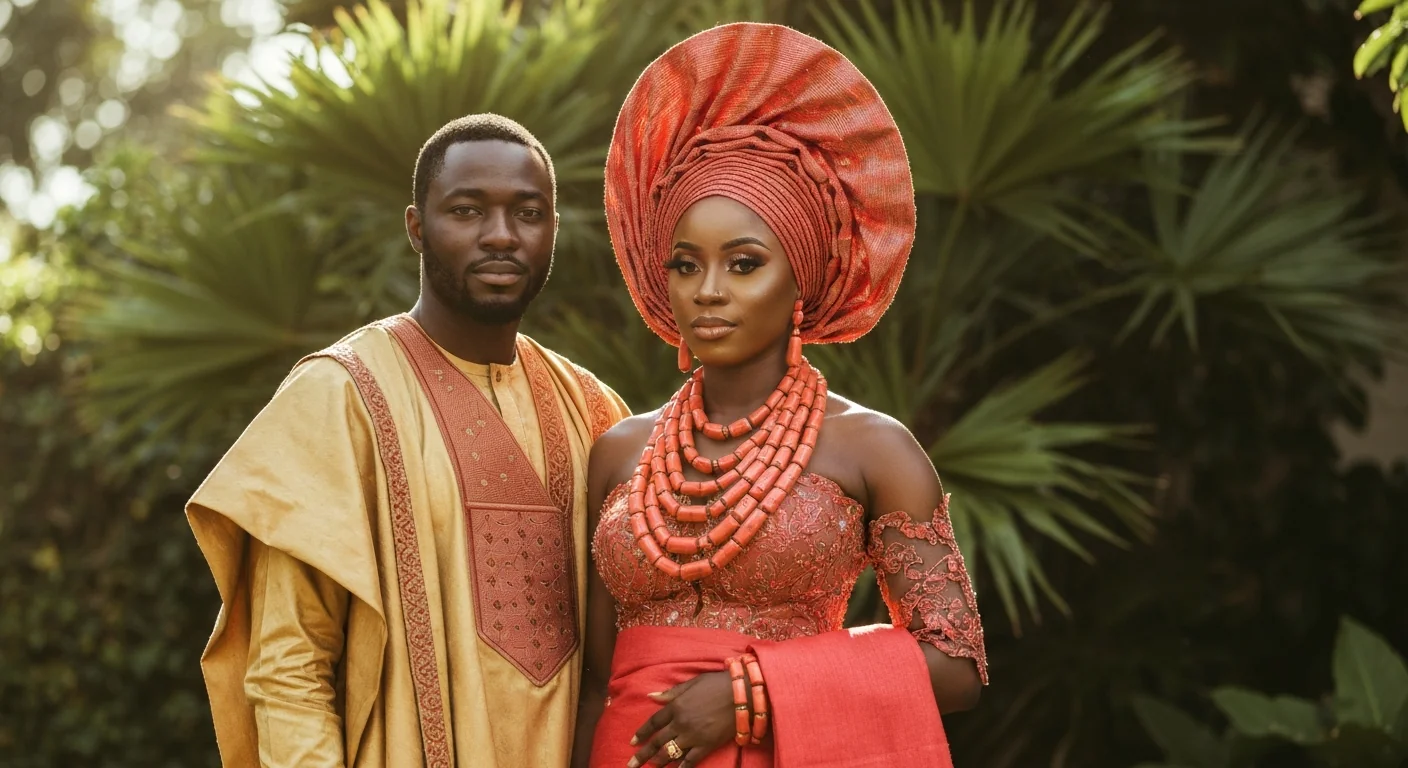
The core fabric is aso-oke — a handwoven cloth made on narrow-band looms in the traditional Yoruba heartland of southwestern Nigeria. Aso-oke comes in three main weaves: ẹtù (deep indigo blue), sanyan (earthy brown-beige), and alaari (a rich, deep red). For weddings, families often choose alaari or a commissioned color, and the entire bridal party — including the groom’s family — may dress in the same aso-oke to signal unity. This coordinated dressing is called aso-ebi, meaning “cloth of the family.”
The Yoruba bride’s signature accessory is the gele — an elaborate headwrap tied from a stiffened fabric, often aso-oke or metallic brocade. Tying a flawless gele is a skill in itself, and professional gele tyers are commonly hired for weddings. The gele is structured like a sculpture, rising high above the head in fans, pleats, or arcs that can take up to an hour to perfect.
The bridal ensemble is completed with layered coral beads — worn around the neck, wrists, and sometimes threaded through the gele — as well as a wrapper (iro) tied at the waist and a matching blouse (buba).
For the Yoruba groom, the agbada is the wedding statement: a flowing, three-piece outfit consisting of a wide outer robe (often embroidered along the neckline and cuffs), a long inner shirt, and trousers. In gold, white, or deep blue — often matching the bride’s palette — a well-tailored agbada conveys authority, elegance, and prosperity.
Colors most associated with Yoruba bridal fashion: gold, coral, white, and alaari red.
Nigeria — Igbo
Igbo traditional wedding attire centers on the George wrapper — a richly textured, often embroidered fabric (originally from India but now iconic in Igbo culture) that brides tie in layered wraps around the waist and chest. The George is typically paired with a matching or complementary blouse, often heavily embroidered with gold or silver thread.
The defining accessories of an Igbo bride are coral beads — strands and strands of them, worn in thick ropes around the neck, across the chest, and on the wrists. In Igbo culture, coral beads are not merely jewelry; they are symbols of wealth, nobility, and family lineage. A bride who walks in heavily adorned with coral is signaling the prosperity of both her family and her groom’s family.
The headpiece varies by community but often includes a beaded crown or a wrapped coral headband. The bride’s face is sometimes adorned with uli — traditional Igbo body art — in geometric patterns on the cheeks, forehead, or décolletage.
The Igbo groom wears a chief’s outfit: a white shirt with heavy embroidery, a wrapper, a red fez cap (also called the Igbo traditional cap or duku), and sometimes a walking stick or horsetail fly whisk that signals elder status. In some communities, the groom’s cap color and style indicate his clan.
Nigeria — Hausa
Hausa weddings, predominantly Muslim, are characterized by an emphasis on elegance and modesty. Brides often wear heavily embroidered lace — sometimes gold-threaded — in rich jewel tones: deep green, wine, royal blue, or gold. The ensemble includes a blouse, wrapper, and a beautifully pinned headscarf. Hausa bridal jewelry leans toward elaborate gold — necklaces, earrings, bracelets, and rings that collectively represent the groom’s wealth and his family’s generosity.
The groom’s equivalent of the agbada is the babban riga — a magnificently embroidered robe with intricate needlework around the collar, chest, and cuffs, worn over trousers and a matching cap. The embroidery on a babban riga can take weeks to complete and is a direct indicator of the wearer’s status and means.
Ghana
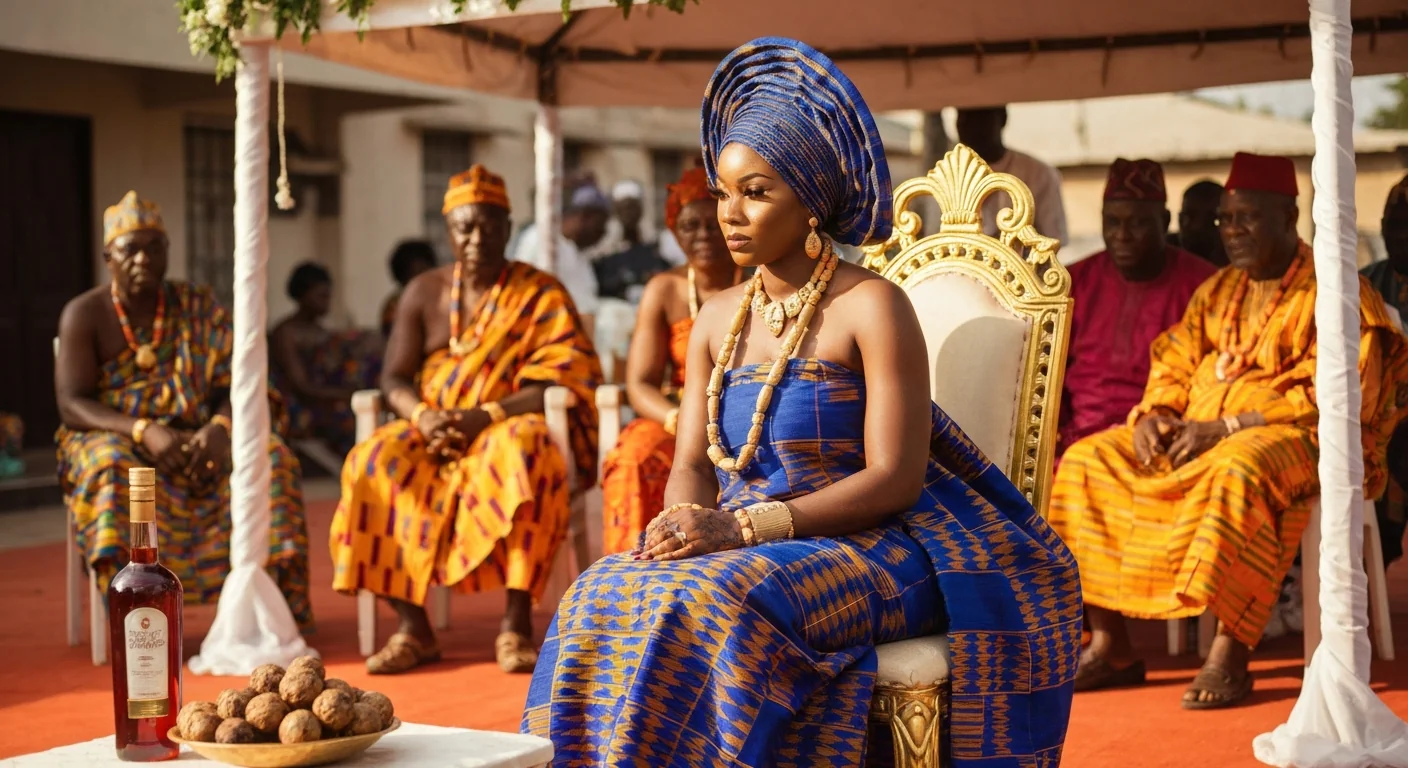
Ghanaian wedding attire is defined by one fabric above all others: Kente cloth.
Kente originates with the Ashanti and Ewe peoples and is woven on narrow looms in strips approximately four inches wide, which are then sewn together to form the final cloth. The patterns are not random — there are over 300 distinct Kente patterns, each with a name, a story, and a specific meaning. Some patterns can only be worn by royalty. Others mark specific occasions. The pattern Adweneasa, for example, means “my thinking has come to an end” — a philosophical statement of completeness often used at significant life events.
Kente colors also carry meaning: gold signifies royalty and wealth, green represents growth and renewal, red evokes political passion and bloodshed for liberation, and blue symbolizes peace and harmony.
Ghanaian brides typically wear Kente wrapped as a dress or two-piece — the cloth draped and pinned at the shoulder or tailored into a structured gown. The matching headwrap, called a duku, is tied to complement the Kente pattern. Krobo beads — handmade glass beads from Ghana’s Eastern Region — are the accessories of choice: vivid, geometric, and worn in multiple strands.
A beautiful Ghanaian tradition is for the bride and groom to wear matching or coordinating Kente, their outfits chosen together so that they tell a visual story as a couple.
Senegal
Senegalese bridal fashion is defined by the boubou (also called grand boubou) — a flowing, wide-sleeved robe worn over matching trousers or a long skirt. For weddings, boubous are made from the finest available fabrics: bazin riche (a stiff, embossed damask that shimmers in the light) or wax print in the richest possible colors.
Senegalese brides are renowned for their gold jewelry — layered necklaces, chandelier earrings, stacked bangles — and for their elaborate hairstyles, often braided and adorned with golden ornaments. The combination of a luminous bazin boubou, heavy gold jewelry, and intricate braiding creates an effect that is simultaneously regal and festive.
The groom’s outfit follows the same boubou structure, with matching or complementary fabric, embroidery at the collar and chest, and a tailored cap called a kufi.
East African Wedding Attire
East Africa’s bridal traditions span everything from the elaborate coastal ceremony of the Swahili coast to the beaded ceremony of the Maasai highlands, with dozens of diverse traditions in between.
Kenya — Kikuyu
In a traditional Kikuyu ruracio (bride price ceremony), attire leans toward fabrics that signal cultural pride. Kikuyu brides commonly wear kitenge or Ankara in warm, golden-brown tones — colors that echo the soil of the Central Highlands. The dress may be a full kitenge gown, a two-piece set, or a wrapper with a matching blouse. Leather accessories — belts, sandals, bangles — add a grounding, earthy quality that connects to Kikuyu agricultural heritage.
At modern Kikuyu weddings, it is also common for the bride’s family to coordinate in a shared fabric (similar to Nigerian aso-ebi), with the kitenge pattern chosen for its connection to the family’s region or aesthetic.
For more on Kikuyu wedding ceremonies, see our guide to Kikuyu ruracio wedding traditions.
Kenya — Maasai
Maasai bridal attire may be the most immediately recognizable on the continent.
The shuka — a red-and-blue or red-and-checked cloth wrapped around the body — is the foundation of Maasai dress for both men and women. For brides, multiple shukas are layered and worn in combination with what can only be described as an architecture of beadwork.
A Maasai bride does not simply buy her jewelry. The beaded accessories she wears on her wedding day are contributed by women across her community — each necklace, bracelet, anklet, and headpiece carrying the blessing of its maker. The enkarewa — the wide, flat collar necklace made by her mother — is the most significant piece, its circular design representing the layout of the Maasai homestead she is entering.
Bead colors are a language: red for bravery and unity, white for purity (representing milk, the sacred Maasai food), blue for sky and water, green for health and land. A fully adorned Maasai bride can be wearing dozens of strands of beads, and the total weight and visual impact is extraordinary.
For a full guide to Maasai wedding customs, including the meaning of every bead color, read our Maasai wedding traditions guide.
Kenya — Swahili / Coastal
On the Swahili coast — spanning Mombasa, Lamu, Malindi, and Zanzibar — bridal attire draws from a centuries-old fusion of African, Arab, Persian, and Indian influences.
Swahili brides are renowned for their wedding-day transformation. The kupamba ceremony (the formal bridal display) sees the bride dressed in embroidered silk or elaborate buibui (a full-coverage outer garment), adorned with gold jewelry — sets of necklaces, earrings, and bracelets that may have been in the family for generations — and painted hands and feet with intricate henna art.
The Swahili groom wears a kanzu (a long white robe) and kofia (an embroidered cap), sometimes paired with a joho (a formal embroidered coat) for the ceremony. The white kanzu and kofia represent Islamic modesty and the formality of the occasion.
Read more in our complete Swahili coastal wedding traditions guide.
Uganda
At a Ugandan Kwanjula (the traditional introduction ceremony, Uganda’s most important pre-wedding event), dress follows strict cultural convention.
Women attending the Kwanjula wear the gomesi — a formal floor-length dress with a square neckline, a waist sash tied at the back, and voluminous sleeves. The gomesi was introduced during the colonial era but has been so thoroughly claimed by Ugandan culture that it is now considered the national dress. For the Kwanjula, brides and female attendants typically wear matching gomesi in a coordinated color chosen by the family.
Men — including the groom — wear the kanzu: a long white cotton robe worn over a suit jacket. The kanzu-over-suit look is uniquely Ugandan and carries both cultural and formal weight. It is the Kwanjula uniform, instantly readable to any Ugandan guest.
For a deep dive into the Kwanjula ceremony, including what guests should bring and wear, see our Kwanjula guide for Uganda.
Ethiopia
Ethiopian brides wear one of Africa’s most elegant wedding outfits: the habesha kemis (also written habesha qemis).
The habesha kemis is a long, flowing dress made from hand-woven cotton in natural white or off-white tones, with intricate tilet (border embroidery) worked along the collar, cuffs, and hem. The embroidery is typically done in deep jewel tones — bordeaux, gold, blue, or green — using traditional Amhara and Tigrinya motifs. The result is a dress that reads as simultaneously pure and ornate: a white canvas elevated by extraordinary needlework.
Many Ethiopian brides layer the kemis with a netela (sheer white shawl) draped over the shoulders, and some add a kaba — a velvet or brocade cape or jacket in gold or silver — for the ceremony. Bridal jewelry tends toward gold crosses, reflecting the Ethiopian Orthodox Christian tradition.
Ethiopian grooms wear a matching habesha suit — white jodhpur-style trousers and a long white jacket with embroidered detailing — creating a visually unified couple that is unlike any other in Africa.
For the full story of Ethiopian wedding ceremonies, read our Ethiopian wedding traditions guide.
North African Wedding Attire
North African wedding attire is defined by layering, transformation, and — in Morocco especially — the theatrical drama of multiple outfit changes throughout the wedding night.
Morocco
A Moroccan bride does not wear one dress. She wears up to seven.
The progression of outfits at a Moroccan wedding is one of the most elaborate in the world. The star garment is the takchita — a formal two-piece ensemble consisting of an inner dress (the first piece) covered by a more ornate, open-fronted overdress (the second piece), secured at the waist by an elaborate belt called a mdamma. Takchitas are made from silk, velvet, brocade, or chiffon — and decorated with hand-sewn sfifa (braid trim), qamriya (geometric beadwork), and metallic embroidery.
Before the takchita, brides typically wear the kaftan — a long, single-piece garment in the same luxurious fabrics. The kaftan first appeared in the 12th century and has evolved into one of the world’s most refined garments. Each city in Morocco has its own kaftan style: Fes is known for jewel-toned silk and gold embroidery, Marrakech for rich velvet, and Rabat for delicate pastel chiffon.
One of the most dramatic moments in a Moroccan wedding is the Amaria ceremony — the bride is seated on a wooden platform carried aloft by attendants through the celebration hall, raised high so all guests can see her in each new outfit as she changes throughout the night.
Colors cycle through the evening: often starting with white or cream, moving through gold, emerald, or burgundy, and ending with the bridal red — a color associated with fertility and joy across North Africa.
Algeria
Algerian bridal attire varies by region, but the most iconic garment is the karakou — an elaborate velvet jacket or dress-jacket combination, densely embroidered with gold and silver thread in intricate geometric and floral patterns. The karakou tradition is particularly strong in Algiers (the capital) and surrounding regions.
Worn over a matching skirt or palazzo trousers, the karakou is paired with heavy gold jewelry — headpieces, necklaces, and earrings — and the total look is one of extraordinary opulence. The embroidery on a karakou can take hundreds of hours to complete and is passed down through generations as a family heirloom.
Regional variations include the chedda of Tlemcen (a crown-like velvet headpiece and structured bodice) and the haik (a white full-body veil) worn in more conservative ceremonies.
Egypt
Egyptian weddings today commonly feature a white Western-style gown for the ceremony, reflecting the influence of European and American bridal fashion in urban Egypt. However, Egyptian bridal culture distinguishes itself through its accessories and ceremony: an Egyptian bride’s gold jewelry — necklaces, cuffs, earrings, and hair ornaments — is often substantial and carefully selected, representing both her family’s wealth and the groom’s financial commitment.
The Zaffa — the traditional Egyptian wedding procession — is where attire becomes performance. Musicians playing drums, horns, and bagpipes lead the couple through the venue, while attendants dressed in folkloric costumes carry candles or incense burners. The bride in her gown and her attendants in their coordinated outfits become part of a theatrical display that guests line up to watch.
In Upper Egypt and traditional communities, older ceremonial garments like the galabiya (a flowing robe) in embroidered silk remain part of rural wedding customs.
Southern African Wedding Attire
Southern Africa’s traditional wedding attire is among the most codified on the continent — particularly among the Zulu, Xhosa, and Ndebele peoples of South Africa, where every element of dress conveys specific information about the wearer’s life stage, clan, and social status.
South Africa — Zulu
A Zulu bride’s traditional wedding outfit is unmistakable.
The isidwaba is a stiff leather skirt — traditionally made from animal hide but increasingly made from modern leather substitutes — that flares at the hem and is worn at the waist. Over the chest, the bride wears the isicwaya — a top made from animal skin, sometimes decorated with beadwork. The effect is dramatic: the rigidity of the leather against the body creates a sculptural silhouette unlike anything in Western bridal fashion.
The bride’s accessories include layers of isigqizo (beaded necklaces), izinqawe (beaded anklets), beaded armbands, and a beaded headband. The color coding of Zulu beadwork is complex — specific bead patterns are associated with the bride’s clan and family identity, making her accessories a visual biography.
The Zulu groom wears ibheshu — a rear apron made from animal skin (historically leopard or cowhide, now more commonly goat) worn over the lower body, alongside isikhakha (front apron) and isihlobo (a band of cowtail or fur worn across the chest). He carries a knobkierie (wooden club) and ikhiwa (shield), symbols of his warrior status and readiness to protect his family.
South Africa — Xhosa
Xhosa bridal attire is built around umbhaco — a white or cream fabric (historically cotton, now also available in linen) decorated with bold geometric patterns in black, red, and orange. The umbhaco is worn as a wrap skirt, and the bride’s top may also be made from the same cloth.
The doek headwrap in matching umbhaco fabric is tied in a distinctive style that communicates the bride’s status. Married Xhosa women traditionally cover their hair as a sign of respect — the doek is part of that transition.
At traditional Xhosa ceremonies, brides sometimes apply ochre (a red-orange clay) to the face and skin. Far from being a simple cosmetic, ochre in Xhosa culture is a spiritual substance associated with ancestral protection and the blessing of elders. The reddened skin is a visual prayer.
South Africa — Ndebele
Ndebele wedding attire is arguably the most visually distinctive in all of Africa — a living art form that cannot be separated from its cultural context.
Ndebele women are renowned across the continent for their beadwork, and the wedding ceremony is when this tradition reaches its apex. The bride wears isigolwani — thick, rigid rings of beadwork worn around the neck, arms, and legs — alongside a beaded jocolo (a stiff beaded apron) and a mapoto (a leather marriage blanket). The quantity and intricacy of the beadwork directly signals the wearer’s life stage: the more beadwork, the more established the woman.
Ndebele beadwork colors follow a highly codified system — not merely decorative but a language that any Ndebele community member can read. Specific color combinations identify family lineage, age, and marital status. A bride’s beaded outfit is essentially a wearable census record.
The isigubu — a marriage blanket painted with geometric Ndebele motifs in red, yellow, green, and black — is draped over the groom’s shoulders, making him immediately identifiable as a groom and signaling his family’s patterns and clan identity.
Zimbabwe
Zimbabwean bridal attire has evolved significantly in recent decades, reflecting the country’s mix of Shona and Ndebele heritage alongside modern influences.
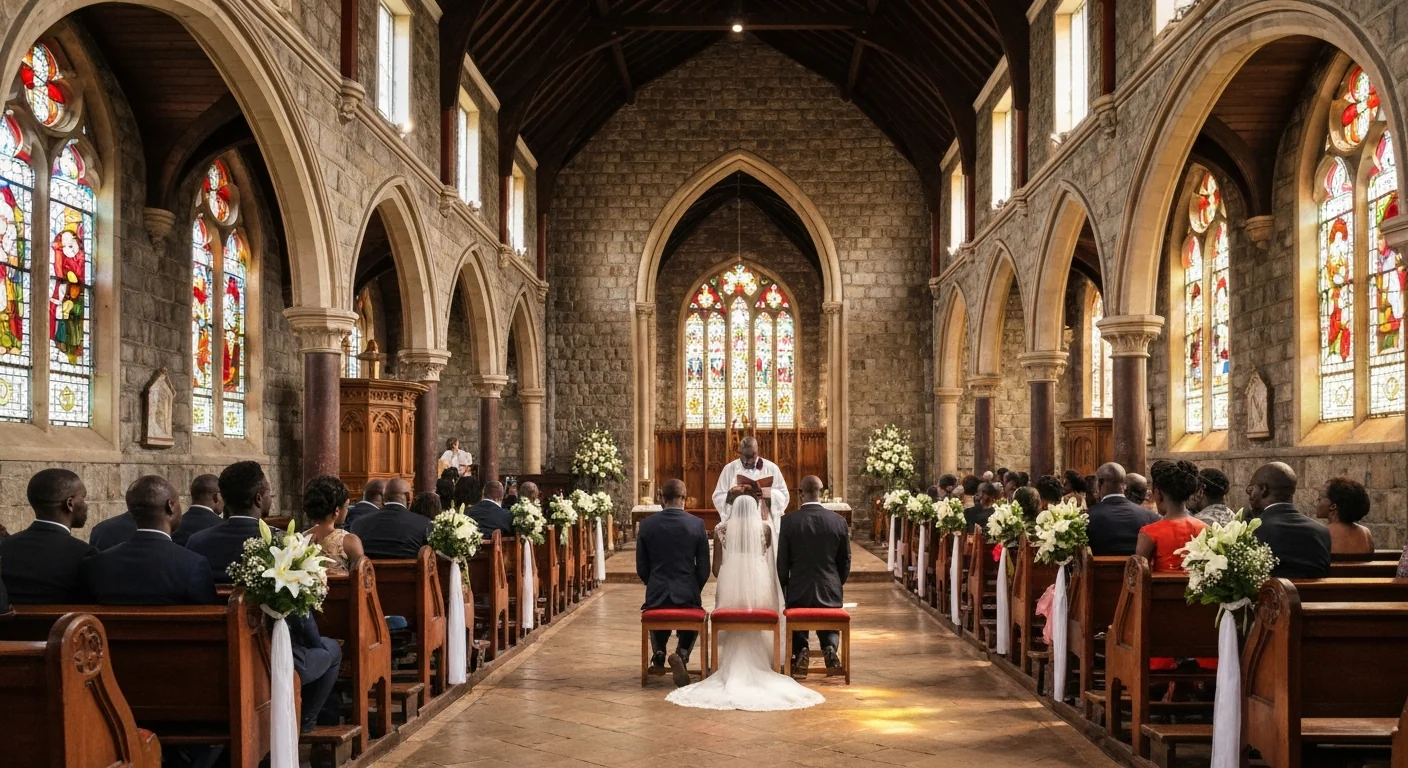
At the roora (bride price ceremony), women typically wear Shona cloth — brightly patterned fabric in earth tones — styled as a wrapper and blouse, often with a matching headwrap. Modern couples frequently combine a white Western-style church gown for the formal ceremony with Shona cloth for the traditional portion of the celebration.
Central Africa and the Islands
Democratic Republic of Congo (DRC)
Congolese wedding attire centers on the liputa — a brightly colored fabric wrap that is tied around the body in various styles depending on the occasion and region. At weddings, liputa comes in the boldest possible patterns: tropical flowers, geometric abstracts, and richly colored wax prints that catch the light of every camera flash.
The Congolese love of vivid color is expressed fully at weddings: brides, mothers, aunties, and female guests coordinating in matching liputa creates a wall-to-wall color effect that transforms the celebration space. A matching fabric headscarf completes the look.
Madagascar
On Madagascar, the sacred textile is the lamba — a rectangular cloth made from silk or cotton (or a silk-cotton blend) that is worn draped around the body in a style unique to each region of the island. At wedding ceremonies, the finest lambas — in vivid colors or traditional striped patterns — are worn wrapped at the waist, draped over the shoulder, or tied around the head.
The landy (silk lamba) is particularly prized at weddings for its sheen and its association with prestige and celebration. Madagascan wedding couples may also wrap a shared lamba around their shoulders during the ceremony, symbolizing their union.
Namibia — Herero
Herero bridal attire is one of the most unusual in Africa because of its origin: the voluminous, full-length Victorian-era dresses worn by Herero women were adopted during German colonial occupation in the late 19th and early 20th centuries, initially as a mark of Christian modesty and later reclaimed as a symbol of Herero cultural identity and resistance.
Today, the Herero ozondjambi (bridal dress) features a wide, bell-shaped skirt with multiple layers of petticoats, a fitted bodice, and long sleeves — all in bold, solid colors (red, green, blue, or purple being common choices). The defining accessory is the ohorokwe — a dramatic horned headpiece made from fabric that mimics the shape of a cow’s horns, a direct reference to the Herero people’s cattle-herding heritage and the centrality of cattle to their identity.
The combination of Victorian silhouette and African cattle symbolism makes Herero wedding attire one of the most striking examples of cultural synthesis on the continent.
The Rise of Cultural Fusion
One of the most exciting developments in African wedding fashion is the deliberate, creative blending of Western silhouettes with traditional African fabrics and accessories.
A Kenyan bride might wear a white ball gown with Ankara-printed panels in the skirt. A Ghanaian groom might wear a tuxedo with Kente-cloth lapels and cuffs. A Nigerian bride might commission a mermaid wedding gown in aso-oke fabric rather than Western bridal lace. A South African couple might wear matching umbhaco sashes over their Western ceremony outfits and change into full traditional dress for the reception.
This fusion is not dilution — it is evolution. Modern African couples are finding ways to honor the cultural depth of their attire traditions while expressing individual creativity and adapting to contemporary wedding contexts. The result is a genre of bridal fashion that is uniquely, unmistakably African while remaining fluid and forward-looking.
Some specific trends worth knowing:
- Ankara ballgowns — a full Western-style bridal silhouette constructed entirely in Ankara wax print
- Kente-trimmed suits — for grooms who want cultural identity without a full traditional outfit
- Beaded accessories on Western dresses — Maasai, Ndebele, or Zulu beadwork worn alongside a classic white gown
- Reception outfit changes — using the second (or third) outfit to move from Western to traditional, so the couple celebrates both worlds
- Matching couple outfits — the growing trend of bride and groom in identical or visually complementary traditional fabric from the same culture
If you’re sourcing traditional attire — whether it’s a custom Kente ensemble, aso-oke bridal set, or beadwork accessories — browsing the Harusi Hub vendor marketplace can help you find fashion designers and tailors who specialise in African bridal wear, filtered by location and style. And with wedding attire often being one of the largest budget line items, tracking the cost across multiple outfits and accessories in your budget tracker keeps the spending visible.
For ideas on incorporating Ankara specifically into your bridal look, read our full guide to Ankara wedding dress ideas.
What to Wear as a Guest at an African Wedding
If you have been invited to a traditional African wedding — particularly one outside your own cultural background — navigating the dress code thoughtfully is a mark of respect and enthusiasm for the couple’s heritage.
Ask the couple directly. This is always the best starting point. Many couples will specify a dress code, a fabric, or a color palette on the invitation or on their wedding website.
Respect aso-ebi if it’s a Nigerian wedding. Aso-ebi is the coordinating fabric distributed to guests as a symbol of family solidarity and celebration. If you have been given aso-ebi, wearing it is an honor and a sign of belonging. If you have not, simply dress smartly in a color that does not clash with the palette.
Avoid white. Across most African cultures, white is the bride’s color. Wearing a white or predominantly white outfit as a guest is considered inappropriate. When in doubt, choose color — the more vibrant, the better.
Embrace the full look. Many women guests at African weddings go all out — full gele, coral beads, floor-length gowns, elaborate headwraps. This is not overdressing; it is participating in the celebration at the level it deserves. Match the energy.
For men, a well-tailored agbada, kanzu, or traditional fabric suit is always welcome. Even if you are not of the culture, making the effort to dress in a culturally respectful way is universally appreciated.
Check if there is a color theme. Some couples provide a specific color palette for guests. Dressing in those tones shows you paid attention and you are part of the collective visual story they are creating.
Celebrating Heritage, One Outfit at a Time
The fabrics, the beads, the headwraps, the leather skirts, the embroidered robes — each element of African wedding attire is a chapter in a story that stretches back generations. When a Ghanaian bride wears Kente, she is wearing her grandmother’s grandmother’s cloth. When a Maasai bride is adorned with beads from women across her community, she is wearing the collected blessings of everyone who loves her. When a Moroccan bride changes into her fifth kaftan of the evening, she is participating in a tradition of beauty and abundance that has defined celebration in North Africa for centuries.
Your wedding attire is one of the most powerful choices you make on your wedding day. Across Africa, that choice is never accidental — and it is always worth celebrating.
To browse more inspiration, ideas, and cultural guides, explore our African wedding traditions guide and our in-depth feature on wedding dress styles in Kenya. And if you want to capture and share your wedding look with the world, our photo editing and gallery guide walks you through exactly how to showcase your wedding photos beautifully.
Showcase your wedding style
Create a wedding website that celebrates your heritage — share photos, your story, and your registry.
Create Your Wedding Website