Swahili Wedding Traditions: Nikah, Kupamba, Henna, and the Coastal Celebration
A complete guide to Swahili and coastal Kenyan weddings — from kuposa proposal to nikah ceremony, kupamba bridal display, henna art, taarab music, and the legendary Swahili feast.

Swahili Wedding Traditions: Nikah, Kupamba, Henna, and the Coastal Celebration
A complete guide to the multi-day Swahili harusi — from the kuposa proposal to the grand walimah feast, and every tradition in between.
A Swahili wedding is not a single event. It is a multi-day celebration that unfolds across homes, mosques, and open-air grounds along Kenya’s coast, drawing together families, neighbours, and entire communities in a series of rituals that have been practiced for centuries. Known simply as harusi, the Swahili wedding is one of the most elaborate and culturally layered wedding traditions in East Africa.
What makes the Swahili harusi distinctive is its fusion of influences. Islamic faith provides the spiritual foundation — the nikah contract, the mahr, the Quranic recitations. But woven through these religious elements are African, Arab, Persian, and Indian customs that arrived on the monsoon winds and settled into the coral stone towns of Mombasa, Lamu, Malindi, and the wider Swahili coast. The result is a wedding tradition that feels both deeply sacred and exuberantly festive.
Whether you are a bride or groom preparing for your own coastal wedding, a guest attending one for the first time, or simply curious about the traditions that define Swahili culture, this guide walks you through every stage of the harusi — from the first formal visit by elders to the final feast that feeds the whole community.
The Stages of a Swahili Wedding
A traditional Swahili wedding follows a clear sequence of stages, each with its own customs, protocols, and significance. Some modern couples compress the timeline, but the order of events remains remarkably consistent from Lamu to Mombasa to the islands of Zanzibar.
1. Kuposa — The Formal Proposal
The harusi begins not with a ring but with a delegation of elders. In kuposa, the groom’s family sends a representative — typically an uncle or respected elder — to the bride’s family home to formally express interest in marriage. The representative carries tende (dates) and a sum of money as a gesture of goodwill and seriousness.
What makes kuposa distinctive in Swahili culture is the protocol around who participates. The parents of both the bride and groom take a deliberately low profile during negotiations. It is the uncles, aunts, and appointed intermediaries who carry the conversation. Social status, family reputation, and the compatibility of the two families all factor into the discussion.
Kuposa is not a single visit. It often takes multiple meetings before both sides reach agreement. The process is measured and deliberate — a reflection of the Swahili proverb “Haraka haraka haina baraka” (haste has no blessings). Only after the bride’s family accepts the proposal does the process move forward.
2. Kisomo — The Quranic Blessing
Once the proposal is accepted, the families gather for kisomo, a session of Quran recitation dedicated to the happiness and prosperity of the couple. An imam or religious scholar leads the recitation, and prayers are offered for the success of the union.
Kisomo is intimate and spiritual, typically held at the bride’s family home. After the recitation, the gathering is served traditional Swahili dishes — a first taste of the generosity and hospitality that will define the celebrations ahead. This stage marks the spiritual endorsement of the marriage and sets a tone of reverence before the more festive events that follow.
3. Kupeana Mikono — The Gift Exchange
Kupeana mikono, which translates roughly to “the giving of hands,” is the formal engagement ceremony where the two families exchange gifts and negotiate the mahari (dowry). This is a significant event that solidifies the commitment between the families.
The occasion is marked by celebration — Swahili drumbeats fill the air, and traditional dances are performed. The exchange is not merely transactional; it is a public declaration that these two families are now bound together. The gifts exchanged symbolise respect, generosity, and the promise of mutual support.
The mahari itself is negotiated during this stage. In Islamic tradition and Swahili custom, the mahr is a gift from the groom to the bride — not to her family. It belongs solely to the bride and may include money, gold jewellery, clothing, or property. The mahr is her right under Islamic law and serves as a form of financial security. Alongside the monetary mahr, the groom’s family also prepares the samadari — an elaborately decorated bridal bed, complete with fine linens, cushions, and perfumes, which is set up in the couple’s new home.
4. Nikah — The Marriage Contract
The nikah is the heart of the Swahili wedding — the Islamic marriage ceremony that makes the union official in the eyes of God and the law. It is typically held at a mosque, though some families hold it at a home or wedding venue.
An imam officiates the ceremony. The groom is present, while the bride is traditionally represented by her father, brother, or uncle (her wali). The imam asks for the groom’s consent to the marriage three times — a deliberate, formal process that emphasises the gravity of the commitment. The bride’s consent is confirmed through her representative. Once both parties agree, the marriage contract (nikah nama) is signed in the presence of witnesses.
After the contract is signed, halwa (a sweet confection) and kahawa (Swahili coffee spiced with cardamom and ginger) are served to guests. In Lamu and other parts of the northern coast, the siwa — a large brass side-blown horn that dates back to the 17th century — is blown to announce the marriage to the community. The sound of the siwa carries across the narrow streets and waterfront, a triumphant declaration that a new family has been formed.
The nikah is followed by prayers and blessings from the gathered community. It is a moment of profound significance — joyful but also solemn, marking the transition from two individuals to a married couple.
5. Kutoa Bi Harusi — The Bride’s Send-Off
After the nikah, the bride is formally sent off from her family home to begin her married life. This ceremony, kutoa bi harusi, is an emotional occasion. The bride is dressed in green — a colour associated with paradise, prosperity, and new beginnings in Islamic tradition.
Her family gathers to offer blessings, advice, and sometimes tears. The send-off is a recognition that the bride is leaving one home to build another, and the rituals surrounding it honour both the family she is leaving and the family she is joining.
6. Kushika Mlango — Blocking the Door
One of the most playful traditions in a Swahili wedding, particularly in Mombasa, is kushika mlango — literally, “holding the door.” When the groom arrives at the bride’s home (or the venue where she is waiting), the bride’s unmarried female relatives physically block the entrance and refuse to let him in until he pays a fee.
The negotiations are theatrical and humorous. The young women name their price, the groom’s party bargains, and the crowd cheers and laughs. It is a lighthearted reminder that the bride is treasured by her family and that the groom must demonstrate his willingness to provide. Eventually, the groom pays (usually in cash), the door opens, and the celebration continues.
Kushika mlango is most commonly practiced in Mombasa weddings. In Lamu, where traditions tend to be more conservative and closely aligned with Yemeni and Omani roots, this particular custom is less common.
7. Walimah — The Grand Feast
The walimah is the grand wedding reception and the most public of all the celebrations. Held in an open field, community hall, or hotel grounds, the walimah is a feast that is open to the entire community. In Swahili culture, feeding your community at a wedding is not optional — it is a religious and social obligation. The Prophet Muhammad encouraged the walimah, and Swahili families take this seriously.
The food is extraordinary. Tables are laden with pilau (spiced rice cooked with meat stock), biryani (layered rice with meat and aromatic spices), kuku wa kupaka (chicken in coconut sauce), samaki wa kupaka (fish in coconut and tamarind sauce), wali wa nazi (coconut rice), mbaazi wa nazi (pigeon peas in coconut milk), sambusa (meat-filled pastries), and bhajia (spiced lentil fritters). Drinks include kahawa (spiced coffee), tangawizi (ginger drink), and madafu (fresh coconut water).
The scale of the walimah reflects the family’s generosity and standing. Hundreds — sometimes thousands — of guests are fed. It is the culmination of the harusi, a celebration that brings together everything the Swahili coast is known for: community, hospitality, music, and food.
Usiku wa Henna — The Henna Night
The henna ceremony, Usiku wa Henna, is one of the most iconic and visually striking traditions of the Swahili wedding. It is a women-only event that takes place in the days leading up to the nikah, and it is both a beauty ritual and a spiritual practice.
The Art of Henna Application
Henna application in Swahili weddings is not a quick decorative touch. It is a meticulous, multi-day process that can span two to seven days, with each session lasting up to twelve hours. The henna paste is made from henna powder mixed with lime juice and applied using a fine twig or cone. The bride’s hands and feet receive five to six applications, each layer building depth and darkness of colour.
The designs are intricate and regionally distinctive. In Mombasa, the piko style is predominant — a bold, geometric pattern that covers the hands and feet in elaborate symmetrical designs. Coastal motifs, Quranic symbolism, and patterns passed down through generations of women are common. The henna is believed to bring blessings, protection, and good fortune to the bride.
The Celebration
Usiku wa Henna is far more than a beauty appointment. It is a celebration in its own right — an evening (or series of evenings) filled with laughter, music, dancing, and storytelling. The bride sits at the centre while her friends, sisters, cousins, and aunts gather around her. Taarab music plays, women dance and sing, and the atmosphere is one of pure feminine joy and solidarity.
The Role of the Somo
Overseeing much of the bride’s preparation is the somo — an older, experienced woman (often a relative or family friend) who serves as the bride’s mentor and guide. The somo applies henna, oversees beauty rituals such as sandalwood oil baths and skin preparation, and — perhaps most importantly — instructs the bride on married life.
The somo’s role is deeply respected in Swahili culture. She is a bridge between generations, passing down knowledge about relationships, intimacy, household management, and the expectations of marriage. Her guidance is considered essential to preparing the bride not just physically but emotionally and mentally for her new life.
Kupamba — The Bridal Display
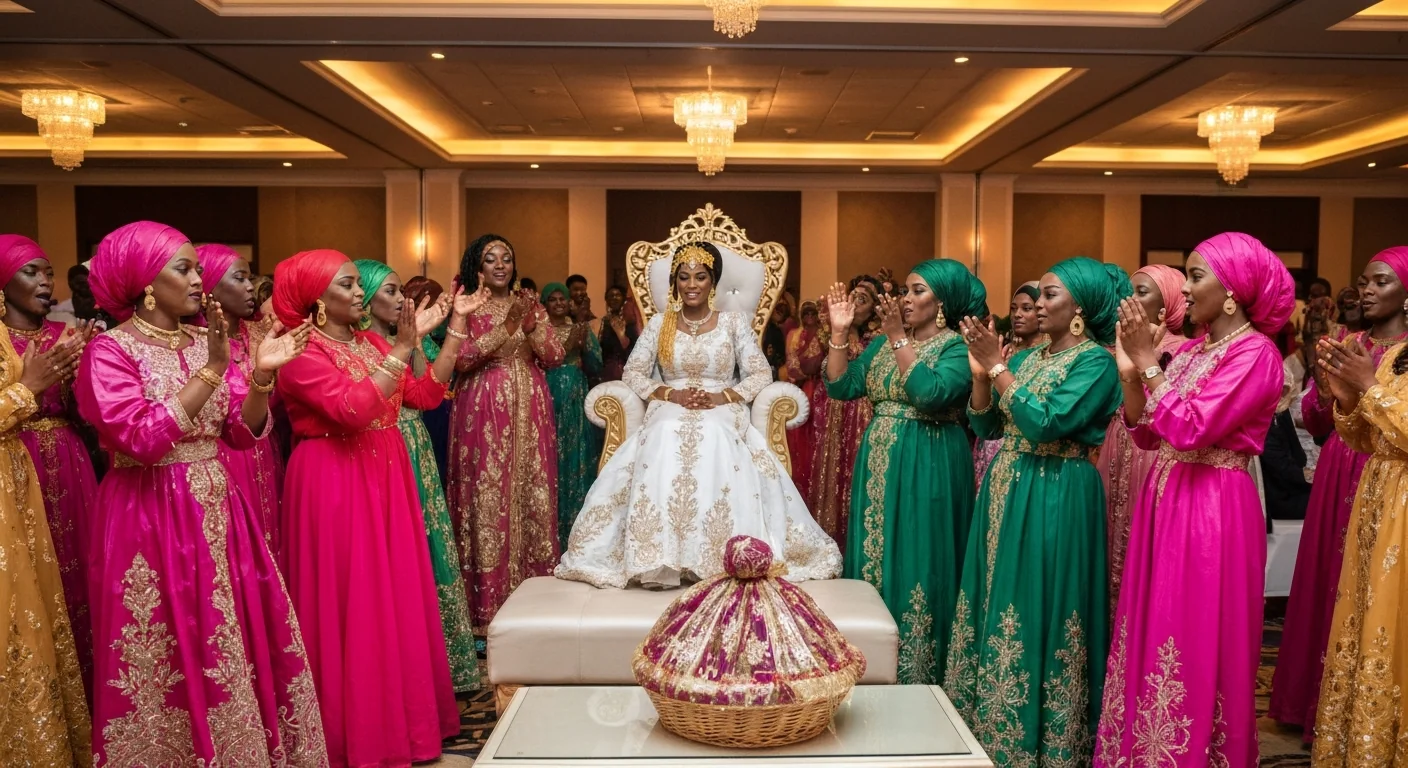
Kupamba is one of the most spectacular events in the Swahili wedding calendar. It is a women-only celebration — a public display of the bride in her full wedding regalia, and it is a tradition unique to the Swahili coast.
The Bride on the Throne
The bride is seated on an elevated throne or ornate chair, dressed in layers of satin, silk, and gold-embroidered fabric. Her hands and feet are covered in fresh henna, jasmine flowers are woven into her hair or pinned to her clothing, and she is adorned with gold jewellery — necklaces, bangles, earrings, and sometimes a gold headpiece. The effect is breathtaking. The bride is presented as a queen, and the women in attendance come forward to admire her, offer blessings, and celebrate her beauty.
Chakacha Dance
Kupamba features the chakacha, a traditional Swahili dance performed exclusively by women. The chakacha is characterised by its rhythmic hip-swaying movements, performed to the beat of drums and the melodies of taarab music. It is sensual, celebratory, and deeply rooted in Swahili feminine expression. Women of all ages participate, and the dancing often continues late into the night.
Shinda — The Women’s Lunch
In some communities, kupamba is preceded by shinda, a women’s luncheon where the bride’s female guests gather wearing matching sare outfits — coordinated fabrics chosen by the bride’s family. The shinda is a more intimate gathering than the kupamba itself, a chance for the women to eat together, catch up, and build anticipation for the main event.
The Significance
Kupamba serves multiple purposes. It celebrates the bride’s beauty and the family’s investment in her preparation. It provides a space for women to gather, dance, and express joy in a culturally sanctioned, women-only environment. And it publicly marks the bride’s transition from single woman to wife, witnessed by the women of her community.
Taarab Music — The Soundtrack of the Swahili Wedding
No Swahili wedding is complete without taarab, the poetic musical tradition that has defined celebrations along the East African coast for nearly two centuries. The word itself comes from the Arabic “tarab,” meaning “to be moved to ecstasy” — and that is precisely the effect this music aims to achieve.
Origins and History
Taarab originated in the 1830s in the royal courts of Zanzibar. Sultan Barghash bin Said, captivated by the music he heard during a visit to Egypt, sent a young musician named Mohamed Ibrahim to Cairo to study Egyptian and classical Arabic music. Ibrahim returned with new instruments and techniques, and taarab began to take shape as a distinctive Swahili genre.
The music blends Arabic melodic structures with African rhythms and Indian instrumentation. A traditional taarab ensemble includes the qanun (a plucked zither), the oud (a pear-shaped stringed instrument), violins, percussion drums, and sometimes an accordion or harmonium. The result is a rich, layered sound that is unmistakably coastal East African.
Siti binti Saad — The Voice That Changed Everything
The most important figure in taarab history is Siti binti Saad (c. 1880-1950), a woman born into slavery in Fumba, Zanzibar. Siti’s extraordinary voice brought her to the attention of wealthy families, and she became the essential performer at weddings and celebrations among Zanzibar’s elite. No ceremony — wedding or otherwise — was considered complete without her.
In the 1920s and 1930s, Siti binti Saad became the first East African vocalist to make commercial recordings, producing over 250 phonograph records. By singing in Swahili rather than Arabic, she brought taarab out of the royal courts and into the lives of ordinary people. She also introduced natiki, a dance and pantomime element inspired by Indian performance traditions, expanding taarab from a purely musical form into a theatrical experience.
Taarab at Weddings Today
At a modern Swahili wedding, taarab is performed during the kupamba, the walimah, and the henna night. The lyrics are deeply poetic, often employing double entendre and metaphor to comment on love, desire, jealousy, and the complexities of relationships. Guests show their appreciation by placing money on the performer’s forehead or tucking it into their clothing — a practice called kutunza.
Taarab remains a living tradition. While recorded music has replaced live ensembles at many weddings, the most prestigious celebrations still feature live taarab bands, and the music continues to evolve while honouring its roots.
Lamu vs. Mombasa — Regional Variations
While the core elements of the Swahili harusi are consistent across the coast, there are notable differences between the traditions of Lamu and Mombasa — the two most significant centres of Swahili culture in Kenya.
Lamu Traditions
Lamu’s wedding customs are among the most conservative on the Swahili coast, reflecting the island’s deep Yemeni and Omani heritage. Weddings in Lamu tend to be more formal and closely aligned with classical Islamic practice.
The siwa horn — a large brass side-blown instrument that dates to the 17th century — is blown to announce the nikah and other key moments. Historically, the siwa was a symbol of royal authority along the Swahili coast, and its use at weddings carries that weight of tradition.
Lamu weddings may also feature dhow processions, where the bride arrives at the ceremony on a beautifully decorated traditional sailing vessel. The dhow, adorned with flowers and fabric, glides through Lamu’s harbour or along the waterfront, creating a spectacular entrance that connects the wedding to the island’s deep maritime heritage.
Mombasa Traditions
Mombasa’s wedding traditions are more diverse, reflecting the city’s position as a major port and its long history of Indian, Arab, and African cultural exchange. Kushika mlango (door blocking) is a distinctly Mombasa tradition, as is the more elaborate chakacha dancing during kupamba.
Historically, Mombasa also practiced the vugo — a virginity ceremony — but this tradition has declined significantly since the 1970s and is rarely practiced today. Indian influences are more visible in Mombasa weddings, from the elaborate biryani served at the walimah to certain decorative elements and even some dance styles.
Mombasa weddings tend to be larger, louder, and more openly festive than their Lamu counterparts. The city’s cosmopolitan character is reflected in weddings that blend tradition with contemporary elements — live taarab alongside modern sound systems, traditional kangas alongside designer outfits, and guest lists that span communities.
Swahili Wedding Attire and Adornment
Clothing at a Swahili wedding is not merely decorative — it communicates status, stage of ceremony, and cultural identity.
The Bride
The bride’s wardrobe changes multiple times across the multi-day celebration. During the nikah and kutoa bi harusi, she may wear green, symbolising paradise and new beginnings. For kupamba, she is dressed in her most elaborate outfit — satin or silk in rich colours, heavy gold jewellery, jasmine flowers, and fresh henna on her hands and feet.
The Kanga
The kanga — a rectangular printed cotton cloth — plays a unique role in Swahili weddings and daily life. Every kanga features a jina (name/proverb) printed along its border. At weddings, the proverbs printed on kangas serve as a subtle communication tool. A mother might give her daughter a kanga printed with “Subira huvuta heri” (patience attracts happiness) as marriage advice. A guest might wear one with “Chanda chema huvikwa pete” (a beautiful finger gets the ring) to celebrate the bride.
Kangas are also given as gifts during kupeana mikono and are sometimes used to wrap gifts or line the samadari bridal bed.
Guest Attire
Female guests at the walimah and kupamba dress in their finest — often coordinated fabric or matching sare outfits for the shinda. Men wear kanzu (long white robes) paired with kofia (embroidered caps) for the nikah, and may change into suits or more contemporary outfits for the walimah.
Swahili Proverbs and the Language of Marriage
The Swahili coast has a rich tradition of proverbial wisdom, and weddings are occasions where these proverbs are spoken, sung, printed on kangas, and woven into conversation. Here are some of the most commonly heard:
-
“Kukopa harusi, kulipa matanga” — Borrowing is a wedding, repaying is a funeral. A warning against taking on debt for celebrations, reminding couples that financial prudence matters more than extravagance.
-
“Chanda chema huvikwa pete” — A beautiful finger gets the ring. A compliment to the bride, suggesting she is worthy and deserving of marriage.
-
“Haraka haraka haina baraka” — Haste has no blessings. A reminder to take things slowly and deliberately — applicable to both the wedding planning process and the marriage itself.
-
“Subira huvuta heri” — Patience attracts happiness. Marriage advice that speaks to the long game of building a life together.
These proverbs are more than decorative language. They carry the accumulated wisdom of generations, and their use at weddings connects the new couple to the broader moral and philosophical traditions of Swahili culture.
Planning a Swahili Wedding Today
Modern Swahili weddings honour tradition while adapting to contemporary life. Here are practical considerations for couples planning a coastal Kenyan wedding:
Timeline: A full traditional harusi can span one to two weeks. Many modern couples condense this to three to five days, combining some stages or holding them on consecutive days rather than spacing them out.
Venue: The nikah is typically held at a mosque. The walimah may be held at a hotel, community hall, or open-air ground. Kupamba and henna nights are usually held at a private home or rented event space.
Budget: The walimah is typically the most expensive component due to the scale of catering required. Families often contribute collectively — the extended family system that defines Swahili culture extends to wedding financing.
Community involvement: Swahili weddings are community events. Neighbours help with cooking, decorating, and logistics. This communal approach reduces costs and strengthens social bonds, but it also means that the wedding belongs to the community as much as it belongs to the couple.
Modern adaptations: Professional photographers and videographers are now standard. Social media has introduced new expectations around decoration and presentation. But the core rituals — kuposa, nikah, henna, kupamba, walimah — remain unchanged, and any couple who honours these traditions will find themselves surrounded by the warmth and support of their community.
Frequently Asked Questions
How long does a traditional Swahili wedding last?
A full traditional Swahili harusi can last anywhere from one to two weeks, starting with the kuposa proposal and ending with the walimah feast. The henna ceremony alone can span two to seven days. However, many modern couples condense the celebrations into three to five days while still observing all the key stages.
Can non-Muslims attend a Swahili wedding?
Yes. While the nikah ceremony at the mosque follows Islamic religious protocols, the walimah feast and many of the cultural celebrations (henna night, kupamba) are community-wide events where guests of all faiths are welcome. If you are attending a nikah at a mosque, dress modestly and follow the guidance of your hosts regarding seating and conduct.
What is the difference between mahr and mahari?
Mahr is the Arabic term and mahari is the Swahili term for the same concept — a gift from the groom to the bride that is her sole property. It is a religious obligation in Islamic marriage and is not paid to the bride’s family. The mahr can include money, gold, jewellery, or property, and it is negotiated during the kupeana mikono stage.
What should I wear as a guest to a Swahili wedding?
For the nikah, dress modestly — long sleeves, covered legs, and a headscarf for women. For the walimah, festive formal attire is appropriate. If you are attending the kupamba or henna night (women only), your host may specify matching sare fabric for the shinda, or you can wear your finest traditional or formal clothing. When in doubt, ask the bride’s family for guidance.
Is kupamba open to men?
No. Kupamba is traditionally a women-only event. The chakacha dancing, the bridal display, and the overall atmosphere of kupamba are specifically designed as a celebration by and for women. Men have their own celebrations, and the walimah is the event where both men and women celebrate together.
How much does a Swahili wedding cost?
Costs vary enormously depending on the scale of the celebration, the number of guests at the walimah, and the family’s approach. The walimah catering is typically the largest expense, as feeding several hundred (or thousand) guests with traditional Swahili cuisine requires significant investment. Many families share costs across the extended family network, and community contributions in the form of labour and food preparation help manage expenses.
Carrying Tradition Forward
The Swahili harusi is more than a wedding — it is a living archive of centuries of cultural exchange, spiritual practice, and community building. Every stage of the celebration, from the quiet Quran recitation of kisomo to the thunderous drums and hip-swaying chakacha of kupamba, tells a story about who the Swahili people are and what they value: faith, family, generosity, beauty, and the deep bonds that hold communities together.
As the Swahili proverb says, “Mwacha mila ni mtumwa” — the one who abandons tradition is a slave. For couples on the Kenyan coast and beyond, honouring these traditions is not about rigidly repeating the past. It is about understanding where you come from so you can build something meaningful where you are going.
Planning your Swahili wedding?
Coordinate nikah, kupamba, and walimah across multiple days — manage guests, track your budget, and keep every detail organised in one place.
Start Planning for FreeFor more on traditional ceremonies across Kenya’s diverse communities, read our Complete Guide to Kenyan Wedding Traditions.