Somali Wedding Traditions in Kenya: Xeedho & the Grand Aroos
A complete guide to Somali wedding traditions in Kenya — xeedho gift basket, aroos celebration, meher, henna night, and Eastleigh's vibrant wedding culture.
Somali Wedding Traditions in Kenya: Xeedho & the Grand Aroos
From the quiet dignity of the nikah to the thunderous joy of buraanbur poetry and the seven-day ritual of the xeedho — a Somali wedding in Kenya is unlike anything else.
Somali wedding traditions in Kenya are not a single day. They are a multi-stage celebration that weaves Islamic faith, clan tradition, and community bonds into an experience that unfolds over days — sometimes a week — leaving no one in the family untouched by its meaning. For the Somali-Kenyan community, particularly in Eastleigh, Nairobi, these weddings are among the most anticipated events in the social calendar.
Kenya is home to one of the largest Somali diaspora communities outside the Horn of Africa. Centred around Eastleigh — locally nicknamed “Little Mogadishu” — and spreading across Nairobi, Garissa, Wajir, and Mandera, Somali Kenyans have maintained their rich wedding traditions across generations, adapting beautifully to the urban Kenyan context while keeping the spirit of each ceremony intact.
Whether you are a Somali-Kenyan couple preparing for your own aroos, a guest attending one for the first time, or a wedding planner working with this community, this guide walks you through every major stage — from the first family meeting to the ceremonial opening of the xeedho basket.
For a broader overview of how different Kenyan communities celebrate marriage, see our Complete Guide to Kenyan Wedding Traditions.
The Somali Wedding: An Overview of the Stages
Traditional Somali weddings follow a clear sequence of events. While regional variations exist — including differences between northern and southern Somali communities — the core sequence is consistent across the Somali-Kenyan community:
- Soo Doonis — the formal proposal
- Yarad and Gabaati — the gift-giving to the bride’s family
- Nikaah — the Islamic marriage contract
- Aroos — the wedding reception and celebration
- Toddobobax — the emergence from seclusion after seven days
- Xeedho-Fur — the ceremonial opening of the gift basket
Each stage carries its own protocol, its own guests, and its own emotional weight. Together they form one of the most complete wedding traditions in East Africa.
Soo Doonis — The Formal Proposal
The Somali marriage process begins with soo doonis, the formal proposal. Rather than a private ring moment, the groom’s family sends a respected representative — typically a paternal uncle or clan elder — to the bride’s family home to express formal interest over glasses of shaah (spiced Somali tea).
The conversation is deliberate and measured. Families discuss lineage, clan compatibility, and character. In Somali tradition, marriage is not just between two individuals — it is between two clans. The elder who goes to ask is the voice of the groom’s entire extended family.
What Are Yarad, Gabaati, and Meher — the Three Bride’s Gifts in Somali Weddings?
One of the most frequently misunderstood aspects of Somali marriage customs is the system of gifts that precede the wedding. There are three distinct gifts, each with a different recipient and purpose:
Gabaati is given to the bride’s immediate family at the time of the proposal — a gesture of respect traditionally offered as a young camel, and more commonly a monetary equivalent in Nairobi.
Yarad is given on the day of engagement to the bride’s wider family circle — a form of gratitude for the community that raised her.
Meher (also written as mahr) is the most significant of the three and the only one that belongs exclusively to the bride. Under Islamic law, it is her right — a financial security the groom must agree to and deliver. It cannot be taken back. A Somali wedding cannot proceed without it. The bride specifies what she wants — money, gold jewellery, or another agreed arrangement — and the groom is obligated to honour that request.
The Nikaah — The Marriage Contract
The nikaah is the Islamic marriage ceremony that makes the union spiritually and legally binding. It is typically a men-focused ceremony, conducted at a mosque or at the bride’s family home, with an imam officiating.
The bride’s father or appointed male guardian (wali) represents her during the ceremony. The imam asks for the groom’s consent to the marriage, and the wali gives the bride’s consent on her behalf. The meher is formally confirmed. Witnesses attest to the agreement. Once completed, the couple is husband and wife in the eyes of God and community.
After the nikaah, sooryo — wedding gifts — are distributed to present relatives and guests, and the atmosphere shifts from solemnity to celebration. For Muslim couples navigating legal registration in Kenya, see our guide on Muslim Nikah Registration in Kenya.
Usiku wa Henna — The Night of Henna
The henna night is one of the most joyful and visually striking parts of the Somali wedding. Held in the days leading up to the aroos, it is a women-only event where the bride is adorned with intricate henna designs and surrounded by her closest female relatives and friends.
In Somali tradition, henna is applied in bold, geometric patterns — typically in black henna — covering both hands and extending up the forearms, as well as the feet and lower legs. The designs are detailed and culturally distinctive, and the application is a multi-hour process that the bride undergoes with patience and ceremony.
Henna in Somali culture carries meaning beyond beauty. Traditionally, only married women applied henna, so the bride’s henna night marks her transition from single woman to wife. Many Eastleigh women also favour henna practically — it can be worn while praying, unlike nail polish.
The henna night in Eastleigh is a celebration in its own right. Music plays, women gather, stories are shared, and the bride sits at the centre while henna artists — many based along Eastleigh’s commercial streets — work their craft.
The Aroos — The Grand Wedding Reception
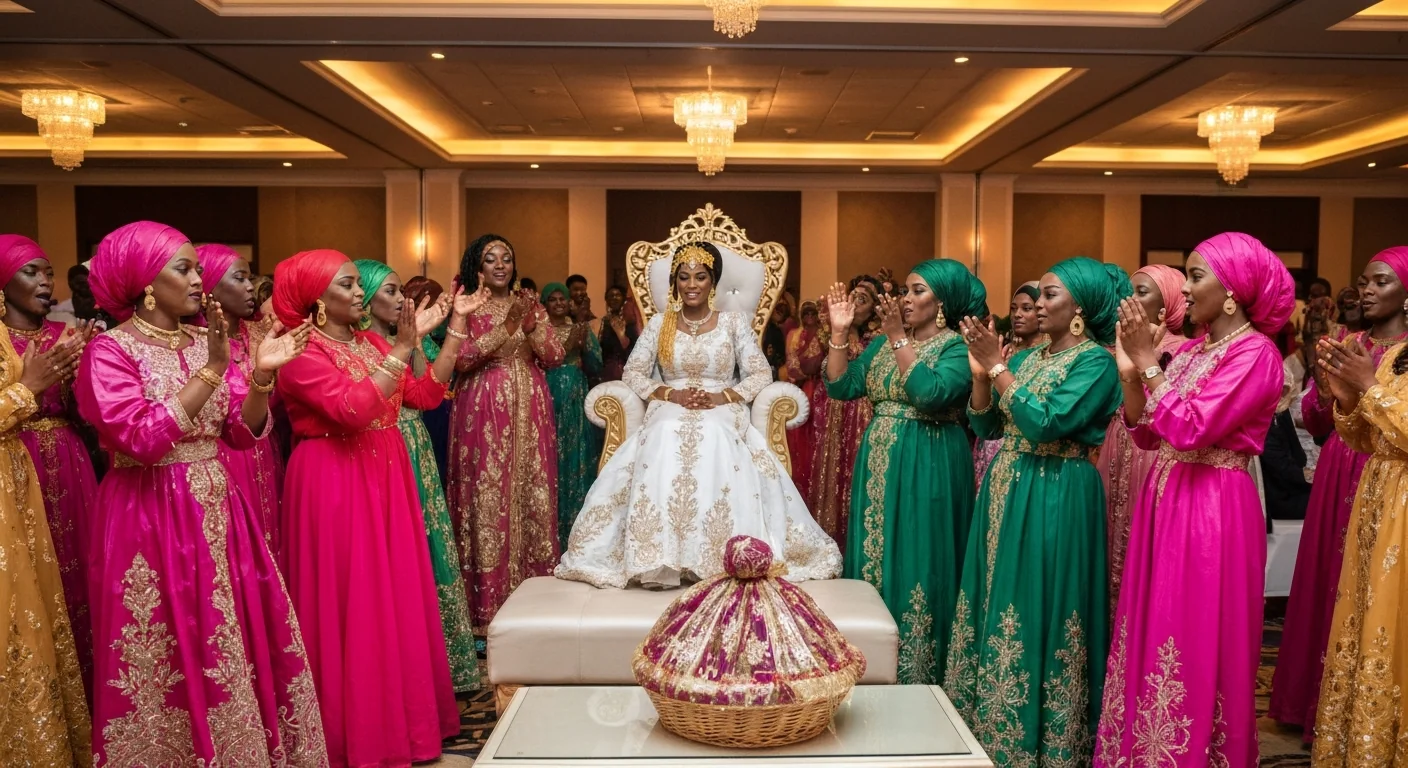
Aroos simply means “wedding” in Somali, but the aroos celebration is anything but simple. It is the public-facing centrepiece of the entire wedding process — an evening reception typically held the same day as the nikaah or the following day, when the community gathers to celebrate with music, dance, and food.
The Bride’s Entrance
One of the most anticipated moments of any aroos is the bride’s entrance. After most of the guests have arrived and the reception space is full, the bride walks in slowly — regally — accompanied by her bridal party. She is dressed to perfection: typically in a dirac, the flowing Somali dress made from sheer, embroidered fabric in jewel tones, worn over a googaro underdress and paired with a garbasaar headcovering. Gold jewellery catches the light. Her hands and feet are covered in fresh henna.
Modern Somali brides in Nairobi often change outfits during the reception, moving between a traditional dirac and a white gown. Both garments are moments of performance and beauty, and the outfit change builds anticipation and excitement throughout the evening.
Buraanbur — The Women’s Poetry and Dance
No Somali wedding is complete without buraanbur. This is the women’s poetic performance tradition — a vibrant, rhythmic form of poetry, song, and dance where women compose and perform verses that praise the bride and groom, celebrate their families, and express communal joy.
Buraanbur is performed with handclapping, ululation, and call-and-response structures. The women performing it are not passive observers — they are the emotional engine of the aroos. The poetry is sophisticated, often invoking the names of family elders and community leaders, weaving individual love stories into a broader tapestry of Somali life and values.
At Eastleigh weddings, buraanbur performances are simultaneously an art form, a social practice, and a form of community record-keeping.
Dhaanto — The Energetic Group Dance
Alongside buraanbur, Somali weddings feature dhaanto — an energetic traditional dance with distinctive shoulder movements, synchronized footwork, and call-and-response vocals. Dhaanto is a group activity: guests join in, elders nod in recognition, and younger generations learn the steps by watching. In Eastleigh, where the community maintains its cultural life through music festivals at Paradise Hall and events at the Awjaama Omar Cultural Centre, dhaanto remains a living tradition.
The Feast
The food at a Somali aroos reflects both generosity and cultural pride. Communal tables are laden with bariis (fragrant rice cooked with spices and meat stock), roasted meats, savoury pastries, and sweet dishes. Shaah — the sweet, spiced Somali tea — flows throughout the evening. The air is perfumed with oud incense and bukhoor, giving the celebration an aromatic quality that guests remember long after the night ends.
Venues in Eastleigh and Nairobi
The Somali-Kenyan community in Nairobi has established a strong network of venues suited to the scale and style of Somali wedding receptions. Eastleigh itself — home to BBS Mall, numerous bridal boutiques, and a dense network of Somali-owned businesses — is the commercial and cultural heart of this community.
Wedding halls and event venues in and around Eastleigh regularly host aroos celebrations for hundreds of guests. For larger events, hotels in Nairobi’s wider CBD and Westlands area are also used, particularly for couples with mixed networks and guests from different communities.
The Toddobobax — Seven Days of New Beginnings
After the aroos, the newly married couple enters a period of seclusion. The toddobobax — a word derived from toddobo (seven) and bax (to emerge) — is the post-wedding ceremony marking the couple’s re-emergence into society.
If it is the bride’s first marriage, the seclusion traditionally lasts seven days. A second marriage may involve a shorter three-day period. The seclusion is a time for the couple to bond, receive the blessings of close family who visit, and settle into their new life together.
On the final night, the family gathers for intimate, women-focused ceremonies marking the bride’s full transition into married life.
What Is the Xeedho — and Why Is It the Heart of a Somali Wedding?
Of all Somali wedding traditions, the xeedho is perhaps the most unique and culturally specific — recognized by UNESCO as an element of intangible cultural heritage of Djibouti and the wider Somali world.
What Is the Xeedho?
The xeedho is a gift prepared by the bride’s mother and female relatives for the groom, presented at the start of the marriage and meant to be opened at the end of the seven-day seclusion period. At its core, the xeedho contains dried dromedary meat (muqmad) — small pieces of camel meat fried in butter and preserved in ghee — placed in a carved wooden container.
But the xeedho is far more than food. The container is placed inside a basket, wrapped in aluminium foil, decorated with leather and shells, covered with fabric, and then placed inside a bag made from traditional fabrics representing a woman’s bridal trousseau. The whole arrangement is then bound with ropes — layers upon layers of knots that are deliberately intricate and carefully hidden.
The wrapping itself symbolizes the bride: beautiful, layered, precious, and deserving of patient, respectful handling.
The Xeedho-Fur — The Opening Ceremony
On the seventh night — the final night of the toddobobax — the entire extended family gathers for the xeedho-fur, the opening of the xeedho. This ceremony is both ritual and test.
A male member from the groom’s family — typically a close relative — is chosen to open the xeedho. He must first remove the outer covering, as one would gently unveil a bride, and then carefully untie every rope and knot. A woman from the bride’s family stands nearby, watching intently, sometimes holding a gentle stick as a symbolic guard.
The ropes are deliberately complex. The knots are layered to challenge. If the groom’s relatives cannot open the xeedho completely, it is considered a sign of disgrace — a symbolic suggestion that the groom may not be capable of properly caring for his bride. In the most traditional communities, a failure to open the xeedho could result in the bride being repossessed by her family.
When the xeedho is successfully opened — revealing the preserved meat within — it is a moment of communal triumph. The couple is publicly affirmed. The families feast on the muqmad together, sharing a meal that connects the new marriage to the generosity and love of the bride’s mother who prepared it.
The Xeedho as Family Legacy
The preparation of the xeedho is transmitted within families through observation — daughters watching mothers and grandmothers, with no written manual. The knowledge lives in the hands and memory of Somali women. A carefully prepared xeedho reflects a mother’s love for her daughter and her appreciation for the son-in-law who has joined the family. In this sense, the xeedho is not just a basket of preserved meat. It is a mother’s letter to the future.
Planning a Somali Wedding in Kenya
Modern Somali-Kenyan couples navigate the full richness of these traditions while adapting to urban schedules and contemporary life. Here are practical considerations:
Timeline: A full traditional sequence spans seven to ten days. Many urban couples in Nairobi condense this, holding the nikaah and aroos on consecutive days and observing a shorter seclusion.
Venues: Eastleigh remains the heart of Somali wedding culture in Nairobi. Community halls in the area are well-versed in hosting large aroos celebrations, with hotels in Nairobi’s CBD available for larger or mixed-community events.
Budget: Aroos catering is typically the largest expense — Somali hospitality demands generosity. Bridal attire (dirac, gold jewellery, henna) and xeedho preparation add further costs to plan for. Use the Harusi Hub budget tracker to map out each cost category before committing to vendors.
Multi-event coordination: Harusi Hub’s multi-event management feature lets you set up your nikaah, aroos, henna night, and toddobobax as separate events — each with its own date, venue, and RSVP list. Get started with the wedding creation guide. For couples coordinating across the Somali diaspora, see our guide for Kenyan Couples Planning from Abroad.
What to Wear as a Guest
- Nikaah: Dress modestly. Women cover their hair; men wear formal attire.
- Aroos: Festive and formal. Vibrant colours, gold accessories, and modest coverage.
- Henna night (women only): Ask your host whether they are coordinating matching fabrics.
When in doubt, dress up. Somali weddings are occasions of beauty and elegance.
Carrying Tradition into the Future
Somali wedding traditions in Kenya are not a relic of the past. They are a living practice that Somali-Kenyan families actively maintain. The xeedho still gets tied and untied on the seventh night in homes across Eastleigh. Buraanbur still brings women to their feet. The meher is still agreed upon in open family meetings. These traditions persist because they carry something true about how the Somali-Kenyan community understands love, responsibility, and family.
For more on Muslim wedding traditions and legal registration, see our article on Muslim Nikah Registration in Kenya. For a broader look at how weddings unfold across Kenya’s diverse communities, explore our Complete Guide to Kenyan Wedding Traditions and our deep-dives into how modern couples are adapting traditions and Indian-Kenyan wedding traditions.
Planning your Somali wedding in Kenya?
Manage your nikaah, aroos, henna night, and toddobobax across multiple events — track guests, budget, and every detail in one place.
Start Planning for Free