Maasai Wedding Traditions: Enkiama, Beadwork, and the Warrior's Path to Marriage
A complete guide to Maasai marriage customs — from age-set initiation to enkiama ceremony, the sacred head-shaving ritual, bead color symbolism, honey beer sharing, and why the bride must never look back.
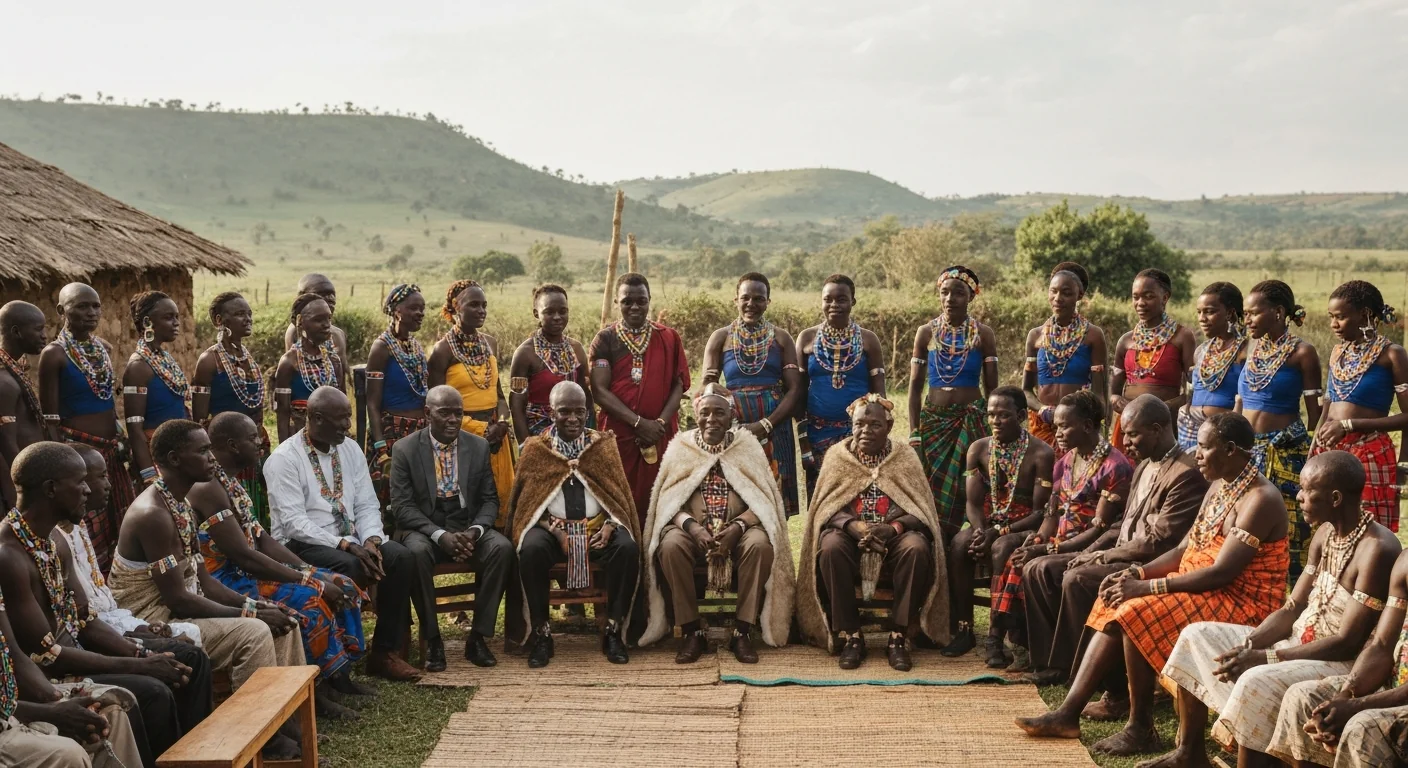
A Maasai man cannot marry until he has proved himself as a warrior. A Maasai bride walks away from her father’s homestead without looking back, or tradition says she will turn to stone. And a father blesses his daughter by spitting on her head. These are not curiosities — they are deeply intentional customs shaped by centuries of pastoralist life across the Rift Valley.
The Maasai wedding, known as Enkiama, is one of East Africa’s most elaborate marriage ceremonies. It is not a single event but a progression of rituals that can span years, beginning with a young man’s initiation into warriorhood and ending with the construction of a new home within the groom’s enkang (homestead). Every step — the cattle dowry, the beaded necklace, the honey beer blessing, the procession — carries specific meaning rooted in community, survival, and spiritual continuity.
This guide walks through each stage of Maasai marriage customs in detail: the age-set system that determines when a man may marry, the dowry negotiations, the sacred head-shaving ritual, bead color symbolism, the wedding day ceremony, and how modern Maasai couples are adapting these traditions today.
For a broader look at how Kenya’s diverse communities celebrate marriage, see our Complete Guide to Kenyan Wedding Traditions.
The Age-Set System: A Warrior Must Earn the Right to Marry
Unlike most Kenyan communities where a man may propose marriage once he has the means, a Maasai man must first serve his community as a warrior — and only when elders determine his service is complete can he take a wife.
How Age-Sets Work
The Maasai organize their society through age-sets (ilporror), groups of men who are initiated together and move through life’s stages as a cohort. Every seven to fifteen years, elders designate a new group of adolescent boys (typically around age fourteen or fifteen) for circumcision and induction into warriorhood. From that point, the age-set progresses through four stages:
- Junior Warriors (Il-murran) — Living together in a manyatta (warrior village), these young men protect the community and its cattle from predators and rival groups. They cannot marry during this period, which lasts five to eight years or longer.
- Senior Warriors — After the Eunoto ceremony (described below), warriors gain elevated status. They begin preparing for domestic life but remain in communal service.
- Junior Elders (Ilpayiani) — At this stage, men gain the right to marry, build their own homesteads, and participate in community decision-making.
- Senior Elders — The most respected members of the community, responsible for spiritual leadership, dispute resolution, and guiding younger age-sets.
A man cannot skip stages. A warrior who has not completed his service and been formally graduated cannot take a wife, regardless of his wealth. This system ensures that every married man has demonstrated discipline, courage, and commitment to the community before starting a family.
The Eunoto Ceremony: From Warrior to Elder
The Eunoto is the graduation ceremony that marks a warrior’s transition from junior to senior warrior status. It is one of the most significant events in Maasai life, performed roughly every fifteen to twenty years for each age-set.
During the Eunoto, warriors shave their long ochre-red hair — a defining feature of their identity as morans — symbolizing the end of their time as protectors living in communal warrior villages. Their mothers shave their heads, and the event is accompanied by days of feasting, singing, and communal prayer. After Eunoto, the former warriors may begin the process of finding a wife and establishing their own households.
The Maasai proverb “Meeta enkang omon” — “No homestead stands alone” — reflects the communal philosophy that shapes this system. A man must serve others before he can lead his own family.
Cattle Dowry: Aadung Inkishu (The Splitting of Cows)
In Maasai culture, cattle are not merely livestock. They are currency, social standing, spiritual connection, and the foundation of every significant life event. Marriage is no exception.
The Negotiation Process
Once a young man’s family identifies a potential bride, the two families enter formal negotiations known as aadung inkishu, which translates to “the splitting of cows.” This is a carefully structured meeting where both sides agree on the number of livestock the groom’s family will pay to the bride’s family.
The dowry typically includes cattle, goats, and sheep. The specific number varies depending on the clan, but several factors influence the negotiation:
- Clan-specific standards — Each Maasai clan maintains its own customary dowry amount. The dowry is tied to the bride’s clan, not the groom’s wealth or the bride’s appearance.
- Typical range — Dowries commonly range from four or five cattle (in arrangements between closely allied families) to twelve or more cattle plus additional sheep and goats. In some cases, the number can be considerably higher.
- Additional gifts — Beyond livestock, the groom’s family may provide blankets, honey, sugar, khat (miraa), and in modern times, cash contributions.
The negotiation is not adversarial. It is a bonding process between two families, establishing an alliance that will endure for generations. The Maasai say “Eeta olosho le nkishu” — roughly, “A community is built on cattle” — and this exchange literally weaves two families into a shared economic and social fabric.
Honey and Milk: The Formal Proposal
Before the dowry negotiation, the groom’s mother and a companion visit the bride’s family bearing ceremonial gifts of honey and milk. These are two of the most valued substances in Maasai diet and culture. The honey is shared among all the women of the bride’s family, and the visit formally announces the groom’s family’s intent to request the daughter’s hand.
If the bride’s family accepts the gifts and shares the honey, it signals their willingness to proceed with the marriage discussions. This is the first of several honey-related rituals that thread through the entire Maasai marriage process.
Pre-Wedding Preparations: The Bride’s Kitchen Party
The days before the Enkiama follow a structured pattern of separation and preparation.
The Bride’s Final Night
In accordance with Maasai tradition, the bride and groom spend the day and night before the wedding apart to honor their separate roles. The bride is escorted by Maasai women to a nearby village or to her own family’s boma, where she stays overnight.
During this time, the women hold what might be described as a Maasai kitchen party — though it is far more ceremonial than the modern Kenyan kitchen party. The elder women teach the bride essential traditions and guide her through the rites of womanhood, preparing her for her new role as a wife and mother. They share wisdom about managing a household, raising children, tending to livestock, and navigating her relationship with her husband’s family.
This gathering is also a time for the bride’s female relatives to contribute beadwork. In Maasai culture, a bride does not simply wear her own jewelry — she is adorned with layers of beaded necklaces, bracelets, and headpieces contributed by women across the community, each piece carrying its maker’s blessings.
The Sacred Head-Shaving Ritual
On the morning of the wedding, one of the most visually striking and emotionally significant rituals takes place: the shaving of the bride’s head.
How the Ritual Unfolds
The bride’s mother is the one who shaves her daughter’s head using a razor. The freshly shaved head is then anointed with lamb fat (or sometimes sheep fat), which is rubbed gently across the scalp until it gleams. After the anointing, the bride’s head is decorated with beaded bands and ornamental headpieces.
What It Means
Head-shaving in Maasai culture marks a transition from one life stage to another. Warriors shave their heads at Eunoto. Brides shave their heads at marriage. In both cases, the act symbolizes leaving behind a former identity and stepping into a new one.
For the bride, the shaved head represents:
- Purity and new beginnings — She enters her husband’s family stripped of her former identity, ready to be reborn into her new role.
- Humility and respect — Hair, in Maasai culture, is associated with beauty and individuality. Removing it signals the bride’s willingness to subordinate personal vanity to her family and community duties.
- The lamb fat blessing — The anointing is a consecration. Fat from a lamb — an animal associated with gentleness and provision — is believed to bless the bride with softness, fertility, and protection.
Interestingly, the ritual occurs twice. After the bride has spent two days at her mother-in-law’s house following the wedding, the mother-in-law shaves the bride’s head a second time, completing the transition and marking her full acceptance into the groom’s family.
Maasai Beadwork: The Language of Color
Maasai beadwork is among the most recognized cultural art forms in Africa, and it plays a central role in the wedding ceremony. The colors are not decorative choices — they are a language.
Bead Color Meanings
Each color in Maasai beadwork carries specific symbolism drawn from the natural world and the community’s values:
| Color | Meaning | Connection |
|---|---|---|
| Red | Bravery, unity, blood, strength | The earth, warrior courage, the blood of cattle that sustains life |
| Blue | Sky, water, energy | Rain that nourishes cattle and land; vitality and survival |
| Green | Health, land, nourishment | The grasses and vegetation that feed livestock |
| White | Purity, peace, health | Milk, the sacred food of the Maasai |
| Orange | Hospitality, warmth, friendship | Generosity and welcome |
| Yellow | Fertility, sun, growth | The sun that sustains all life |
| Black | Unity, hardship, solidarity | The people’s shared struggles and resilience |
The Wedding Necklace: Enkarewa
The most important piece of beadwork at a Maasai wedding is the enkarewa — a wide, flat collar necklace made specifically for the bride by her mother. This necklace is not just adornment; it is a map.
The enkarewa’s design represents the layout of the Maasai village. The circular hole at its center symbolizes the emboo — the central enclosure where cattle, sheep, and goats are kept at night for protection. The surrounding beadwork represents the ring of houses that form the enkang. By wearing the enkarewa, the bride carries a symbolic version of her future home against her chest.
The colors chosen for the wedding necklace are deliberate, typically emphasizing red (for the couple’s strength and unity), white (for purity), and blue (for the life-giving water and sky that sustain the community).
Beadwork After Marriage
A woman’s beadwork changes after marriage to reflect her new status. Married Maasai women wear a distinctive long necklace with blue beads called a nborro, signaling to the community that they are wives and mothers. The beadwork a woman wears throughout her life tells her story — her age, her marital status, the number of children she has, and her clan affiliation.
The Enkiama: Wedding Day Ceremony
The Enkiama itself is an all-day affair that begins at dawn and stretches deep into the evening. Every hour brings a new ritual, each building upon the last.
Morning: The Blessing of the Bride
The day begins early — often around 6:00 AM. After the bride’s head has been shaved and anointed, the female family members gather to dress her. She is wrapped in layers of colorful shukas (the traditional Maasai cloth wraps) and adorned with beadwork — her own pieces and those contributed by other women.
Two elders then perform the enkidongi (blessing). One elder carries a calabash of milk; the other carries a calabash of enaisho (honey beer). They dip bundles of fresh grass into their vessels and sprinkle the bride’s face, legs, and body. The grass symbolizes fertility and new growth. After the sprinkling, the grass is attached to the bride’s belt and shoes, where it remains throughout the day as a living emblem of the blessing.
The Father’s Spit: A Blessing of Departure
Before the bride leaves her father’s homestead, her father performs one of the most distinctive Maasai rituals: he spits on his daughter’s head and chest.
In Maasai culture, spitting is not an insult — it is a profound blessing. The father’s saliva is believed to carry his wisdom, protection, and good fortune. By spitting on his daughter, he is transferring these blessings to her, ensuring prosperity in her marriage. Saliva also symbolizes fertility and abundance, making this act a prayer for the bride to have many healthy children.
This is among the last things the father does for his daughter as a member of his household. Once she departs, she belongs to her husband’s family.
The Groom’s Procession
The groom, accompanied by a group of Maasai men, makes his way to the bride’s homestead in a lively procession. The journey can last several hours, with the men singing traditional songs and community members joining along the way to greet and celebrate with the groom. The procession builds in size and energy as it progresses, arriving at the bride’s boma with singing, chanting, and the rhythmic jumping that characterizes Maasai celebration.
When the groom arrives at the bride’s house, he presents her with a wedding gift, formally marking the start of the celebration.
The Bride Must Not Look Back
One of the most poignant moments of the Enkiama occurs when the bride leaves her father’s homestead to begin her journey to her new home with the groom.
As the procession forms and the bride begins to walk away, she must not look back at her family’s home. Tradition holds that if she turns around, she will turn to stone. The belief is more than superstition — it carries deep symbolic weight:
- Complete commitment — Looking forward signals that the bride is fully dedicated to her new life, her new family, and her new responsibilities.
- Irreversibility — The walk away from her natal home is final. No members of her birth family attend the wedding ceremony at the groom’s homestead, reinforcing the complete transition.
- Emotional strength — The bride demonstrates the resilience expected of a Maasai woman, who must manage a household, raise children, and build a home — often with limited support from her birth family.
The bride walks slowly and deliberately behind her escorts. The measured pace is intentional — she is not meant to appear overly eager, but rather composed and dignified as she enters this new chapter.
Honey Beer Sharing: Enaisho
Honey beer (enaisho) holds a central place in the wedding celebration. Brewed from honey provided by the groom’s family as part of the bride price, enaisho is shared ceremonially among the couple, their families, and the community.
The sharing of honey beer represents:
- Prosperity — Honey is a prized and relatively scarce commodity in the Maasai diet, making it a symbol of abundance.
- Sweetness in marriage — The taste of the beer itself is a metaphor for the hoped-for sweetness of the couple’s life together.
- Community bonds — By sharing from the same vessel, the two families become one.
The honey beer ceremony typically occurs during the blessing portion of the day, alongside the milk sprinkling and prayers led by community elders.
Feasting and Celebration
The wedding includes the slaughtering of a cow — a communal feast that brings together family, friends, and neighbors. The meat is shared among all attendees, symbolizing unity, abundance, and the collective support the couple will receive. Elders bless the meat before distribution, and specific portions are reserved for honored guests and family members according to tradition.
The afternoon features a spear-throwing competition, where men showcase their skill and the warrior spirit that defines Maasai masculinity. As the sun begins to set, the couple leads the Maasai wedding dance — a vibrant, communal celebration in which participants form a circle, symbolizing the unity and continuity of their bond. The dancing is accompanied by traditional songs praising the couple, blessing their marriage, and expressing communal hopes for fertility and prosperity.
The day concludes with an evening meal shared with family and close friends.
Post-Wedding Rituals: Building a New Life
The Enkiama does not end on the wedding day. Several important rituals follow.
Enoyie: The Blessing and Welcome
When the newlywed couple arrives at the groom’s homestead, they are received with a ceremony called Enoyie. The groom’s family and community members formally bless the bride and welcome her into their midst. This ritual represents the bride’s official acceptance into her new family and is essential for establishing her place within the community.
Enkiok: Establishing the New Home
After Enoyie, the groom’s family builds a new home — a manyatta — within the homestead for the couple to live in. Traditionally constructed by women using locally available materials like wood, grass, and cow dung, the manyatta represents the couple’s independence and the beginning of their journey as a family.
The construction of the manyatta is itself a communal act. Women from the groom’s family work together to build it, reinforcing the idea that a marriage is not between two individuals alone but between two communities.
The Second Head Shaving
After spending two days in her mother-in-law’s house — during which the groom may not sleep with her or eat food in the same house — the mother-in-law shaves the bride’s head a second time. This final shaving marks the completion of the bride’s transition and her full integration into the groom’s family. From this point forward, she is considered a daughter of her new household.
The Enkang: Where Ceremonies Come to Life
Understanding the enkang (homestead) is essential to understanding Maasai wedding ceremonies, because the enkang is where everything happens.
Structure and Layout
A Maasai enkang is a circular compound enclosed by a fence of thorny acacia branches, designed to protect livestock from predators. Inside the fence, individual houses (inkajijik) are arranged in a ring around a central enclosure called the emboo, where cattle, sheep, and goats are kept at night.
Each house is built by the woman who lives in it, using a framework of wooden poles covered with a mixture of mud, grass, cow dung, and water. The houses are small — typically a single room divided into areas for sleeping, cooking, and storage — but they are warm, waterproof, and remarkably durable.
The Enkang as Ceremony Center
The central emboo serves as the gathering place for all major ceremonies, including weddings. Its circular layout naturally creates an amphitheater-like space where the community can gather, dance, sing, and feast. The placement of cattle at the center — the most valued possession in Maasai life — underscores the spiritual and economic values that underpin every ceremony performed within its boundaries.
During a wedding, the enkang transforms into a bustling celebration ground. The entrance is decorated, guests stream through the thorny gate, and the emboo becomes a dance floor, a feasting hall, and a sacred space for blessings — all at once.
Modern Maasai Weddings: Tradition Meets Change
Maasai wedding traditions are remarkably resilient, but they are not static. Urbanization, education, legal reforms, and economic changes are reshaping how modern Maasai couples approach marriage.
Education and Delayed Marriage
As access to formal education expands across Maasai communities, both men and women are marrying later. Educated Maasai women are more likely to have a voice in choosing their spouse, and educated men increasingly prioritize sending all their children to school — a financial commitment that makes polygamy less practical.
The emphasis on education has also prompted families to reconsider early marriage arrangements, allowing daughters to complete their schooling before entering into matrimony.
Urbanization and Blended Ceremonies
Many young Maasai men and women now live and work in urban centers like Nairobi, Narok, and Arusha. These individuals often navigate between two worlds — maintaining their cultural identity while adapting to city life.
The result is increasingly common blended weddings that combine traditional Maasai elements with modern Kenyan wedding practices. A couple might hold a church or civil ceremony in the city, followed by a traditional Enkiama at the family’s rural homestead. Some couples incorporate Maasai beadwork, honey beer, and traditional blessings into otherwise contemporary wedding settings.
Changing Gender Roles
Maasai women today play a far more prominent role in economic life, education, and community leadership than in previous generations. Women’s growing autonomy is influencing marriage customs in several ways:
- Consent — While arranged marriages still occur, there is growing emphasis on the bride’s consent and her role in choosing her partner.
- Dowry discussions — Some families are rethinking the nature and scale of bride price negotiations, though cattle remain central to the process.
- Entrepreneurship — Maasai women’s beadwork cooperatives and tourism ventures give women independent income, shifting household power dynamics.
Legal Frameworks
Kenya’s Marriage Act of 2014 recognizes customary marriages, including Maasai unions, while also establishing legal protections including minimum marriage age requirements and provisions against forced marriage. These legal frameworks operate alongside, and sometimes in tension with, traditional customs.
Preserving What Matters
Despite these changes, the core elements of the Enkiama endure. The age-set system, cattle dowry, head-shaving ritual, beadwork, honey beer, and communal blessings continue to anchor Maasai weddings. Many young Maasai couples see their wedding as an opportunity to honor their heritage, even as they adapt specific practices to modern life.
As one Maasai proverb puts it: “Meitoki engolong oshoke” — “The zebra cannot change its stripes.” The Maasai carry their identity with them wherever they go, and their wedding traditions remain one of the most vivid expressions of that identity.
Frequently Asked Questions
How long does a Maasai wedding ceremony last?
The Enkiama itself is an all-day event, typically starting around 6:00 AM and continuing through the evening. However, the full marriage process — including pre-wedding preparations, the ceremony day, and post-wedding rituals like Enoyie and Enkiok — spans several days. The broader journey from warrior service to marriage can take years.
How many cows are needed for Maasai bride price?
The number varies by clan, as each Maasai clan maintains its own standard dowry. Common ranges are four to five cattle for marriages between allied families, up to twelve or more cattle plus sheep and goats. The dowry may also include additional gifts like honey, blankets, and in modern times, cash. The specific amount is negotiated during the aadung inkishu (splitting of cows) meeting between the two families.
Why does the Maasai father spit on his daughter at her wedding?
In Maasai culture, spitting is a sign of blessing, not disrespect. The father’s spit is believed to carry his wisdom, protection, and good fortune. By spitting on his daughter’s head and chest before she departs, he transfers these blessings to her, praying for a prosperous marriage and healthy children. This is one of the father’s final acts as her guardian before she joins her husband’s family.
Can a Maasai man marry before completing his warrior service?
No. The Maasai age-set system strictly requires a man to complete his time as a junior warrior and undergo the Eunoto ceremony before he is eligible for marriage. Only after graduating to junior elder status does a man gain the right to take a wife, build his own home, and participate in community decision-making. This process typically takes a minimum of five to eight years after initiation.
What is the significance of the wedding necklace (enkarewa)?
The enkarewa is a wide collar necklace made by the bride’s mother specifically for the wedding day. Its design represents the layout of the Maasai village — the central hole symbolizes the emboo (cattle enclosure), and the surrounding beadwork represents the ring of houses forming the enkang. The colors chosen carry symbolic meaning, with red for strength, white for purity, and blue for vitality. Wearing the enkarewa means the bride carries a symbolic representation of her future home.
Do modern Maasai couples still follow all traditional wedding customs?
Many modern Maasai couples, particularly those living in urban areas, hold blended weddings that combine traditional and contemporary elements. A couple might have a civil or church ceremony in Nairobi followed by a traditional Enkiama at the family homestead. Key elements like the cattle dowry, head-shaving, beadwork, and communal blessings remain central, though some families adapt the scale and specific practices to fit modern circumstances. The trend is toward honoring the spirit of tradition while accommodating education, career, and urban life.
Planning your Maasai wedding?
Coordinate enkiama ceremonies, manage cattle dowry discussions, and keep your planning organised from the first blessing to the last dance at the enkang.
Start Planning for FreeFor more on traditional ceremonies across Kenya’s diverse communities, read our Complete Guide to Kenyan Wedding Traditions.