Samburu Wedding Traditions
A complete guide to Samburu wedding traditions — the age-set system, imugit ceremony, mporo marriage necklace, bride price, and how urban Samburu adapt today.
Samburu Wedding Traditions
A Samburu warrior (moran) spends the better part of a decade proving himself — protecting livestock, learning survival, and earning his place among men. Only after his age-set passes through the imugit ceremony does he earn the right to marry. A Samburu wedding is not simply a celebration. It is the culmination of a man’s entire first chapter of life.
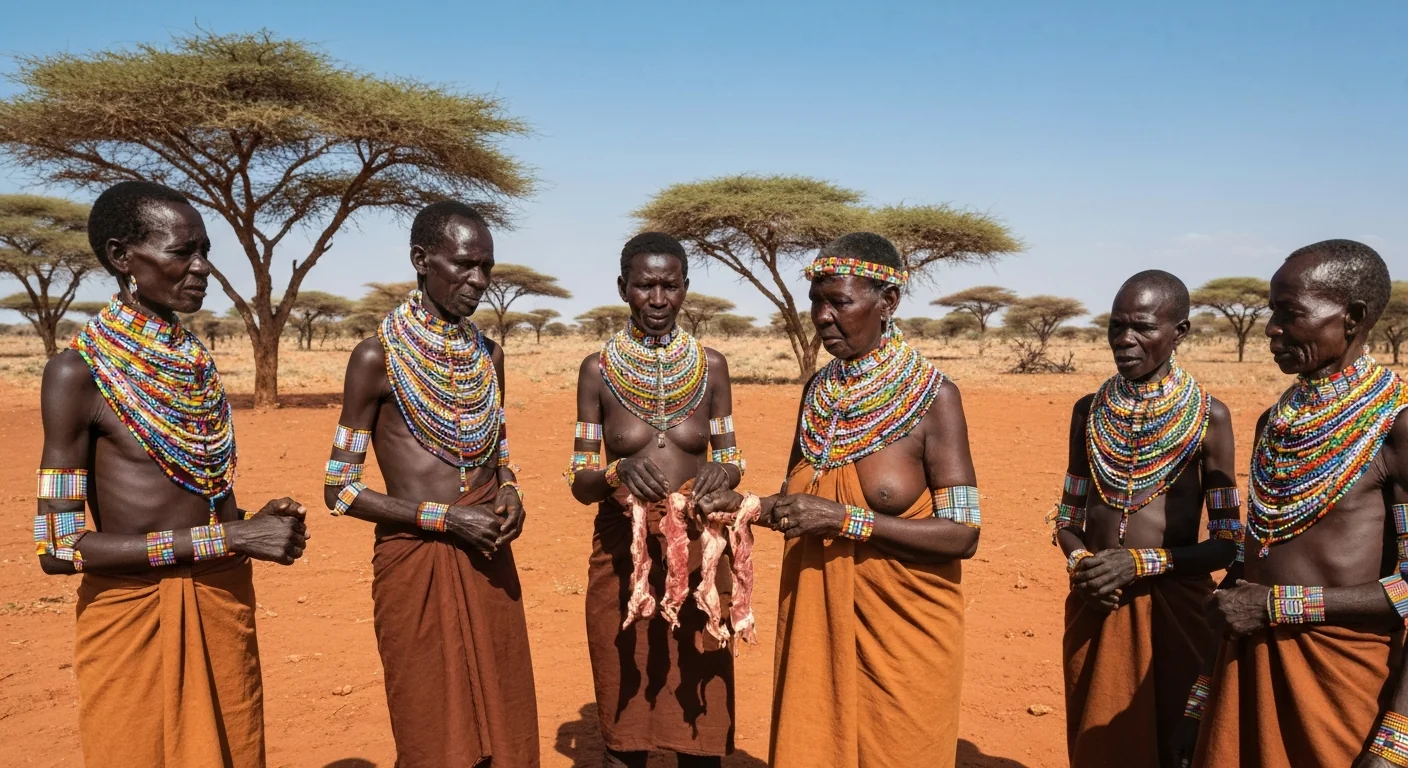
Samburu wedding traditions are shaped by one of Kenya’s most distinctive social structures: the age-set system that governs when a man may marry, how elders conduct negotiations, and what ceremonies mark each stage. The Samburu are a Nilotic community of northern Kenya, closely related to the Maasai but with their own distinct language, customs, and identity. They are semi-nomadic pastoralists living across Samburu, Laikipia, and Marsabit counties — a land of acacia scrubland, dry riverbeds, and vast sky. Their society is built on livestock, age-set governance, and a rich tradition of beadwork that communicates everything from a woman’s marital status to her clan affiliation.
Samburu marriage traditions are elaborate and multi-layered, governed by the age-set system that structures all of Samburu society. This guide covers every stage: the moran period and when marriage becomes possible, the role of families and elders in negotiation, the bride price, the wedding ceremony itself, the significance of beaded jewelry, and how younger Samburu couples in urban Kenya are navigating these traditions today.
For a broader overview of how Kenya’s communities approach marriage, see our Complete Guide to Kenyan Wedding Traditions.
How Does the Samburu Age-Set System Determine When a Man Can Marry?
The Samburu organize their society — for men — through a progression of age-sets: boys, morans (warriors), junior elders (ipayan), and senior elders. Every man moves through these stages alongside the group of peers who were initiated with him. No one skips ahead.
Initiation and the Moran Period
Boys between the ages of fourteen and sixteen undergo circumcision — the initiation ceremony that marks their entry into the moran (warrior) age-set. The ceremony is significant: the boy is shaved, given new shoes, and wrapped in a sheepskin that his mother has anointed with grease and charcoal dust. The circumcision takes place at the threshold of the boy’s home, witnessed by an elder, and the boy must show no fear or pain — his stoicism is proof of his readiness for the warrior life ahead.
After initiation, morans live in a communal, intensive period of service: protecting the community from predators and raids, herding cattle, and learning the skills of survival and leadership. Morans may not marry during this period. The moran stage lasts approximately ten years.
The Imugit Ceremony: Graduation to Elder
After roughly ten years of moran service, the age-set undergoes the imugit ceremony — a formal graduation that marks the transition from warrior to junior elder (ipayan). The imugit ceremony involves the sacrifice of an ox, whose meat is eaten entirely, with the bones burned afterward. The moran undergoes a ceremonial haircut, shedding the long red-ochre hairstyle associated with warrior status.
From the imugit of the bull ceremony — which takes place approximately eleven to twelve years after circumcision — men become eligible to marry and begin establishing their own households.
However, not all men marry immediately after the imugit. In practice, only a small proportion of newly graduated men obtain wives right away. Most begin building up their herds and initiating negotiations, a process that itself takes years. Senior elders in the community often move faster, as they may be seeking second or third wives and have the wealth to secure agreements quickly — creating genuine competition for eligible women.
The Vow Ceremony: Crossed Sticks
A distinctive Samburu element of the marriage commitment is the crossing of wooden sticks as vows are exchanged between the couple. The sticks represent deep roots and lasting life — an elegant symbol drawn from the natural world that the Samburu depend upon daily.
Family Negotiations and the Role of Elders
In Samburu culture, a young man does not negotiate his own marriage. Morans are considered too inexperienced for such matters. Fathers, guardians, and senior male relatives handle the marriage negotiations on a man’s behalf.
This can create a layered dynamic. If a man loses interest in a woman after negotiations have begun, he may pass the marriage opportunity to his brother — but only if that brother is of the same age-set. The age-set bond runs deeper than individual preference; the entire group carries collective responsibility and shared social standing.
Once both families agree to proceed, the formal engagement and bride price negotiations begin in earnest.
Bride Price: Livestock and Ceremonial Gifts
Samburu bride price is paid in livestock — primarily cattle and small stock — negotiated between the two families based on the economic circumstances of the moment. If the groom’s family cannot immediately pay in full, it is sometimes agreed that the couple may begin living together as husband and wife while the payment is completed over time.
Beyond livestock, the groom is expected to provide specific ceremonial gifts to the bride from the outset of their relationship. These include:
- Two goatskins — used in the wedding ceremony itself
- Two copper earrings — a marker of status and commitment
- A container for milk — milk being sacred in Samburu culture, the container carries deep symbolic weight
- A sheep — for ceremonial slaughter
Great importance is placed on the groom’s preparation of these gifts. Their quality and completeness signal his readiness and his respect for the bride’s family.
The Wedding Ceremony: Coming Together
The Groom’s Arrival
On the wedding day, the groom’s entourage — his family and close friends — approaches the bride’s homestead and formally states the reason for their visit. After an agreement is confirmed between the two family groups, the groom’s party withdraws from the homestead, then returns singing, with a goat in tow. The goat is slaughtered as a sign of consensus and celebration — a living symbol of the families’ agreement made concrete.
The Bride’s Presentation
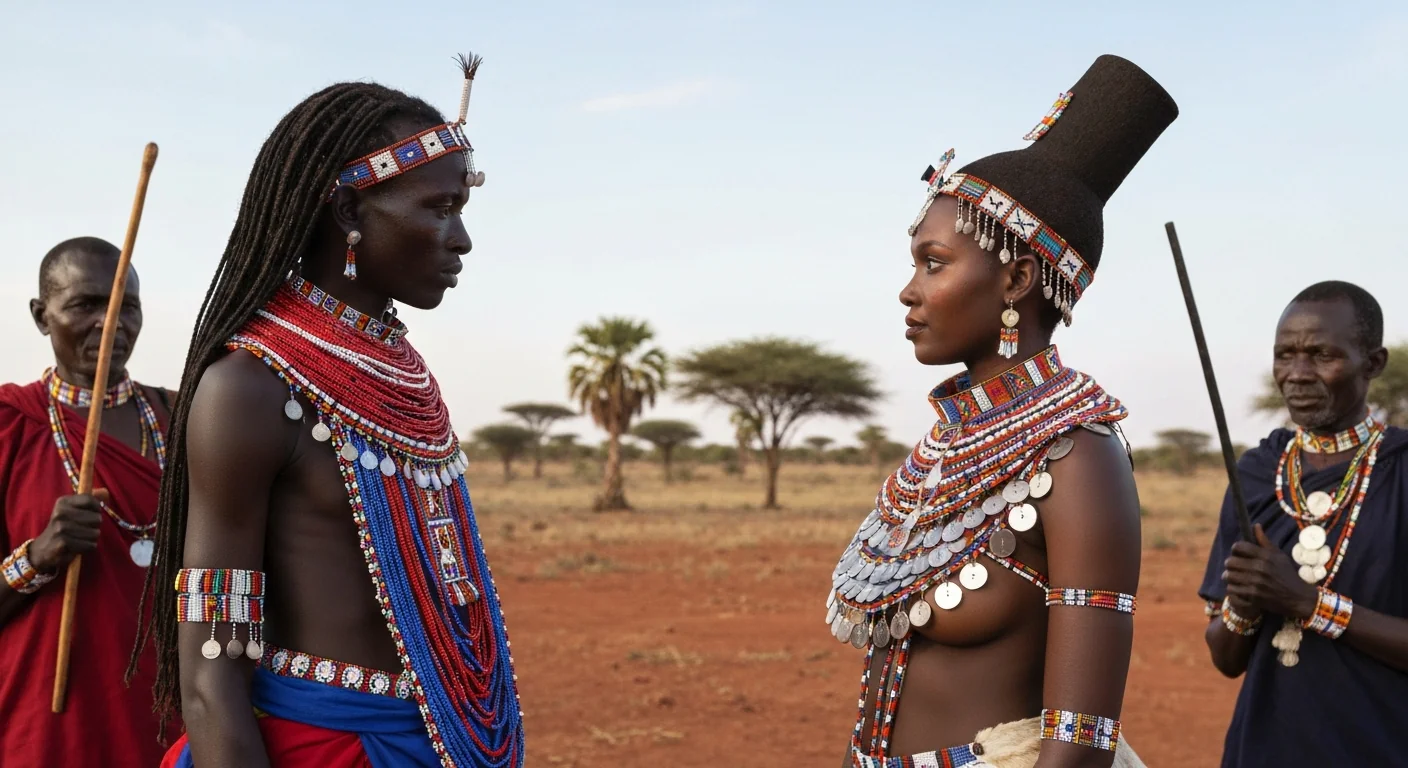
After the goat is slaughtered, the bride is formally introduced to the gathered guests. She is dressed in a cow’s hide painted with red ochre — a ceremonial garment reserved for this moment, distinct from everyday dress. The groom ties strips of cow’s skin around his wrists and arms, completing the traditional attire that marks the solemnity of the occasion.
The bride is also given a necklace chain that indicates her new marital status, worn visibly as a public declaration to the community of her transition from unmarried to married woman.
The Formal Handover
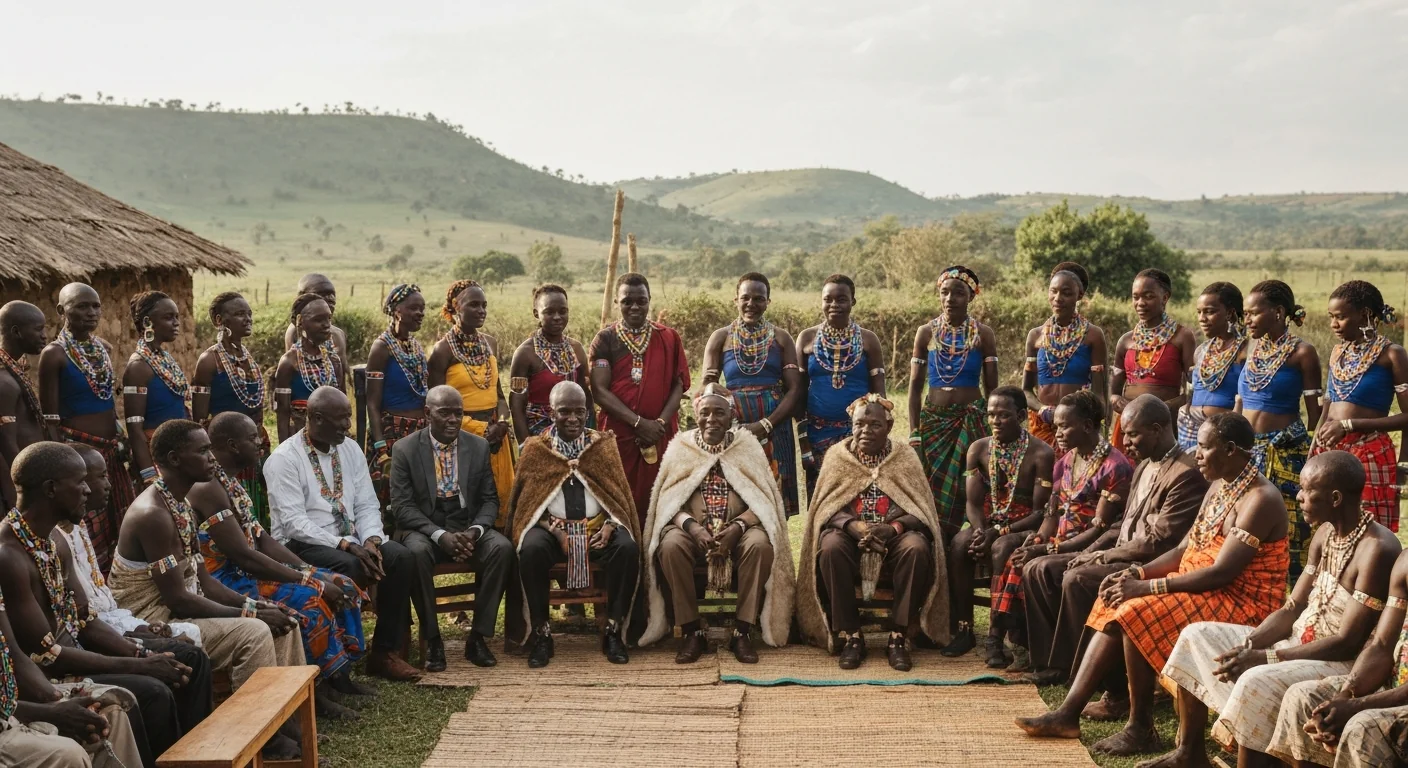
In the evening, the groom’s party and the elders of the bride’s local clan group gather in the circumcision hut — the most sacred gathering space in the community. The bride is formally handed over in a ceremony led and witnessed by elders from both sides. This is the legal and spiritual heart of the Samburu wedding.
The Milk Departure
The following morning, the couple prepares to leave the bride’s homestead and travel to the husband’s home to begin their new life together. This departure is not simply a walk out the gate. The couple sits down four times on their way out of the homestead, drinking milk at each stop. Milk in Samburu culture is sacred — it is associated with Nkai (the Samburu deity), with fertility, with purity, and with life itself. Each pause to drink is a blessing: a moment of reflection, connection, and spiritual fortification before the journey ahead.
The Wedding Dance
The Samburu wedding celebration includes communal dancing — a display of energy and joy in which both elders and young people participate. Men perform competitive jumping, testing height and stamina in a display that signals vitality and strength. Women dance with neck and shoulder movements, wearing their elaborate beaded collars — a vibrant, rhythmic expression of community and beauty.
Samburu Beadwork: The Language on Your Neck
Beadwork is one of the most visible and culturally significant elements of Samburu life, and it reaches its fullest expression at marriage. Every necklace, bracelet, and earring communicates specific information about the wearer.
The Mporo: A Marriage Necklace
The mporo is the traditional Samburu married woman’s necklace — a beaded piece passed from mother to daughter, carrying stories across generations. By Samburu tradition, a man begins gifting beads to his betrothed early in the relationship, so she can start building her necklace collection. The more elaborate the beads and the resulting necklace, the greater his wealth and status are communicated to the community.
Color Symbolism
Samburu bead colors carry specific meanings drawn from the natural and spiritual world:
| Color | Meaning |
|---|---|
| Red | Strength and power of the community |
| Blue (bright) | Energy and vitality |
| Blue (dark) | The most sacred color — symbol of Nkai (the sky deity), who blesses the people with rain |
| Green | Grass and water, vital for livestock; a lighter green ensures healthy pregnancy |
| White | Milk, the source of new life and purity |
| Black | The hardships of the pastoralist lifestyle; solidarity through struggle |
Jewelry as Biography
A Samburu woman’s jewelry collection is a living record of her life stage and social position:
- Young unmarried women wear plain, heavy red-colored necklaces.
- Married women wear colorful, heavy necklaces with a simpler white-and-red beaded necklace on top, plus earrings combining ancient beads and aluminum rings.
- Warriors (morans) wear colorful necklaces with a chain across their chin, signaling their single status.
- Younger boys wear a simple green necklace.
The beads are also used at every major life transition — birth, initiation, marriage, and death. They are sacred objects, not accessories.
At marriage, the shift in a woman’s beaded jewelry is visible and immediate. The community knows what she is wearing, and what it means.
The Role of Elders: Keepers of Custom
Throughout the Samburu marriage process, elders serve as the essential authorities. Negotiations are conducted by experienced men, the formal handover is witnessed by clan elders, and the blessings are administered by those with the deepest knowledge of Samburu custom. A marriage that has not been properly witnessed and concluded by elders carries less social weight within the community.
Elders also govern the age-set system that determines when marriage is possible — making them the gatekeepers not just of individual ceremonies, but of the entire social structure that marriage ritualizes.
How Are Urban Samburu Couples Adapting Their Wedding Traditions?
The Samburu are among the Kenyan communities where traditional marriage customs are most intact — but they are not unchanged.
Education and Delayed Marriage
As access to formal education expands in Samburu County, both men and women are marrying later. Educated Samburu women are increasingly reluctant to enter arranged marriages, particularly as second or third wives. “Most of the girls are now educated. They refuse to be taken in as second wives,” as one community observer noted in 2012 — a dynamic that has only deepened in the years since.
Economic Pressure on Bride Price
Harsh economic conditions in northern Kenya, combined with climate pressures on livestock herds, mean that some families are negotiating bride price in more flexible terms. The principle remains; the scale adapts.
Urban Samburu Couples
Samburu men and women working in Nairobi, Nanyuki, and other towns often hold blended weddings — a traditional ceremony at the family’s homestead in the north, combined with a modern reception for urban friends and colleagues. The core rituals of the imugit progression, the formal family handover, the beaded attire, and the milk ceremony remain, while modern elements are layered in around them.
See our article on how modern couples are adapting traditions for more on how Kenyan couples are navigating this balance.
Planning a Samburu Wedding
A Samburu wedding involves multiple events across days — and often across geography. The traditional ceremony at the family homestead in northern Kenya may be hundreds of kilometers from the couple’s urban home. Managing the logistics of both requires clear planning.
Harusi Hub is designed for exactly this kind of multi-event wedding. You can set up separate events for your traditional and modern ceremonies, manage guest lists for each occasion, and track all your planning in one free dashboard. Use the Harusi Hub creation wizard to get started in minutes.
The budget tracker is especially useful for Samburu weddings, where costs span livestock negotiations, ceremonial attire, transport between regions, and a modern reception.
For related reading, see our article on Turkana wedding traditions — the Turkana and Samburu share deep pastoral parallels in their marriage customs — and our overview of the best wedding venues in Nairobi for urban Samburu couples planning their modern reception. If you are thinking through the full cost of a multi-event wedding, our wedding budget guide for Kenya and article on how modern couples are adapting traditions are good next reads.
Frequently Asked Questions
When can a Samburu man marry?
A Samburu man may begin seeking a wife after his age-set completes the imugit ceremony, approximately eleven to twelve years after his circumcision initiation. This marks the transition from warrior (moran) to junior elder (ipayan), and is the earliest point at which marriage is socially sanctioned.
What is the significance of the mporo necklace?
The mporo is the traditional married woman’s beaded necklace of the Samburu. It is passed from mother to daughter and built up over a lifetime of bead gifts, beginning with those given by the betrothed. The complexity of the necklace communicates the husband’s wealth and the woman’s social standing within the community.
What is the milk ceremony at a Samburu wedding?
On the morning after the wedding, as the couple prepares to leave the bride’s homestead for the husband’s home, they sit down four times on their way out of the gate and drink milk at each stop. Milk is sacred in Samburu culture — associated with Nkai (the deity), purity, and new life. The four pauses are a form of blessing for the journey ahead.
What do Samburu couples wear at their wedding?
The bride wears a cow’s hide painted with red ochre — a ceremonial garment distinct from everyday dress. She is also adorned with elaborate beaded necklaces, earrings, and bracelets. The groom ties strips of cow’s skin around his wrists and arms. Together, the attire is a visible declaration of tradition and community identity.
Planning your Samburu wedding?
Coordinate your traditional ceremony in the north and your modern reception in the city — manage every event, guest, and budget in one free platform.
Start Planning FreeFor more on traditional ceremonies across Kenya’s diverse communities, read our Complete Guide to Kenyan Wedding Traditions.