Turkana Wedding Traditions
A complete guide to Turkana marriage customs — livestock bride price, the Ekuma bull ritual, meat necklace, elder blessings, and modern adaptations.
Turkana Wedding Traditions
A Turkana man who has not married cannot speak in the council of elders. He is considered too young — regardless of his age. In Turkana society, marriage is not just a personal milestone. It is the door through which a man enters full adulthood and earns his place in the community.
The Turkana are one of Kenya’s largest pastoralist communities, living primarily across the vast arid plains of Turkana County in the northwest. For the Turkana, cattle, camels, and goats are not merely livestock — they are wealth, identity, and the currency of every significant social transaction. Nowhere is this more evident than in marriage.
Turkana wedding traditions, centered on the ceremony known as Akuta (also written as Akuuta), are among the most elaborate in Kenya. The marriage process unfolds over several days, involves the entire community, and requires one of the most substantial bride prices on the continent. This guide walks through every stage — from courtship and dowry to the bull-killing ritual, the symbolic meat necklace, elder blessings, and how Turkana couples today are adapting these centuries-old customs to modern life.
For a broader introduction to how Kenya’s diverse communities celebrate marriage, read our Complete Guide to Kenyan Wedding Traditions.
What Is the Turkana Bride Price — and Why Is It So Significant?
Marriage in Turkana society begins with bride price — and the numbers are not small. A man seeking to marry traditionally parts with at least fifty cattle, thirty to fifty camels, and up to two hundred small stock (sheep and goats). This makes the Turkana bride price one of the most substantial in Kenya, reflecting both the central role of livestock in Turkana wealth and the deep value placed on women within the community.
Because the bride price is so significant, accumulating it can take two years or more. During this period, the prospective groom travels to friends and relatives across the community to borrow animals. This is not seen as a sign of poverty — on the contrary, it reinforces social ties, as every person who contributes livestock to the dowry becomes invested in the success of the marriage. The network of mutual obligation created by this borrowing process binds families and clans together for generations.
The distribution of the bride price follows a structured protocol. Three-quarters goes to the bride’s immediate parents, with the remaining quarter distributed among her relatives according to their relationship and seniority. Every allocation is deliberate and governed by custom.
A critical point in Turkana law: if a man has children with a woman for whom he has not paid bride price, those children are considered to belong to the maternal family — not the father. The father cannot claim them, and any future dowry paid for daughters belongs to the mother’s relatives. The bride price is therefore not merely ceremonial — it establishes legal kinship.
Courtship: Emalas
The formal process begins when a young man identifies a woman he wishes to marry. This initial stage is called emalas — he approaches her directly, they agree to pursue marriage, and he then informs his parents. The families make contact, and the lengthy process of dowry negotiation and accumulation begins.
Turkana marriages are sometimes arranged by families, but a man’s own initiative through emalas is also common and respected. What matters is that once both families are agreed, the process moves forward with the full weight of community expectation behind it.
The Wedding Ceremony: Three Days of Ritual
Once the bride price has been settled, the wedding ceremony — often called Emong — is held at the bride’s locality. The ceremony spans three to four days, with each day structured around specific rituals regulated by time, space, and the authority of elders.
Day One: The Bull-Killing Ritual (Akichum Ekumwae)
The ceremony begins before dawn on the first day with one of its most powerful rituals: the killing of a bull, known as akichum ekumwae or simply ekuma. This takes place inside the animal shed (anok), away from casual view.
By Turkana custom, the bull is always killed with a spear — not any other implement. The blood drawn from the slaughtered animal is given to the groom and his age-mates to drink as an act of solidarity and strength. The skinning then takes place outside the shed, after which the groom’s friends carry the pieces of meat — called nginerin — while singing praises and making their way toward the bride’s hut.
The groom also hosts his age-mates in a special ceremonial dance called ekimwomwor, performed at his homestead, celebrating his transition to married life.
Alongside the bull, several he-goats are slaughtered as gifts for the bride’s stepmothers and the father-in-law’s age-group companions — a practice known as Nakopir. Each offering is deliberate, reinforcing the bonds between specific family lines.
The Bride’s Hut (Ekol)
Throughout the first day of the ceremony, the bride remains hidden inside a specially constructed hut called an ekol. This temporary structure is built by the groom’s mother and sisters — an act of labor that symbolizes their welcome and acceptance of the new wife into their family. The bride sits inside from early morning until evening, attended by elderly women from the bride’s family, while the ritual activities unfold around her.
The Meat Necklace: A Symbol of Belonging
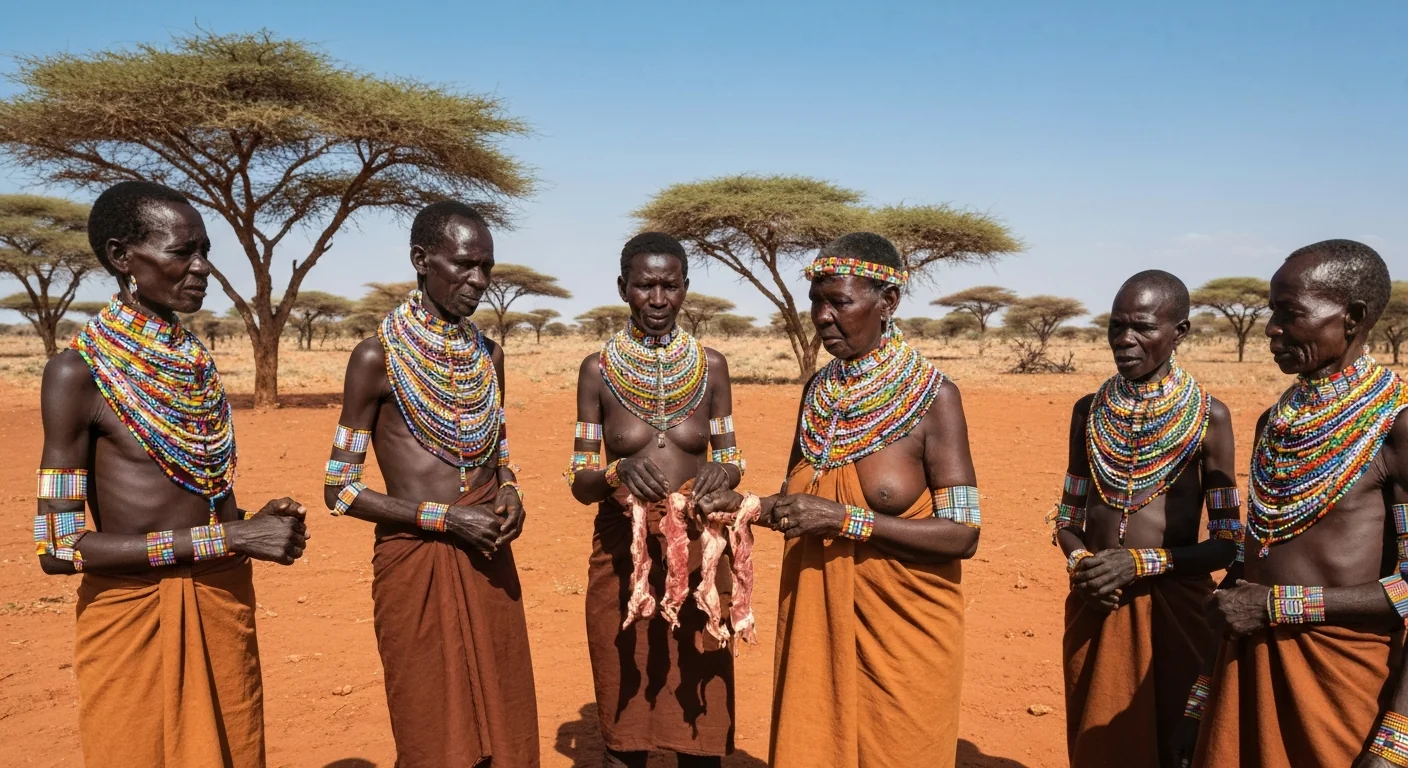
One of the most visually striking and symbolically significant rituals of the Turkana wedding is the meat necklace. After the bull has been slaughtered and the meat prepared, strips of fatty meat are taken by the eldest woman present and draped around the neck of the bride’s mother — as a symbol of coronation and honor. The eldest woman then distributes the meat among the different households in attendance.
The groom’s friends place more meat outside the bride’s hut, where the bride’s mother and elderly women are seated, enticing them to partake. This ritual sharing of meat communicates acceptance, abundance, and the bonding of two families.
Later, a symbolic metal ring called the alagama is placed around the bride’s neck, with strips of meat tied around it. This ritual is also performed for all family members of the new household. The alagama is not merely decorative — it carries spiritual weight. According to tradition, the ring bonds the wife to the rituals of her new family. The ceremony and the ring together establish that the wife and children of the union now legally and spiritually belong to the husband’s family.
The Communal Feast and Elder Gathering
The men gather in a circle known as akiriket — seated in order of seniority, with the eldest man beginning first. The boiled meat (with specific cuts designated by gender and age) is eaten collectively. The elders drink soup sip by sip from the same vessel. This communal eating is not merely sharing food — it is a formal act of witness and social bonding.
After the feast, the elders formally announce the end of the ceremonial portion. The older men are then given a local brew to enjoy through the night, a time for stories, blessings, and the informal passing of wisdom.
The “Kidnapping” of the Bride
In the evening of the main ceremony day, one of Turkana tradition’s most theatrical and meaningful moments unfolds. The groom’s family “raids” the bride’s hut to take her away.
Before the bride is released, her family stages a protective resistance. The two families engage in a sham fight with sticks — a ritualized confrontation that represents the bride’s family’s reluctance to let their daughter go. The struggle is symbolic, not violent, and ends when the groom’s side prevails and the bride is formally released.
As the bride is led away, she cries and physically resists — writhing and pulling against her escorts. This, too, is prescribed tradition: her visible distress represents the breaking of her natal family bond. It communicates to the community that she is not leaving willingly from indifference, but from the pull of a new life that she enters with grief for what she leaves behind.
Once she has been taken from the hut, the bride is stripped of the beaded necklaces she has accumulated since childhood — those given to her by her birth family — and replaced with new necklaces brought by the groom as a wedding gift. The exchange is deeply symbolic: her old identity is removed, and her new one, within her husband’s family, is placed upon her.
Elder Blessings: The Final Rituals
The formal handing over of the bride is accompanied by a sequence of blessings administered by the elders. These include:
- Smearing with white ochre (emunyen) — applied to both bride and groom, and to any children already born to the couple, as a sign of blessing and spiritual protection.
- Sprinkling of water — symbolizing purification, new beginnings, and fertility.
- Agat — traditional prayer or chanting led by elders who are well-versed in Turkana spiritual customs, calling upon the ancestors and community spirits to bless the union.
These rituals are not optional embellishments. Elders within the community emphasize that the ceremony must be performed correctly and completely. Incomplete or improperly conducted rituals are believed to attract serious spiritual consequences — illness, the death of livestock, or misfortune for the children of the union.
What Happens to the Bride’s Hut?
In traditional Turkana ceremonies, the temporary hut (ekol) built for the bride during the ceremony is destroyed after the wedding. This deliberate dismantling signals the end of the bride’s former status and the completion of her transition. She will build or occupy a new home in her husband’s homestead — a fresh structure for a new life.
The Role of Elders: The Community’s Authority
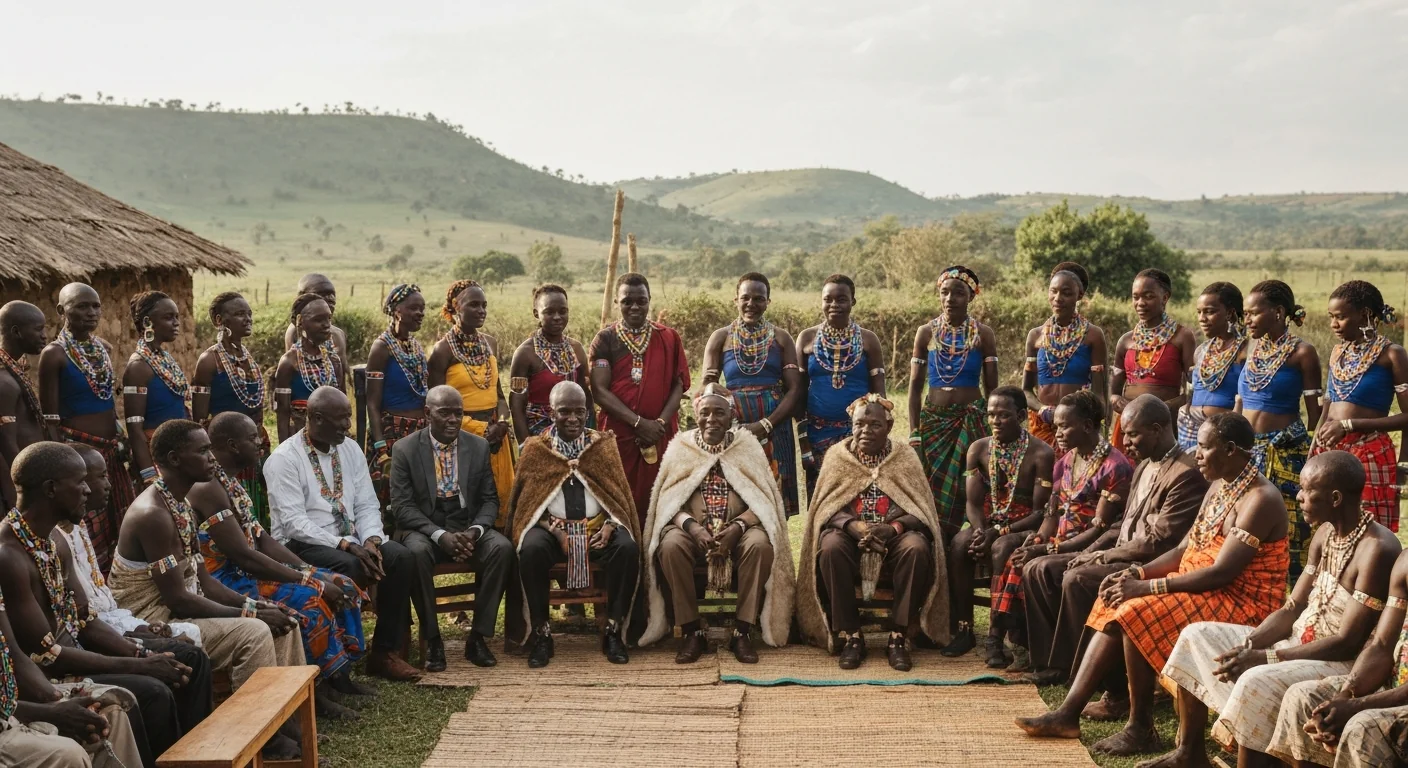
Throughout the Turkana marriage process, elders serve as the guardians of tradition. They oversee dowry negotiations, validate the ritual sequence, lead the blessings, and formally announce the conclusion of each ceremonial stage. A man who has not been through the Akuta ceremony — even if legally married — cannot participate in the council of elders that governs community affairs. Marriage through traditional ceremony is, in this sense, the credential for civic participation.
For Turkana men, the wedding is therefore not merely personal. It is a civic rite of passage.
How Are Modern Turkana Couples Adapting Their Wedding Traditions?
Increasing numbers of Turkana people live and work in urban centers — Lodwar (the county capital), Nairobi, Eldoret, and other towns. Education, employment, and urban life have introduced new dynamics to Turkana marriage customs.
Blended Ceremonies
The most common modern adaptation is the blended wedding — a traditional Akuta ceremony held at the family’s rural homestead alongside or before a modern church or civil wedding. Many Turkana couples treat the traditional ceremony as the primary validation of their marriage within the community, while the civil or church ceremony satisfies legal requirements and the preferences of educated or urban relatives.
Some families choose to hold the traditional ceremony first in the village and the modern wedding later in town; others sequence them in the opposite order. What is consistent is that both are considered necessary.
Bride Price Negotiations
Urban Turkana families are negotiating bride price in more flexible ways. While livestock remains the symbolic standard and the cultural ideal, some families now accept partial payment in livestock and partial payment in cash, or agree to a payment plan spread over several years. The principle of bride price as a binding social contract remains; the form is adapting.
Women’s Education and Consent
Educated Turkana women increasingly have a greater say in whom they marry and when, though family involvement in marriage negotiations remains central to community norms. Access to education has also delayed the typical age of marriage for both men and women in urban contexts.
If you are planning a wedding that blends traditional ceremonies across multiple days and locations, Harusi Hub’s multi-event planning tools can help you stay organised. You can set up separate events for your traditional and modern ceremonies, track budgets per event, and manage RSVPs for different guest groups — all from one dashboard.
For couples navigating a traditional plus modern wedding weekend, see our guide on planning a traditional and white wedding weekend and our article on how modern couples are adapting traditions.
Planning Your Turkana Wedding
A Turkana wedding involves logistics that stretch across months and sometimes years — dowry negotiations, livestock sourcing, coordinating relatives from across the county, and potentially managing both a traditional ceremony at the rural homestead and a modern wedding in town. For couples who also need to handle legal registration alongside their traditional ceremony, our guide to marriage registration in Kenya explains the requirements.
Create your wedding on Harusi Hub to bring all of this into one place. You can create separate events for each ceremony, build a budget that accounts for livestock contributions and modern catering costs, and share your wedding details with family members who are helping to plan. The budget tracker is particularly useful for tracking the multiple cost streams involved in a Turkana wedding — from the Akuta ceremony to the modern reception.
For more on how Kenya’s communities celebrate marriage, read our overview of Kenyan wedding traditions, our deep dive into Samburu wedding traditions — the Samburu are close neighbours with similarly livestock-centred customs — and our article on destination weddings in Kenya for families considering venue options outside the home county. If you are working out how much a Turkana wedding will cost across both ceremonies, our wedding budget guide for Kenya is a practical starting point.
Frequently Asked Questions
What is the Turkana bride price?
The traditional Turkana bride price (bride wealth) includes at least fifty cattle, thirty to fifty camels, and up to two hundred sheep and goats. The exact amount is negotiated between the two families and can take two or more years to accumulate. Modern adaptations sometimes include partial cash payment, but livestock remains the cultural standard.
How long does a Turkana wedding ceremony last?
The traditional Akuta ceremony spans three to four days, with specific rituals assigned to each day. The full marriage process — from courtship (emalas) through dowry negotiation and the wedding — can take two years or longer.
What is the significance of the meat necklace?
The meat necklace ritual, in which strips of meat are draped around the bride’s mother’s neck and distributed to family members, symbolizes the formal bonding of two families. The metal alagama ring placed on the bride’s neck further establishes her membership in her husband’s family and carries spiritual significance.
Can a Turkana man participate in the council of elders without a traditional wedding?
No. A man who has not been through the traditional Akuta marriage ceremony cannot participate in the council of elders, regardless of his age. The traditional wedding is the community’s formal recognition of full adult status.
Planning your Turkana wedding?
Manage your traditional Akuta ceremony, modern reception, and every event in between — all in one place, completely free.
Start Planning FreeFor more on traditional ceremonies across Kenya’s diverse communities, read our Complete Guide to Kenyan Wedding Traditions.