Meru Wedding Traditions: Nthenge, Nteguri & Modern Adaptations
Complete guide to Meru wedding traditions — the nthenge goat ceremony, nteguri dowry, sunset ritual, and how modern Ameru couples blend tradition and church.
Meru Wedding Traditions: Nthenge, Nteguri & Modern Adaptations
Your groom’s uncle walks out into the yard and returns holding a goat. Not just any goat — an indigenous Meru breed, pure bloodline, carefully selected. The crowd falls quiet. The elders lean in. This is the nthenge ya miraa, and everything that happens next depends on whether it passes inspection.
A Meru wedding is a journey, not a single day. Among the Ameru — the Bantu-speaking people of Meru and Tharaka Nithi Counties on the slopes of Mount Kenya — marriage unfolds through courtship, a vivid dowry ceremony, and a wedding that takes place at sunset, when, according to tradition, demons are at their weakest. Each stage carries layers of meaning that have been refined over generations of community life in the fertile highlands of central Kenya.
This guide walks you through the complete Ameru marriage process: what each stage involves, who participates, what is given, and how today’s couples honour these traditions while building modern lives together. Whether you are planning a Meru traditional wedding, marrying into an Ameru family, or simply want to understand one of Kenya’s richest highland cultures, this is the overview you need.
For broader context on Kenya’s many wedding traditions, see our Complete Guide to Kenyan Wedding Traditions.
Who Are the Ameru?
The Ameru are a Bantu-speaking community who inhabit Meru and Tharaka Nithi Counties on the northeastern slopes of Mount Kenya. They are organised into distinct sub-groups — including the Imenti, Tigania, Igembe, Tharaka, and others — each with their own dialect variations but sharing the same core cultural values and marriage customs.
Ameru society is historically governed through age-set systems and council structures. Two alternating governance bodies — the Kiruka and the Ntiba — managed community affairs, with each consisting of senior elders who exchanged authority at periodic intervals, overseeing everything from conflict resolution to the regulation of community rites including marriage. This deep respect for elder authority shapes every aspect of the wedding process.
Marriage among the Ameru is not merely a private arrangement between two people. It is a covenant between two families, witnessed by the community and blessed by elders, that establishes new kinship ties and social obligations on both sides.
The Three Stages of Ameru Marriage
The traditional Ameru marriage process moves through three essential stages: courtship, dowry, and the wedding ceremony. Each stage has its own rituals, participants, and expectations. Together they create a marriage that is publicly witnessed and culturally anchored.
Stage 1: Courtship — Nthaka
Courtship among the Ameru was structured and community-supervised. Young people of marriageable age — those who had undergone circumcision, a mandatory rite of passage — could begin seeking partners, but not without proper procedure.
A young man did not approach a girl directly without first making inquiries. He would gather information about her — her family’s reputation, her clan affiliations, her character — through trusted intermediaries. He enlisted her friends or mutual relatives to arrange an informal meeting in a public space. Private meetings between unmarried young people were culturally discouraged, so these early encounters happened at community ceremonies, dances, and other public gatherings.
If both parties were interested, the young man informed his parents. Both families then conducted their own assessment of the other — examining reputation, health history, and character. A family’s standing in the community mattered enormously. Once both families approved, the couple was considered engaged and preparations for the dowry ceremony began.
Even in traditional times, elopement occurred. When a couple eloped, community elders from the groom’s side accompanied his parents to the bride’s family home to report the matter and begin formalising the union. This path was less preferred but was ultimately folded back into proper process through elder mediation.
Stage 2: Dowry — The Nthenge Ceremony
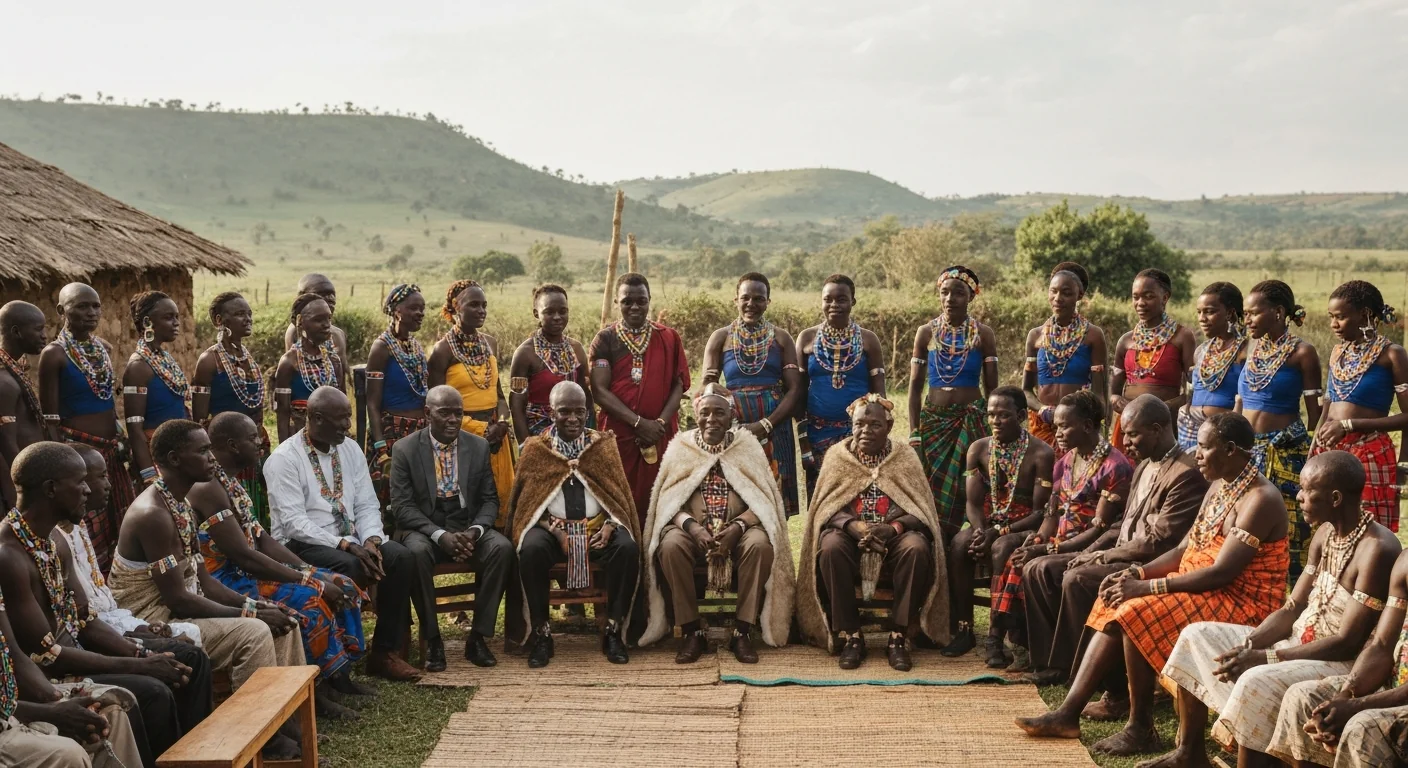
The dowry ceremony is the heart of the Ameru marriage process and the most colourful event of the entire journey. Attended by nearly all members of the village, it transforms a private agreement into a public covenant.
The Standard Dowry Composition
Traditional Ameru dowry was standardised — unlike many other communities, there were no extended negotiations over quantity. The components included:
- An ewe (female sheep)
- A container of honey (giempe kia naichu)
- A bull
- A heifer
- Five she-goats and a ram
These items were fixed by custom. What varied was the quality, and elders examined everything carefully.
The Nthenge Ya Miraa — The Ceremonial Goat
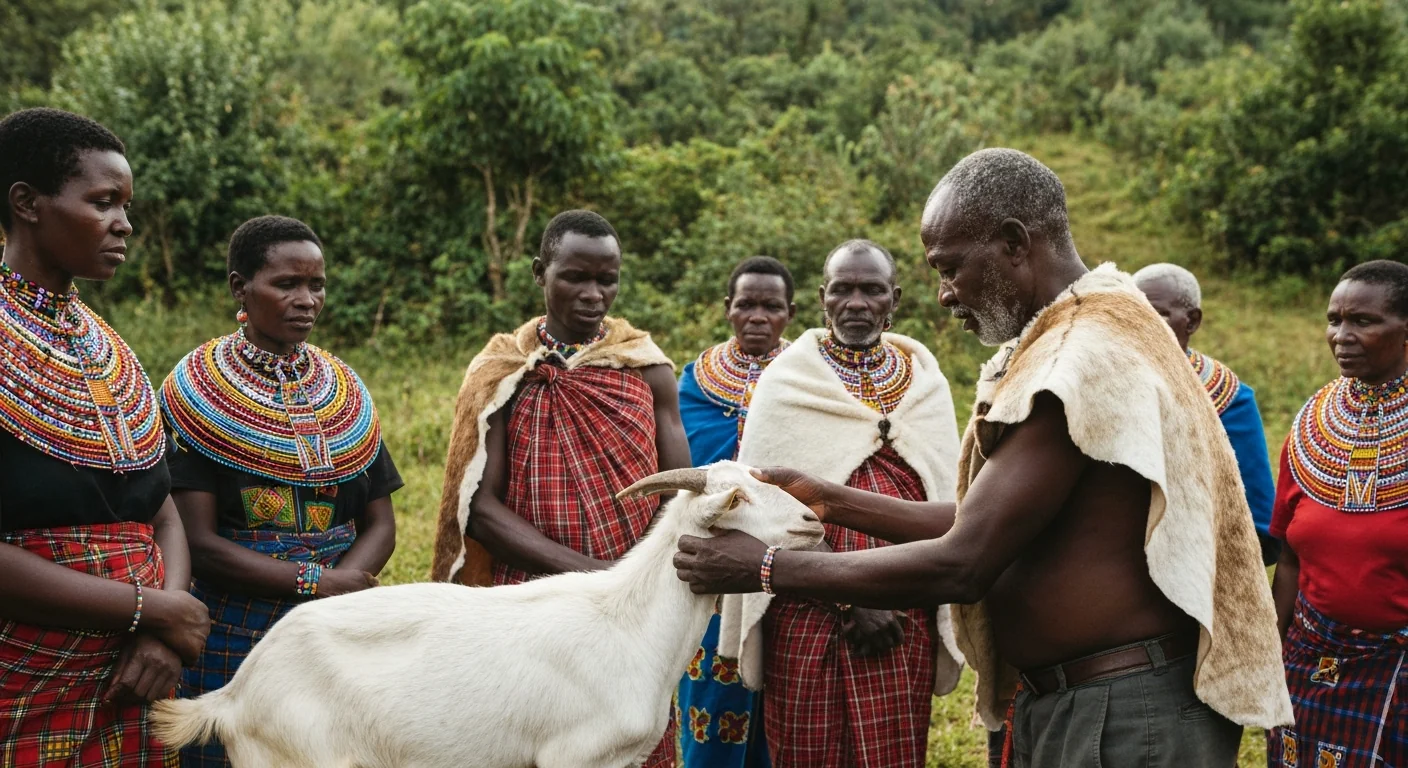
The centrepiece of the dowry ceremony is the nthenge ya miraa — a he-goat that carries enormous symbolic weight. When the moment arrives, the groom’s uncle walks out and returns leading this goat. It must be an indigenous Meru breed — a pure native goat whose bloodline is unsullied. No crossbreeds or compromised animals are acceptable.
The spokesman presents the nthenge to the bride’s family. The elders examine it closely, just as they would inspect the miraa (khat) package that is also part of the offering. When the goat passes inspection, cheers fill the air. The acceptance of the nthenge signals that the dowry process is proceeding in good faith.
The Nteguri — The Most Significant Payment
Beyond the standardised dowry items, the nteguri is the most extensive and significant component of the bride wealth exchange. The nteguri is not a single item but a package of diverse gifts — the most elaborate and expensive part of the dowry process — which can include additional livestock, household goods, and other items agreed upon between the families.
After the nthenge is accepted, elders from both families convene inside the house to begin detailed discussions about the bride price under the nteguri arrangement. These negotiations are conducted privately, with respect and gravity, led by senior men from each family. The bride price agreed upon is typically paid in instalments — sometimes over many years, or even a lifetime. The commitment matters more than the schedule.
The Women’s Feast and Gift Exchange
Once the dowry is agreed upon, celebrations begin immediately. The bride’s family prepares a grand feast. Women from the groom’s village arrive carrying bags of finger millet, sorghum, black beans, and cowpeas — gifts emptied into large baskets (nkaranga) presented to the prospective in-laws. This exchange of agricultural staples is not merely practical; it symbolises the joining of two households and their means of sustaining life.
A series of visits follow, with groups of women from both sides carrying gourds of gruel. These visits serve to acquaint the two families with each other, building the relationships that will sustain the marriage over decades.
The He-Goat and She-Goat Symbolism
The he-goat and she-goat presented as part of the dowry carry specific meaning. They represent the union that will be formed between the man and the woman after marriage. These animals must be virgins — untouched by breeding — and they are delivered to the bride’s family by two young girls and a young boy (kaiji). The innocence of the carriers mirrors the purity expected of the animals themselves.
Stage 3: The Wedding Ceremony — Sunset Union
The Ameru wedding ceremony itself was traditionally a more intimate occasion than the grand dowry celebration. It formalised the union of two families and marked the release of a daughter from her parents’ care — a significant transition carried out with deep intentionality.
Why Sunset?
Ameru weddings traditionally took place at sunset, when demons were believed to be at their weakest. This timing reflects the Ameru people’s traditional spiritual worldview — one in which the timing of significant life events is connected to the movements of spiritual forces. The setting sun marks the close of one chapter and the beginning of another.
The Wedding Procession
On the wedding day, the groom’s female relatives arrived at the bride’s home accompanied by strong young men (muraa). Together they came to escort the bride to her new matrimonial home. This procession carried the weight of two families — the women as cultural guides and the young men as an escort of honour.
Songs were sung from the moment the groom’s family arrived until they departed, filling the occasion with music that carried both celebration and farewell.
The Matrimonial House
Before the wedding, the groom built a new matrimonial house for his wife. In place of the door, he hung banana leaves — a symbolic threshold. The morning after the couple consummated their marriage, the bride replaced the banana leaves with an actual door. This act was her declaration of arrival: she had crossed the threshold and now inhabited the house as its mistress.
Elder Gifts and Blessings
At the conclusion of the ceremony, the bride’s family presented the groom with traditional gifts: a three-legged stool, a fly whisk, and a shield — items representing leadership, authority, and protection. The bride received jewellery and a bag. Both were prayed over and blessed by elders from both families before departing to begin their new life together.
What Do Ameru Weddings Sound and Taste Like?
Meru wedding celebrations are rich sensory experiences woven through with community participation.
Songs and Music
Songs accompany every stage of the Ameru marriage process. At the dowry ceremony, communal singing from both families fills the homestead throughout the day. At the wedding itself, songs mark the bride’s departure from her parents’ home — a mixture of celebration and tender farewell that acknowledges the weight of the transition she is making.
Traditional Meru music features vocals, percussion, and ceremonial instruments played by community members rather than professional performers. The music is participatory — everyone sings, everyone belongs to the celebration.
Traditional Foods
The wedding feast reflects the agricultural richness of Mount Kenya’s slopes:
- Finger millet dishes — historically the primary staple of the Ameru, featured prominently at ceremonial occasions
- Sorghum ugali — thick porridge prepared in large quantities for communal feasting
- Boiled and roasted goat — provided from the dowry animals, prepared generously for assembled guests
- Honey — both a dowry component and a celebratory food, honoured in Ameru culture as a gift of the land
- Black beans and cowpeas — the agricultural gifts brought by the groom’s family become part of the feast itself
Modern Meru Weddings: Blending Tradition and Faith
The Ameru have been in contact with Christian missionaries since 1912, and this influence has profoundly shaped how modern marriages are conducted. Today’s Meru wedding is typically a multi-event journey that weaves together traditional rites, church ceremonies, and civil registration.
What Has Changed
Church weddings are now central to most Ameru marriages. Catholic, Protestant (including SDA, Anglican, and Pentecostal denominations), and evangelical churches all have strong presences in Meru and Tharaka Nithi Counties. A church ceremony follows the traditional dowry process and may include formal marriage counselling, scripture readings, and vow exchanges witnessed by the congregation.
Civil registration at the Attorney General’s office ensures legal recognition of the marriage — adding a third layer to the customary and religious ceremonies.
Dowry flexibility has become the norm. Where traditional custom specified exact animals and quantities, modern families accept the spirit of the dowry rather than its letter. Elders acknowledge that what matters is the gesture of appreciation and commitment, not adherence to a precise livestock list. Cash, a combination of animals and money, or symbolic gifts alongside a monetary contribution are all accepted today.
Wedding venues and reception parties have evolved. A traditional wedding at the bride’s family home at sunset is now often followed by a modern reception — at a hotel, events venue, or in the family compound — with catering, a sound system, photography, and formal speeches.
What Endures
Despite decades of change, the core elements of Ameru marriage remain remarkably resilient:
- Elder involvement is non-negotiable. No wedding — however modern — proceeds without the participation of senior relatives from both families as formal witnesses and blessing-givers.
- The nthenge ceremony continues. Even in modernised dowry gatherings, the presentation of the indigenous goat and its inspection by elders remains a moment of cultural gravity.
- Family investigations before engagement remain common. Families still inquire carefully about a prospective partner’s background, health, and reputation before giving their approval.
- The bride’s departure songs — the communal singing as she leaves her parents’ home — are preserved in both traditional and church-integrated weddings.
For couples navigating both traditional and modern expectations, read our article on how modern Kenyan couples are adapting their traditions for practical guidance.
How Do You Plan a Meru Traditional Wedding?
If you are planning a Meru wedding — whether fully traditional, blended, or honouring select customs within a modern celebration — here is what to prepare for.
Timeline
Allow at least several months for the full process:
- Courtship and family approvals — 2 to 8 weeks, depending on how quickly families can meet and assess.
- Dowry date setting — once families agree, the nthenge ceremony date is set well in advance to allow both sides to prepare gifts, food, and travel arrangements.
- The dowry ceremony — typically a full day event at the bride’s family home. Budget for catering, entertainment, and the dowry animals.
- The wedding ceremony — often held separately from the dowry, sometimes weeks later. Allow time for the groom to prepare the matrimonial home.
- Church and civil ceremony — coordinate with the church and the civil registrar to align dates.
Planning multiple events across traditional, religious, and legal ceremonies is complex. Harusi Hub’s multi-event planning feature lets you manage each occasion separately — different guest lists, dates, venues, and RSVPs — all in one place. The guide to managing your wedding events walks you through exactly how to set this up.
Budget Considerations
The dowry ceremony is the primary financial commitment. Between livestock, honey, feasting food for the entire village, and the gifts exchanged by women from both sides, costs can be substantial. For a detailed breakdown of wedding budgeting in Kenya, see our Kenya wedding budget guide.
Discuss expectations with both families early — ideally through a trusted intermediary — so there are no surprises on the day. For help tracking every expense category, the budget setup guide on Harusi Hub shows you how to manage costs by event.
Guest Management Across Multiple Events
A Meru wedding typically involves different guests at different stages. The dowry ceremony may be a community-wide event, while the church wedding is more curated, and the reception more formal. Using digital invite links for each event — tailored to different guest groups — means every relative and guest receives the right information without confusion.
Frequently Asked Questions
What is the nthenge in a Meru wedding?
The nthenge ya miraa is the ceremonial he-goat that forms the centrepiece of the Ameru dowry ceremony. It must be an indigenous Meru breed — a pure native goat with an untainted bloodline. The goat is presented to the bride’s family by the groom’s spokesman and is inspected by elders. Its acceptance signals that the dowry is proceeding in good faith.
Is bride price negotiated in a Meru wedding?
Unlike many communities where extensive negotiation occurs, traditional Meru dowry had a standardised composition — a fixed set of livestock and honey that all grooms were expected to provide. Today, modern families are more flexible and accept cash or symbolic equivalents. Detailed discussions about additional bride price components (nteguri) do still happen privately between elders, with payments often made over time.
Why do Meru weddings happen at sunset?
Traditional Ameru marriages were solemnised at sunset because of the belief that demons were at their weakest at that hour. This timing reflects the Ameru community’s traditional spiritual worldview, in which significant life transitions are connected to the movement of natural and spiritual forces.
How long does the full Meru marriage process take?
The full process — from initial courtship and family investigations through dowry, the wedding ceremony, and final bride price payments — can take a year or more. Bride price instalments may continue for many years after the wedding itself.
What gifts do the families exchange at a Meru wedding?
Beyond the dowry animals (an ewe, a heifer, a bull, she-goats, a ram, and the nthenge), women from the groom’s village bring bags of finger millet, sorghum, black beans, and cowpeas as gifts to the bride’s family. At the conclusion of the wedding ceremony, the bride’s family presents the groom with a three-legged stool, a fly whisk, and a shield; the bride receives jewellery and a bag.
How do modern Meru couples balance tradition and church weddings?
Most modern Ameru couples complete the traditional dowry ceremony first, then hold a church wedding — Catholic, Protestant, or evangelical — followed by civil registration. The traditional rites are honoured as the cultural foundation of the marriage, while the church ceremony provides religious blessing and the civil registration provides legal recognition.
Carrying the Ameru Legacy Forward
The Ameru marriage process is one of Kenya’s most layered and intentional wedding traditions. From the careful inquiries of courtship to the drama of the nthenge ceremony, from the sunset wedding to the bride replacing banana leaves with a door — every element exists to mark this transition with the full weight of community witness and ancestral blessing.
What makes these traditions endure is not rigidity but adaptability. A couple who negotiates their nteguri at a Nairobi hotel, holds a church wedding in Meru town, and celebrates their reception in Nanyuki is not departing from Ameru custom — they are carrying it into new terrain. The elders, the songs, the nthenge, and the blessings exist to launch your marriage with the full support of your people. Honour what resonates, adapt what must evolve, and carry the Ameru marriage legacy into the life you are building together.
For more on how Kenyan couples are blending tradition with modern celebrations, see plan your traditional and white wedding weekend and how modern couples are adapting traditions. You may also enjoy reading about Kikuyu ruracio wedding traditions and Kalenjin koito engagement ceremony for comparison across Mount Kenya’s neighbouring communities.
Planning your Meru traditional wedding?
Manage your nthenge ceremony, church wedding, and reception across multiple events — track guests, RSVPs, and budget all in one place.
Start Planning Free