Ngurario: The Sacred Kikuyu Wedding Ceremony Explained
A complete guide to Ngurario — the sacred final Kikuyu wedding ceremony. Learn every ritual, its cultural significance, what to prepare, and how to plan it.
Ngurario: The Sacred Kikuyu Wedding Ceremony Explained
You have done the ruracio. You have paid the deposit. Everyone says you are married. But in Kikuyu culture, the elders know the truth: until Ngurario is done, the marriage is not complete.
Ngurario is the final and most sacred stage of Kikuyu marriage. It is the ceremony that closes the process, permanently and irrevocably. Where ruracio negotiates the union, Ngurario seals it — spiritually, culturally, and within the eyes of the community.
Many Kikuyu couples who have had church weddings and civil ceremonies will tell you that without Ngurario, something feels unfinished. That is because, under Kikuyu customary law, it is. This guide explains every step of the Ngurario ceremony, the meaning behind each ritual, what you need to prepare, and how modern couples are adapting this ancient rite.
For the full context of every stage leading up to Ngurario, read our Complete Guide to Kikuyu Ruracio Wedding Traditions.
What Is Ngurario?
The word Ngurario is derived from the Kikuyu verb meaning “to slaughter” — specifically referring to the ceremonial slaughter that is at the heart of the ceremony. It is also called Gutinia Kiande, named after its most significant ritual: the cutting of the shoulder joint.
Ngurario is the fifth and final stage of the Kikuyu marriage process:
| Stage | Name | What Happens |
|---|---|---|
| 1 | Kumenya Mucii | Investigative first visit — lineage confirmed |
| 2 | Kuhanda Ithigi | The engagement — bride is officially booked |
| 3 | Ruracio (Kuracia) | Main dowry negotiation and payment |
| 4 | Itara | Bride’s family visits the groom’s home |
| 5 | Ngurario | The sacred final rite — marriage permanently sealed |
After Ngurario, the marriage is considered complete under Kikuyu customary law. Traditionally, the bond was considered eternal — a woman who had undergone Ngurario was permanently married. While modern families recognize that circumstances can change, the ceremony retains its gravity: this is the most serious commitment a Kikuyu couple makes to each other and to their community.
If a couple has only had a church wedding or a civil ceremony but not Ngurario, many Kikuyu elders will still consider the marriage culturally incomplete. Conversely, if a couple has completed Ngurario but not a church ceremony, the union is fully recognized under Kenya’s Marriage Act, 2014, as a customary marriage.
Why Does Ngurario Matter — Isn’t Ruracio Enough?
Ngurario is not a repetition of ruracio. It serves a completely different function.
Ruracio establishes the relationship between two families and agrees on the bride price. It is a negotiation.
Ngurario finalizes the woman’s transition from her birth family into her husband’s clan. It is a transformation.
Through the rituals of Ngurario, the bride publicly becomes a member of a new household — not as a guest or an outsider who married in, but as a full, permanent member with the highest standing available to a married Kikuyu woman. After Ngurario, she attains the rank of Nyakinyua — the highest social rank in the Agikuyu hierarchy for women. Before Ngurario, a married woman belongs to the order of Kang’ei — married, yes, but not yet fully absorbed into the husband’s clan.
The Nyakinyua rank carries real social weight. A Nyakinyua woman may take on leadership roles in the community. She may advise younger women, participate in elder councils, and be treated as a full authority figure in the family. This rank cannot be earned any other way — only through Ngurario.
What You Need for Ngurario
Ngurario requires specific animals, carefully chosen. The preparation of these animals is not casual.
The Animals
-
4 goats in total, with specific roles for each:
- The most important: an unblemished ram — white or of a single colour, with no scars, no broken horns, and no blemishes of any kind. This animal is presented to the elders and must meet their approval. A flawed ram is a bad omen and brings embarrassment to the groom’s family. If you are not confident in assessing livestock quality, bring a knowledgeable elder or butcher with you when purchasing.
- The remaining goats: used for the ceremonial meal and for the specific rituals of the day
-
Muratina (traditional Kikuyu brew made from the fruit of the Kigelia africana tree, fermented with honey or sugarcane and millet): this drink has deep ceremonial significance and is not merely refreshment — it is part of the rite itself.
Attire
The groom and bride change into Kikuyu traditional attire for the central ritual of Gutinia Kiande:
- The bride wears a brown gown or dress made from local fabric, accessorized with beads, earrings, and bangles
- The groom wears matching traditional attire in the same colour palette
Both families should also dress appropriately — smart traditional or formal attire. This is a sacred ceremony, and dress communicates respect.
Who Attends
Ngurario is presided over by elders from both families. The attendance is typically more intimate than ruracio — this is a family ceremony, not a public performance. Key people present include:
- Both sets of parents
- Elders from both clans to witness and pray
- The couple’s close family members
- The spokesman(s) who guided the negotiations
- The bride’s sisters (who play an active role in the ceremony)
The Ceremony: Step by Step
Opening Prayers
Before any ritual begins, elders from both families offer prayers to Ngai (God) and invoke the ancestral spirits to bless the union. This is not a formality — it is the spiritual foundation of everything that follows. Kikuyu marriage is understood as a covenant not just between two people but between two clans and their ancestors. The prayers open that covenant.
Arrival at the Bride’s Home — Kuhura Hoti
On the day of Ngurario, the groom arrives at the bride’s home with his delegation. They are not immediately admitted. The women from the groom’s side sing outside; the women inside the house sing back. This call-and-response — kuhura hoti — continues until the door is opened.
Before being fully welcomed in, the groom’s delegation must offer a gift at the threshold. Only once this exchange is complete does the ceremony proper begin.
The Knife Hiding — Kumuthaitha
Before the ceremonial slaughter can begin, the bride’s sister hides the knives. The groom must pay a fee — kumuthaitha — to have them returned. The amount is negotiated on the spot with the bride’s female relatives. This is one of many small, joyful negotiations woven into the day, each one reinforcing the bond between the families.
This moment is typically lighthearted. The groom’s side approaches it with humour, the bride’s family drives a tough but warm bargain, and the recovered knives are presented to much laughter.
The Slaughter — Guthinja Mburi
The unblemished ram is brought forward. Elders inspect it. Once approved, it is slaughtered by the groom or a representative. This act is witnessed by the elders of both families and is accompanied by blessings. In older Kikuyu practice, the blood and stomach contents of the goat were sprinkled at the gateway toward Mount Kenya (Kirinyaga) as a purification act — cleansing the homestead and invoking the protection of Ngai.
Gucagura Muka Wake — Identifying the Bride
Even at Ngurario, the tradition of identifying the bride is sometimes observed. A group of women — often a dozen or more — are wrapped head to toe in colourful lessos so their faces are hidden. The groom must pick his bride from among them.
For a man who has been through ruracio, this should be familiar territory — but it is no less tense. A wrong choice means a penalty payment. Study your bride’s hands, her posture, the particular way she stands before the ceremony begins.
When the groom correctly identifies his bride, the crowd erupts in ululation. This is one of the most joyful moments of the entire day.
The Father’s Gift
At the time of Gutinia Kiande, the bride’s father gives his daughter a goat as a personal gift — a token of love and appreciation for the woman she has become. This is separate from all negotiations. It is a father saying: “I see you. I am proud of you.”
The Sacred Rituals of Ngurario
The following rituals form the ceremonial core of Ngurario. Each one is rich with meaning and must be performed in the correct order.
Ritual 1: Gutinia Kiande — Cutting the Shoulder
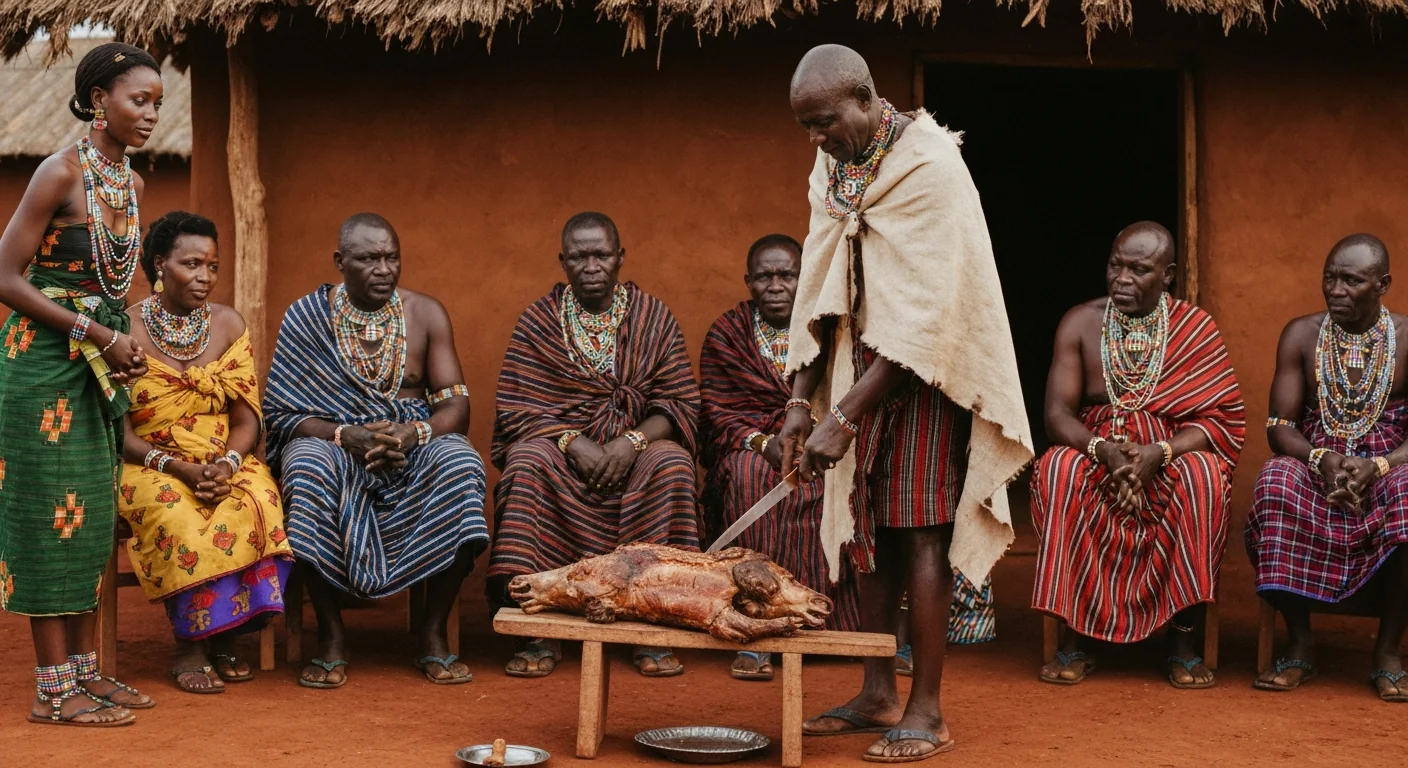
What it is: The shoulder joint (kiande) of the slaughtered ram is separated and placed on a traditional basin before the couple.
What happens: The groom cuts the shoulder — he must do this cleanly, without breaking the bone. Breaking the bone is considered a bad omen. If the groom is not experienced at butchery, practice beforehand. The bride holds the joint steady while he cuts.
At this moment, the MC or a presiding elder calls on the groom to make a public declaration. He must acknowledge — in front of everyone gathered — that even if the wife gives birth to a child not biologically his, he will take care of that child. This declaration is one of the most profound moments of the ceremony: it is a public commitment to unconditional care.
Once the cut is made, the bride’s mother-in-law (or a senior woman in the groom’s family) serves pieces of the shoulder to the bride. She eats. This act — the eating of the kiande — marks the bride’s spiritual transformation. She is no longer a daughter-in her parents’ home. She is a wife in her husband’s clan.
The community’s acknowledgement comes in a phrase: “Ndamutinire kiande” — “She has been given the shoulder.” In Kikuyu culture, this is the highest confirmation of marital status. If you hear someone say this about a woman, it means she is fully, permanently married.
The shoulder joint is significant for another reason: it contains only one joint, symbolising the permanence of the union. Unlike a multi-jointed bone that can be separated at different points, the kiande has one connection. One marriage. One family. Inseparable.
Ritual 2: Kuria Matu — Eating the Ears
What it is: Kuria matu means “eating ears.”
What happens: The groom gives the bride the ears from the slaughtered goat. She eats them. He also eats from the ears. As they eat, the meaning is spoken aloud for all to hear: from this day forward, they must always listen to each other.
This ritual extends beyond the couple — single women present at the ceremony also eat goat’s ears. For them, it is a prayer and a reminder: listen in your future marriage.
There is no subtext here. The Kikuyu do not dress this up in metaphor. Kuria matu is exactly what it says: eat, and remember to listen. Communication, patience, and attentiveness are presented as sacred obligations, not suggestions.
Ritual 3: Gukundania Ucuru — Sharing the Porridge
What it is: The bride prepares traditional fermented porridge (ucuru) and must coax the groom into accepting it.
What happens: The groom and his escorts sit on ceremonial stools (njung’wa). The bride approaches with the porridge. The groom — following tradition — refuses. He makes demands. He complains that his hair is not combed, his shoes are dusty, that she has not attended to him properly.
The bride must satisfy each request before he will accept the porridge. She combs his hair. She polishes his shoes. She brushes his jacket. She attends to him as his partner in domestic life.
When he finally accepts the porridge — drinking from a traditional calabash (kihiuri) — the crowd responds with celebration. The other five men in the groom’s party are then also fed porridge by their own wives or partners.
This ritual is part comedy, part covenant. It is by far the most entertaining part of the ceremony and generates enormous laughter. But beneath the performance lies a serious message: this couple is beginning a life of mutual service. She tends to him; he eventually accepts. Neither party is passive.
A note for modern couples: Some families have updated this ritual to reflect mutual care more explicitly — the groom may also perform a small act of service for the bride before she feeds him. This adaptation is increasingly common among urban Kikuyu couples and is generally accepted, provided the core structure of the ucuru ritual is preserved.
Ritual 4: Drinking from One Vessel
The couple shares a single cup of muratina (or another agreed drink). Drinking from the same vessel seals their unity. They are no longer two people negotiating a relationship — they are one household.
The elders present may also drink from this vessel or from a shared cup in a parallel gesture of communal blessing.
After the Rituals: The Wedding Certificate
Immediately after Gutinia Kiande is complete, the presiding MC or elder calls the couple forward and issues them a traditional marriage certificate — a document acknowledging that the Ngurario ceremony has been performed and that the couple are recognized as husband and wife under Kikuyu customary law. The MC reads out the certificate details and announces to all gathered that this woman is now fully married.
This certificate is not to be confused with a civil registration document — for full legal standing, couples should also register their customary marriage under Kenya’s Marriage Act. Our guide on marriage registration in Kenya covers this process in detail.
Ngurario Proverbs and Their Meaning
Proverbs accompany every moment of Ngurario. Here are the ones most commonly invoked:
-
“Ndamutinire kiande” — She has been given the shoulder. The highest confirmation that a woman is permanently married. Used to describe a woman who has undergone Ngurario.
-
“Mendanite ta gikwa na mukungugu” — They love each other like a yam and its support. The ideal marriage: two people who are incomplete without each other. Often spoken as a blessing at the closing of the ceremony.
-
“Uthoni nduraragwo” — You never spend the night at your in-laws’ home. The groom’s delegation must depart before nightfall — even at Ngurario.
-
“Mũgĩthĩ thayũ” — Go in peace. The blessing spoken when the groom’s delegation departs at the end of the ceremony.
Modern Adaptations
Ngurario has survived centuries because Kikuyu culture has always allowed form to adapt while protecting essence. Here is how modern couples are approaching it.
After the church wedding: Many couples hold their church or civil wedding before Ngurario. The culturally correct sequence is Ngurario last — but in practice, some families hold the church wedding between ruracio and Ngurario for logistical or family reasons. As long as Ngurario is eventually completed, this is accepted.
Christian integration: Many Kikuyu families open Ngurario with a church elder or pastor offering the opening prayers alongside the traditional elder. The two can coexist. The goat slaughter, the shoulder cutting, and the porridge ritual remain unchanged; the spiritual framework expands to include both Ngai and the Christian God, whom many Kikuyu understand as one and the same.
Venue: Ngurario is traditionally held at the bride’s family home. Urban families sometimes host it at a rented venue when the family home cannot accommodate the guests. The ceremony adapts to location, but the rituals must all be present.
The ucuru ritual: Some modern families have softened the submission elements of the ucuru ritual while preserving its core — the bride feeds the groom, they eat together, they acknowledge their mutual life of service. The comedy remains. The meaning remains.
For more on how today’s Kenyan couples navigate the balance between tradition and modern life, read our article on modern couples adapting Kikuyu traditions. The broader landscape of Kenyan wedding traditions is also covered in our Complete Guide to Kenyan Wedding Traditions.
Planning the Weekend: From Ruracio to Ngurario
For couples planning both a traditional Kikuyu wedding weekend and a white wedding, the logistics can be significant. Many couples hold ruracio on a Saturday and the church or civil wedding the following day or the next weekend. Ngurario often happens weeks or months later, once both families are ready.
Harusi Hub supports multi-event planning — you can add ruracio, Ngurario, your church wedding, and your reception as separate events within your planning dashboard, each with its own guest list and RSVP setup. Read our full guide on planning a traditional and white wedding weekend for the sequencing.
Use the Manage Wedding Events guide to set up multiple events in Harusi Hub, and create your free wedding website to keep both families informed of dates, venues, and logistics in one place.
Your budget tracker at Harusi Hub can hold all your Ngurario costs — goats, attire, food, drinks, transport — separately from your white wedding budget so you always know exactly where you stand.
Ready to plan your Ngurario and white wedding together?
Harusi Hub is built for couples navigating traditional and modern weddings — manage every ceremony, every guest list, and every budget line in one free platform.
Start Planning Free